
Categories
New Blog
How Do Pulse Width Modulation (PWM) Signals Regulate A DC Brushless Fan 12V?
July 15 , 2026Electronic devices have become increasingly compact, powerful, and intelligent over the past decade. Whether used in industrial automation, medical instruments, communication systems, energy storage equipment, security devices, or consumer electronics, these systems generate more heat than ever before. Effective thermal management is no longer simply a design consideration but a critical factor that determines product reliability, efficiency, and service life.
Among various cooling solutions, the Brushless Fan has become the preferred option because of its high efficiency, long operating life, stable performance, and low maintenance requirements. A modern brushless motor can operate continuously for tens of thousands of hours while consuming relatively little power, making it ideal for equipment that runs around the clock.
However, cooling requirements are rarely constant. A server may generate little heat while idle but require maximum airflow during heavy computing. An industrial controller may experience varying thermal loads depending on production cycles. A medical device may need extremely quiet operation during normal conditions while still being capable of delivering powerful cooling when temperatures rise. Simply allowing a fan to operate at full speed all the time wastes energy, increases noise, and shortens component life.
This is why Pulse Width Modulation, commonly known as PWM, has become the industry standard for speed control. Instead of reducing supply voltage, PWM intelligently regulates motor speed through digital control signals, allowing the fan to deliver only the airflow required at any given moment.
Today, PWM-controlled cooling technology is widely used in servers, telecommunications equipment, industrial control cabinets, electric vehicle charging systems, battery energy storage systems, smart home appliances, medical devices, and many other applications. As intelligent temperature management becomes increasingly important, understanding how PWM works has become valuable not only for engineers but also for purchasing managers and equipment manufacturers selecting the right cooling solution.
This article explains how PWM regulates a fan 12v 120mm, why it performs better than traditional voltage control, and how businesses can select the most suitable DC Cooling Fan for long-term reliability.
Understanding Pulse Width Modulation
Pulse Width Modulation is an electronic control method that adjusts motor speed without continuously changing the input voltage. Rather than supplying a lower voltage to reduce speed, the controller rapidly switches the power signal between ON and OFF states thousands of times every second.
During each switching cycle, the proportion of time that the signal remains ON is called the duty cycle. By adjusting this duty cycle, the controller determines the average power delivered to the motor while still supplying the full operating voltage during each pulse.
For example, if the PWM signal remains ON for only one-quarter of each cycle, the duty cycle is 25 percent. If it remains ON for half of the cycle, the duty cycle becomes 50 percent. At 100 percent duty cycle, the signal remains fully ON, allowing the fan to operate at its maximum rated speed.
Although the concept appears simple, this rapid switching process creates highly efficient speed regulation because electrical energy is transferred with minimal power loss. Since the motor always receives full voltage during each pulse, it maintains stronger torque than a motor operating under reduced voltage.
This characteristic makes PWM especially suitable for modern Brushless Fan designs, where efficiency, precise speed regulation, and reliability are essential.
Why Modern 12V Brushless Fans Prefer PWM
Many early cooling fans adjusted speed by lowering the supply voltage. While this method can reduce rotational speed, it also decreases motor torque. At sufficiently low voltages, the motor may fail to start or rotate inconsistently, especially when environmental resistance or bearing friction increases.
PWM solves these problems by maintaining a constant 12-volt power supply while independently controlling motor operation.
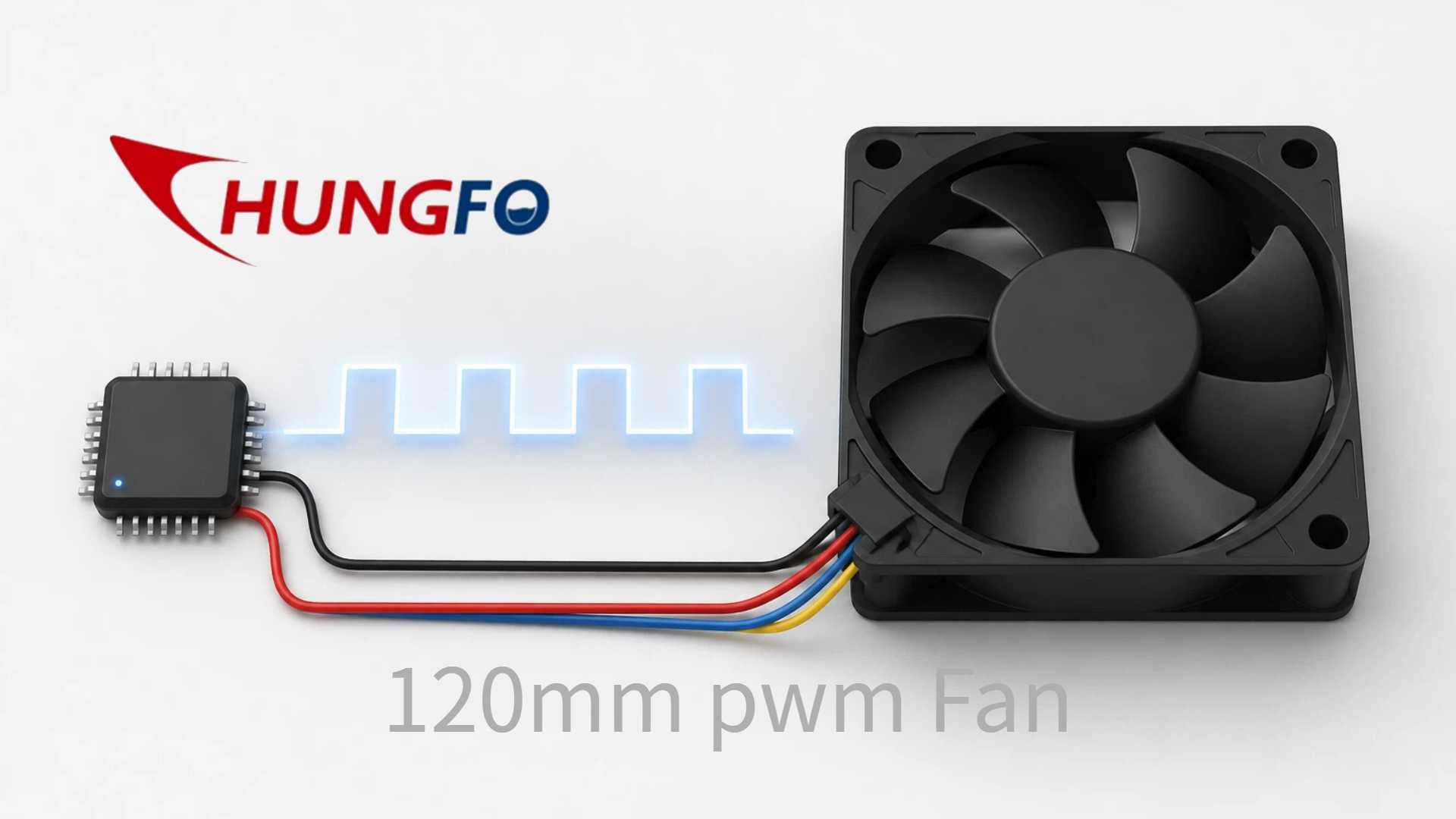
In a typical four-wire Brushless Fan, two wires provide power and ground, one wire outputs tachometer signals for RPM monitoring, and the fourth wire receives the PWM control signal generated by the system controller.
Instead of interrupting the primary power source, the PWM signal communicates directly with the internal motor driver. The driver interprets the incoming duty cycle and adjusts electronic commutation accordingly. As a result, the fan speed changes smoothly while maintaining stable electrical operation.
Because the internal electronics continue receiving a constant power supply, the fan can operate reliably across a much wider speed range than voltage-controlled alternatives.
This is particularly important for precision cooling systems where airflow must closely follow changing thermal conditions without introducing instability or excessive acoustic noise.
The Internal Working Principle of PWM-Controlled Fans
To better understand PWM regulation, it helps to examine the internal structure of a brushless cooling fan.
Unlike brushed motors that rely on physical brushes for electrical commutation, brushless motors use permanent magnets attached to the rotor while electromagnetic coils remain fixed inside the stator.
Hall-effect sensors continuously detect rotor position.
An integrated driver circuit processes these sensor signals and energizes the appropriate stator windings at precisely the correct moment.
When PWM control is added, the driver circuit also receives digital instructions indicating the desired operating speed.
Rather than simply reducing electrical power, the controller intelligently adjusts commutation timing and switching behavior according to the PWM duty cycle.
Because all switching occurs electronically, there is virtually no mechanical wear caused by electrical contact.
This brushless design contributes significantly to the exceptional lifespan associated with modern cooling fans.
For industrial-grade equipment operating continuously throughout the year, this durability represents a major advantage over traditional brushed motors.
PWM Frequency and Why 25 kHz Is the Industry Standard
One question frequently asked by engineers concerns PWM frequency.
Why do most manufacturers recommend approximately 25 kilohertz?
The answer involves both motor performance and human hearing.
If PWM operates at relatively low frequencies, switching noise may become audible. The rapid ON and OFF transitions produce vibrations that can generate irritating high-pitched sounds.
Most people can hear frequencies up to approximately 20 kilohertz.
By selecting a PWM frequency around 25 kilohertz, manufacturers move the switching frequency beyond the normal hearing range, significantly reducing audible noise.
Higher frequencies also allow smoother motor control because the driver receives more frequent control updates.
However, increasing frequency indefinitely is not beneficial.
Extremely high switching frequencies increase electronic switching losses and may generate unnecessary electromagnetic interference.
Therefore, approximately 25 kilohertz has become an excellent balance between efficiency, acoustic comfort, electronic stability, and manufacturing compatibility.
Today, many server manufacturers, industrial automation companies, and telecommunications equipment suppliers specify 25-kilohertz PWM control as part of their cooling system requirements.
How Duty Cycle Changes Fan Speed
The duty cycle is the most important parameter in PWM control.
Instead of continuously changing voltage, the controller simply changes how long each switching pulse remains active.
A low duty cycle delivers less average power, causing the motor to rotate more slowly.
As duty cycle increases, airflow, static pressure, and rotational speed gradually increase.
For example, a Brushless Fan operating at 20 percent duty cycle may provide sufficient airflow for standby operation.
When internal temperatures rise, the controller may automatically increase duty cycle to 50 percent, providing additional cooling while maintaining relatively quiet operation.
During maximum system workload, duty cycle can increase to 100 percent, allowing the fan to deliver its highest airflow capacity.
Because this adjustment occurs continuously, the cooling system responds dynamically to changing environmental conditions.
Rather than wasting energy through continuous full-speed operation, PWM allows intelligent thermal management that balances cooling performance, power consumption, and acoustic comfort.
Modern intelligent controllers often combine temperature sensors, microcontrollers, and PWM algorithms to automatically optimize cooling throughout the equipment's operating cycle.
This adaptive cooling strategy is now common in industrial computers, intelligent manufacturing systems, communication base stations, battery energy storage systems, precision laboratory instruments, and high-performance consumer electronics.
Even compact products requiring a 5015 24v fan solution increasingly adopt PWM principles to improve efficiency and reduce unnecessary energy consumption, demonstrating how digital speed control has become a standard feature across multiple voltage platforms.
PWM Versus Traditional Voltage Regulation
Although both PWM control and voltage regulation can reduce the speed of a cooling fan, their working principles are fundamentally different. Understanding these differences helps engineers select the most suitable cooling solution for their equipment.
Voltage regulation changes the motor speed by reducing the supply voltage. For example, a 12V fan may be supplied with only 9V or 7V to slow its rotation. While this method appears simple, it also reduces the motor's available torque. Under heavy resistance or low-temperature environments, the fan may struggle to start, rotate unevenly, or even stop completely.
PWM control avoids these problems because the motor continues receiving a stable 12V power supply. Only the control signal changes, allowing the internal driver circuit to regulate motor operation without sacrificing starting performance.
This approach offers several important advantages. The motor starts more reliably, maintains stable rotation at lower speeds, responds quickly to changing temperatures, and generates less unnecessary heat inside the electronic driver. These benefits explain why modern industrial equipment, servers, communication systems, and medical devices increasingly rely on PWM rather than simple voltage adjustment.
For applications requiring precise airflow management, PWM has become the preferred technology for every high-quality DC Cooling Fan.
Three-Wire and Four-Wire Brushless Fans
Another common question concerns the difference between three-wire and four-wire cooling fans.
A three-wire Brushless Fan typically includes a positive power wire, a ground wire, and a tachometer output wire. The tachometer continuously reports the fan's rotational speed to the controller, allowing the system to monitor operating conditions. However, speed control usually depends on changing the supply voltage.
A four-wire fan adds an independent PWM control wire. Instead of varying the input voltage, the controller sends digital PWM signals through this fourth wire while the fan continues receiving a constant 12V supply.
Separating power delivery from speed control offers several important benefits.
The fan can operate smoothly across a much wider RPM range.
Low-speed performance becomes more stable.
Temperature response becomes faster.
Speed accuracy improves significantly.
Noise can be reduced without sacrificing cooling performance.
These advantages make four-wire PWM fans the preferred choice for intelligent electronic systems where automatic thermal management is required.
Common Applications of PWM-Controlled Cooling Fans
PWM technology is now found in nearly every industry requiring reliable thermal management.
Industrial automation equipment uses intelligent cooling to maintain stable temperatures inside electrical cabinets, programmable controllers, and motion control systems.
Communication equipment depends on continuous cooling because network switches, optical transmission devices, and data centers operate twenty-four hours a day. Dynamic airflow adjustment reduces energy consumption while maintaining reliable network performance.
Medical equipment also benefits from PWM regulation. Diagnostic instruments, patient monitoring systems, laboratory analyzers, and imaging equipment often require both low acoustic noise and highly stable operating temperatures. PWM enables quiet operation during normal workloads while automatically increasing airflow when additional cooling becomes necessary.
Energy storage systems represent another rapidly expanding application. Lithium battery packs generate varying amounts of heat depending on charging and discharging conditions. Intelligent PWM control allows cooling performance to match battery operating conditions, improving both efficiency and battery lifespan.
Electric vehicle charging stations have become another important market. Fast charging generates significant heat inside power modules and converters. Automatically adjusting fan speed helps improve charging reliability while reducing unnecessary energy consumption during standby operation.
Consumer electronics also continue adopting PWM-controlled cooling. Gaming computers, professional workstations, home servers, smart appliances, and entertainment systems all benefit from quieter operation and improved energy efficiency.
Even compact electronic products using a fan 5 volt design increasingly incorporate intelligent PWM control to optimize cooling while minimizing power consumption.
Choosing the Right DC Cooling Fan
Selecting the correct cooling fan involves much more than simply matching the voltage.
Engineers should first determine the required airflow based on the total heat generated by the equipment. Airflow is commonly measured in cubic feet per minute, while static pressure becomes particularly important when airflow must pass through dense heat sinks, filters, or confined ventilation channels.
Noise requirements should also be carefully considered. Office equipment, medical devices, and consumer electronics often require extremely quiet operation, making PWM-controlled fans an excellent choice because they reduce speed automatically whenever full airflow is unnecessary.
Bearing selection directly affects service life. Sleeve bearings provide economical solutions for general-purpose equipment, while dual ball bearings offer significantly longer operating life and improved performance under high temperatures or continuous operation.
Environmental conditions should never be overlooked. Equipment operating outdoors or in harsh industrial environments may require dust resistance, moisture protection, corrosion resistance, or wide operating temperature ranges.
Compatibility with the control system is equally important. Engineers should confirm whether the controller supports standard PWM communication and whether RPM feedback is required for system monitoring.
Selecting a high-quality Brushless Fan from an experienced manufacturer ensures that all of these performance factors work together to provide reliable long-term cooling.
Why Manufacturers Around the World Choose Chungfo Fan
Reliable cooling begins with reliable manufacturing.
Chungfo Fan has specialized in thermal management solutions for more than twenty years, serving customers across industrial automation, consumer electronics, medical equipment, telecommunications, refrigeration, power supplies, renewable energy, and intelligent manufacturing.
Our product portfolio includes DC axial fans, AC axial fans, centrifugal blowers, cross-flow fans, frameless fans, and customized cooling solutions designed to meet diverse application requirements.
Our manufacturing facility utilizes advanced automated production lines supported by comprehensive quality management systems. Every production stage is carefully monitored to ensure consistent product performance.
Each Brushless Fan undergoes rigorous inspection before shipment, including airflow testing, static pressure measurement, speed verification, dynamic balance testing, noise evaluation, electrical safety inspection, high-temperature operation, low-temperature reliability testing, and long-duration endurance validation.
Our engineering team also works closely with OEM and ODM customers to provide customized thermal solutions.
Services include PWM parameter optimization, speed customization, connector configuration, cable customization, waterproof design, IP-rated protection, bearing selection, motor optimization, and private labeling.
Whether customers require a compact fan 5 volt product for portable electronics or a high-performance DC Cooling Fan for demanding industrial equipment, Chungfo Fan provides dependable manufacturing capabilities backed by experienced engineering support.
By combining advanced production technology with strict quality control, we help customers improve product reliability while shortening development cycles and reducing overall project risk.
Future Trends of PWM Cooling Technology
Thermal management continues evolving alongside advances in artificial intelligence, industrial automation, cloud computing, renewable energy, and electric transportation.
Future cooling systems will become increasingly intelligent rather than simply operating at fixed speeds.
Integrated temperature sensors, intelligent control algorithms, Internet of Things connectivity, and predictive maintenance technologies will allow cooling fans to respond automatically to changing operating conditions.
Artificial intelligence may even predict future thermal loads based on equipment behavior, allowing PWM systems to adjust airflow before overheating occurs.
Energy efficiency regulations around the world are also encouraging manufacturers to adopt smarter cooling solutions that reduce electricity consumption without compromising performance.
As electronic devices continue becoming smaller while producing greater computing power, demand for intelligent Brushless Fan technology will continue growing across virtually every industry.
Conclusion
Pulse Width Modulation has transformed the way modern cooling systems operate. Instead of relying on inefficient voltage reduction, PWM uses intelligent digital signals to regulate motor speed with remarkable precision while maintaining full operating voltage.
This approach delivers smoother operation, higher efficiency, lower noise, improved starting performance, reduced power consumption, and longer service life. These advantages explain why PWM has become the standard control method for today's 12V Brushless Fan products.
From industrial automation and telecommunications to medical equipment, battery energy storage, electric vehicle charging infrastructure, and consumer electronics, PWM-controlled cooling solutions continue supporting the next generation of high-performance electronic systems.
Choosing the right 230v Axial Fan involves more than selecting the correct voltage. Airflow, static pressure, bearing design, control compatibility, environmental protection, manufacturing quality, and engineering support all contribute to long-term reliability.
With decades of manufacturing experience, advanced production capabilities, and a commitment to continuous innovation, Chungfo Fan remains dedicated to providing efficient, reliable, and customized cooling solutions for customers worldwide. Whether your project requires a standard industrial cooling fan, a specialized fan 5 volt design, or a fully customized thermal management solution, our experienced team is ready to help you achieve dependable performance in even the most demanding applications.