Categories
New Blog
EC Fan vs DC Fan: Understanding Energy-Efficient Cooling Solutions
November 06 , 2026Quick Answer: What Is the Difference Between EC Fans and DC Fans?
EC fans and DC fans are both widely used in modern cooling and ventilation systems, but they differ in their power input, motor control architecture, electronic integration and installation requirements.
A conventional brushless DC fan operates with a direct-current power supply, such as 5V, 12V, 24V or 48V DC. It uses electronic commutation to control motor rotation and is commonly integrated into electronic equipment, telecommunications devices, industrial control systems and compact cooling assemblies.
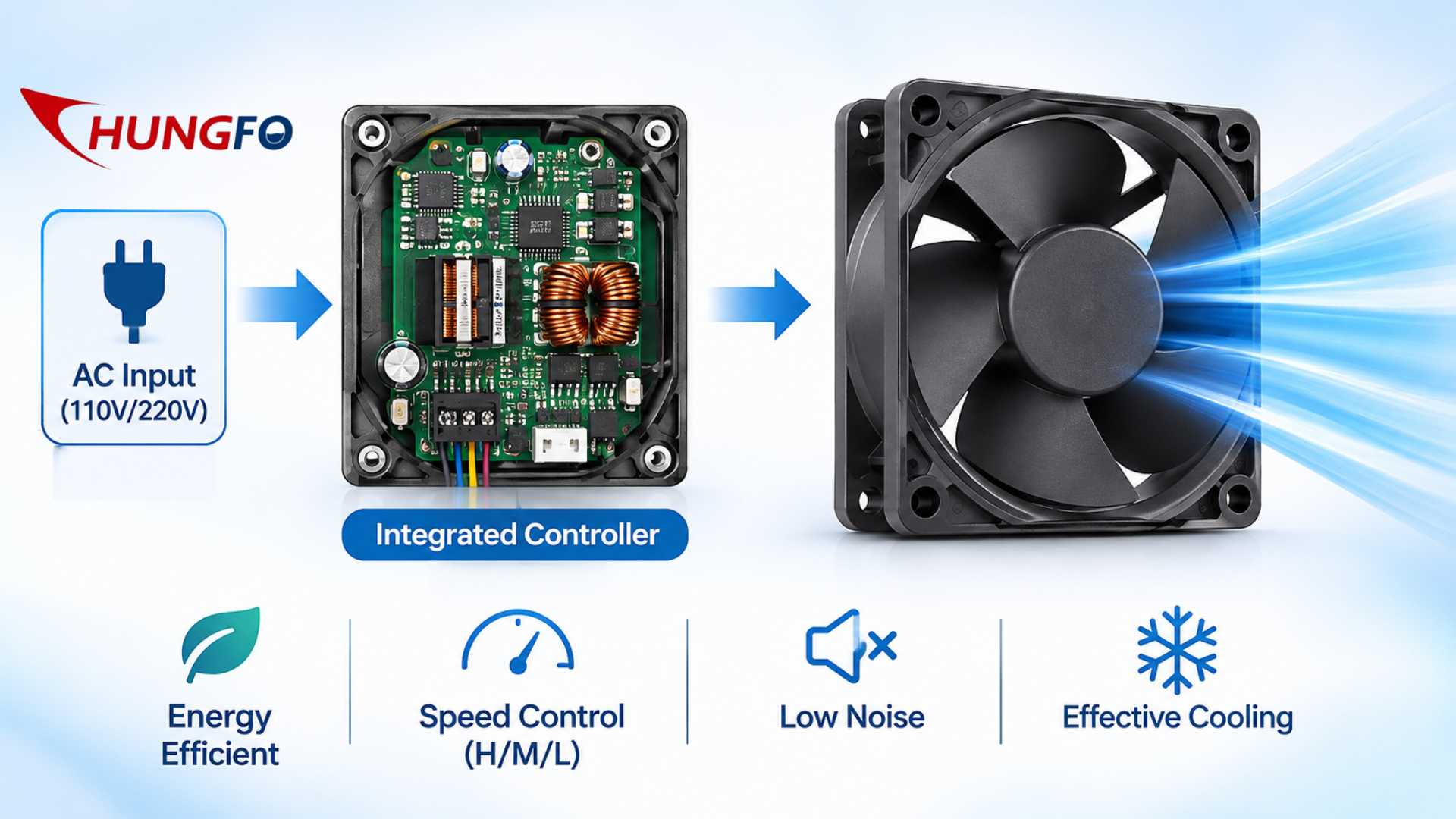
An EC fan, or electronically commutated fan, generally combines a brushless permanent-magnet motor with integrated electronic control. Many commercial EC fan models accept AC mains input, convert the incoming AC power internally and use electronic commutation to drive the motor. This architecture allows an EC fan to combine the efficiency and controllability of brushless DC motor technology with convenient AC power compatibility.
The main advantage of EC technology is not simply that it uses a different type of electricity. Its integrated electronics, motor design and variable-speed operating capability can improve overall energy efficiency, particularly in applications that operate for long periods or require airflow adjustments according to changing cooling demand.
However, EC fans are not automatically the best choice for every application. DC fans remain highly practical when equipment already has a DC power bus, requires compact dimensions or operates from batteries and low-voltage power supplies.
For equipment manufacturers, the correct selection should consider the complete electrical system, airflow requirements, static pressure, operating hours, control requirements, installation conditions and total operating cost.
Key Takeaways
EC stands for Electronically Commutated. EC motors use electronic switching instead of traditional mechanical commutation.
Many EC fans accept AC mains input while internally using a brushless DC motor architecture.
Conventional brushless DC fans require an external DC power supply, such as 12V or 24V DC.
Both technologies can provide efficient operation, but their actual efficiency depends on motor design, controller performance, fan aerodynamics and operating conditions.
EC technology is particularly attractive for applications requiring long operating hours, variable-speed control and direct AC power compatibility.
DC fans are suitable for electronic products and equipment that already provide a regulated DC power supply.
Buyers should compare complete-system energy consumption instead of evaluating motor efficiency or fan-terminal power alone.
Correct fan selection requires evaluating airflow, static pressure, noise, temperature, voltage and installation dimensions.
1. Introduction: Why Energy-Efficient Cooling Matters
Cooling and ventilation are essential functions in modern electrical and electronic equipment. As devices become smaller, more powerful and more densely integrated, the amount of heat generated within limited installation spaces continues to increase.
Industrial control cabinets, power supplies, communication equipment, medical devices, commercial refrigeration systems and automated machinery all depend on reliable airflow management.
A cooling fan may appear to be a relatively small component compared with the main equipment. However, when it operates continuously for thousands of hours, its electricity consumption, thermal performance and reliability can influence the overall operating cost of the equipment.
For equipment manufacturers, choosing a suitable fan is therefore not simply a matter of finding a component with the correct dimensions. It is a decision involving electrical compatibility, mechanical integration, thermal management and long-term energy consumption.
Two commonly considered technologies are electronically commutated fans and direct-current brushless fans.
Both can use permanent-magnet motors and electronic commutation. However, the difference in their power architecture and control integration can influence installation complexity, system efficiency and product design.
Understanding these differences helps engineers and purchasing teams select a suitable cooling solution instead of relying on general marketing claims.
2. What Is an EC Fan?
EC stands for Electronically Commutated. An EC motor is a brushless motor that uses electronic circuits to control the timing and sequence of electrical current supplied to the motor windings.
Unlike a traditional brushed motor, an EC motor does not depend on mechanical carbon brushes and a commutator to change the current direction. Instead, electronic control circuitry manages the motor's magnetic field and rotation.
A typical EC fan consists of several major components:
Permanent-magnet rotor,Stator windings,Electronic commutation circuit,AC-to-DC rectification stage, where applicable,Motor control electronics,Fan impeller and housing,Electrical connection and protection components.
In many AC-input EC fan designs, incoming alternating current is converted into direct current through integrated power electronics. The electronic controller then supplies appropriately timed current to the motor windings.
This means an EC fan can often connect directly to an AC power source without requiring a separate external AC-to-DC power supply.
However, not every product marketed as an EC fan has exactly the same electrical architecture. Input voltage, frequency range, speed-control interface and protection functions must always be confirmed through the manufacturer's technical datasheet.
2.1 How Does an EC Motor Work?
The operating process can be understood in several stages.
First, the fan receives electrical power from its designated power source. In an AC-input model, the integrated electronics convert the incoming AC power into a suitable DC supply.
Second, the electronic controller determines the appropriate switching sequence for the motor windings. Depending on the motor design, rotor-position information may be obtained through sensors or sensorless control algorithms.
Third, the controller energizes the stator windings in a controlled sequence. The resulting magnetic field interacts with the permanent magnets in the rotor, producing rotational movement.
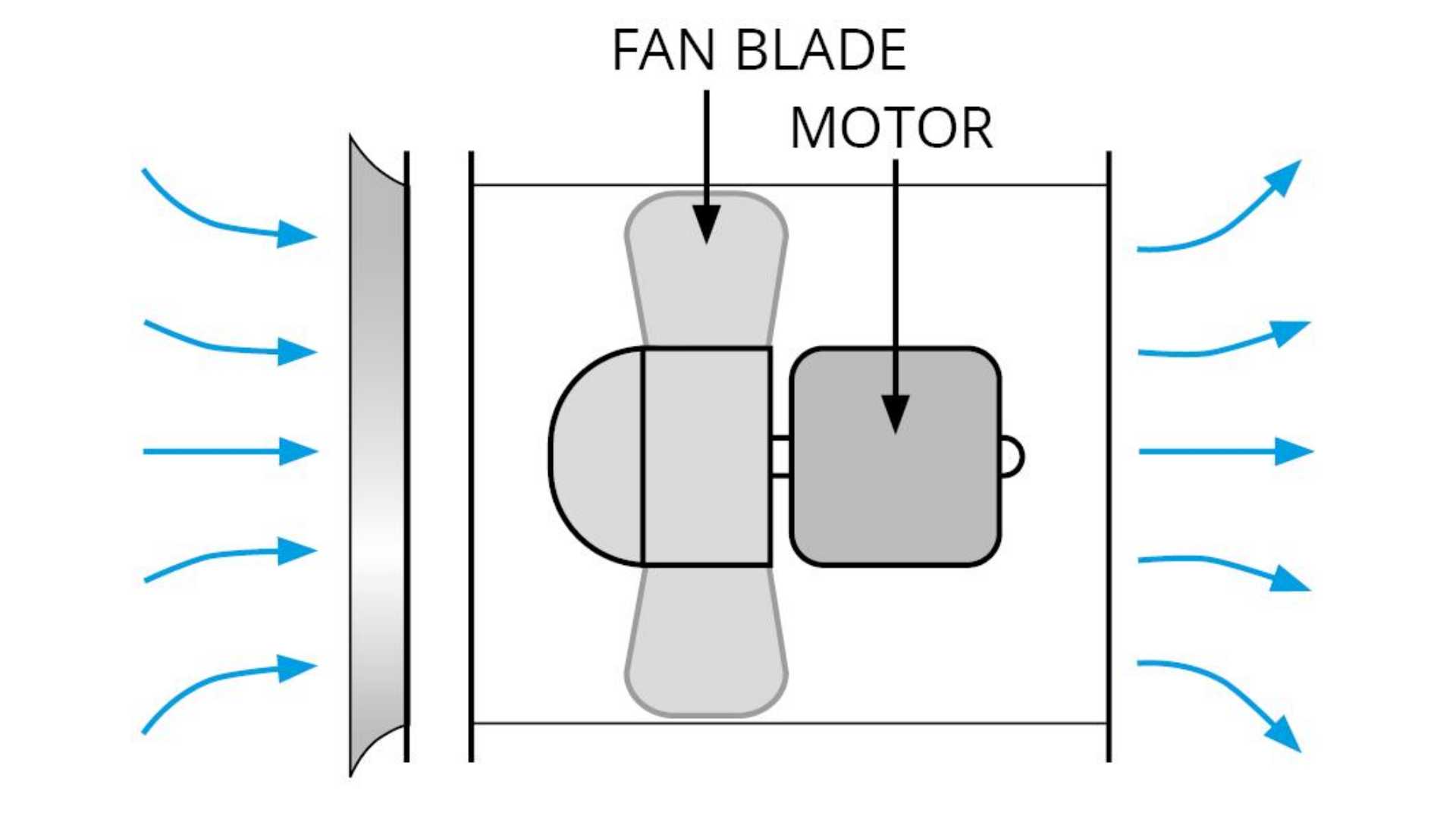
Finally, the rotating motor drives the fan impeller and generates airflow.
The electronic control system can also adjust the motor's operating speed according to an external control signal, temperature requirement or predefined operating program when these functions are supported.
2.2 Why Is Electronic Commutation Important?
Electronic commutation provides several important advantages.
It eliminates mechanical brush contact in brushless motor designs, reducing brush-related wear. It also allows more precise control over motor speed and torque characteristics.
For ventilation systems, the ability to adjust fan speed is especially important.
A cooling system does not always require maximum airflow. During periods of low thermal demand, a fan may operate at a reduced speed. When equipment temperature increases, the control system can increase airflow.
This approach can reduce unnecessary energy consumption while maintaining suitable equipment temperatures.
3. What Is a DC Fan?
A DC fan operates using direct-current electrical power.
In modern industrial cooling applications, the term DC fan generally refers to a brushless DC fan, also known as a BLDC fan. These products are widely used in electronic equipment, industrial control devices, communication systems and compact ventilation assemblies.
Common DC fan voltage ratings include:
5V DC,12V DC,24V DC,48V DC
The actual voltage range depends on the product design and application requirements.
A typical brushless DC fan includes a permanent-magnet rotor, stator windings, electronic driver circuit, fan blades and housing.
When DC power is supplied, the internal driver circuit controls the current sequence in the motor windings. This creates a rotating magnetic field that drives the permanent-magnet rotor.
The motor then rotates the impeller to generate airflow.
3.1 How Does a Brushless DC Fan Work?
A brushless DC fan operates through electronic switching rather than mechanical brushes.
The controller energizes different motor phases in a specific sequence. The interaction between the stator's magnetic field and the rotor's permanent magnets creates torque.
Depending on the design, the fan may use Hall-effect sensors or sensorless control to determine rotor position.
Many industrial DC fans also provide additional control and monitoring functions, such as:
PWM speed control,FG speed feedback,RD alarm output,Locked-rotor protection,Reverse-polarity protection,Overcurrent protection.
These functions are model-dependent and should be confirmed before integration.
3.2 Why Are DC Fans Widely Used in Electronics?
Many electronic products already contain DC power supplies.
Computers, communication equipment, power conversion devices and embedded control systems commonly distribute regulated DC power to their internal components.
Using a DC fan in these products can simplify electrical integration because the equipment does not necessarily need an additional power-conversion stage for the fan.
DC fans are also available in many compact dimensions, making them suitable for products with limited installation space.
For example, small axial cooling fans can be used in compact electronic enclosures, network devices, power modules and industrial control equipment.
4. EC Fan vs DC Fan: Understanding the Core Differences
Although EC and DC fans are closely related in motor technology, their power architecture and system integration are different.
One important clarification is that EC motors are themselves based on electronically commutated brushless motor technology. Therefore, comparing an EC fan with a brushless DC fan is not the same as comparing two completely unrelated motor principles.
The practical distinction usually concerns how the fan receives electrical power and where its power-conversion and control electronics are integrated.
4.1 Power Input
A conventional DC fan requires a direct-current power source.
For example, a 12V DC fan needs a suitable 12V DC supply. A 24V model needs a compatible 24V DC supply.
An AC-input EC fan is designed to operate from a specified alternating-current power source, commonly 110V or 220V AC depending on the model.
Its integrated electronic system performs the necessary power conversion and motor control.
This difference can influence system architecture.
If a machine already has a regulated DC power bus, a DC fan may be easier to integrate. If the equipment primarily uses AC mains power, an AC-input EC fan may reduce the need for a separate external power supply dedicated to the fan.
4.2 Motor Technology
Both modern brushless DC fans and EC fans can use permanent-magnet rotors and electronic commutation.
The EC motor combines the brushless motor with integrated electronics designed for its power input and operating requirements.
Consequently, the distinction should not be simplified into the statement that EC fans have brushes or that all DC fans use brushed motors.
Most modern industrial DC cooling fans are brushless.
The correct comparison should focus on the complete fan system, including the motor, controller, power-conversion stage and electrical interface.
4.3 Energy Efficiency
Energy efficiency is one of the main reasons engineers consider EC technology.
The permanent magnets used in brushless motors eliminate the need to create the rotor magnetic field through certain types of electrically excited windings. Electronic commutation can also provide effective control across different operating speeds.
However, actual efficiency is influenced by several factors:
Motor electromagnetic design,Controller efficiency,Power-conversion losses,Fan blade geometry,Airflow resistance,Operating speed,Static pressure,Installation conditions.
An efficient DC fan can outperform an inefficient EC fan in a particular application. Conversely, an EC fan may provide better complete-system energy performance when it avoids external conversion losses or operates more efficiently at the required duty point.
Therefore, buyers should not assume that the EC label alone guarantees a specific energy-saving percentage.
4.4 Speed Control
Both EC and DC fans can support variable-speed operation.
A DC fan may use voltage adjustment, PWM control or a dedicated speed-control interface, depending on the product.
An EC fan may support integrated speed control through interfaces such as 0–10V signals, PWM, potentiometer input or other manufacturer-specific control methods.
Not every EC fan supports all these functions.
For equipment manufacturers, the most important consideration is whether the available control interface is compatible with the main equipment's controller.
4.5 Installation and System Integration
A DC fan requires a compatible DC supply and suitable wiring.
An AC-input EC fan may connect directly to the equipment's AC power system, provided the voltage, frequency and electrical protection requirements match the fan specifications.
However, an EC fan may require additional attention to electrical safety, grounding, electromagnetic compatibility and control-signal wiring.
DC fans can be particularly convenient in compact electronic equipment where DC power is already available.
EC fans can be advantageous in larger equipment where AC mains power is available and variable-speed ventilation is required.
4.6 Maintenance and Service Life
Both brushless DC and EC motors eliminate traditional mechanical brush wear.
This can reduce one important source of maintenance compared with brushed motor designs.
Nevertheless, the service life of a fan depends on more than motor commutation technology.
Important factors include:
Bearing construction,Bearing lubrication,Operating temperature,Dust and moisture exposure,Vibration,Electrical stress,Installation orientation,Continuous operating load.
A fan using a ball bearing system may have different operating characteristics from one using a sleeve bearing system.
Buyers should examine the manufacturer's rated service life and test conditions rather than relying solely on the EC or DC classification.
4.7 Noise and Vibration
Noise is another important consideration in fan selection.
Fan noise can originate from aerodynamic turbulence, motor electromagnetic forces, bearing movement and structural vibration.
Reducing fan speed may reduce aerodynamic noise, but it also affects airflow and static pressure.
An EC fan with precise speed control may help an equipment designer match airflow to the actual cooling requirement instead of continuously operating at maximum speed.
A DC fan can also achieve low-noise operation when its blade design, motor balance and operating speed are properly selected.
The final noise performance must be evaluated using measured data under defined test conditions.
5. EC Fan vs DC Fan Comparison Table
|
Comparison Item |
AC-Input EC Fan |
Brushless DC Fan |
|
Power Input |
AC mains, according to model |
DC power supply |
|
Motor Technology |
Brushless electronic commutation |
Brushless electronic commutation |
|
Power Conversion |
Commonly integrated |
Usually external system supply |
|
Common Voltage |
110V / 220V AC, model-dependent |
5V / 12V / 24V / 48V DC |
|
Speed Control |
Integrated or external electronic control |
PWM, voltage or dedicated control |
|
Installation |
Suitable for AC-powered systems |
Suitable for DC-powered systems |
|
Energy Efficiency |
Often advantageous in suitable AC applications |
High potential efficiency |
|
Control Integration |
Model-dependent interfaces |
Model-dependent interfaces |
|
Typical Applications |
HVAC, industrial ventilation, refrigeration |
Electronics, telecom, control equipment |
|
Main Selection Factor |
AC compatibility and operating efficiency |
DC availability and system integration |
This comparison describes typical AC-input EC fans and brushless DC fans. Individual models may differ.
6. Why Energy Efficiency Matters in Industrial Cooling
Industrial fans may operate continuously for extended periods.
Even a relatively small difference in electrical power consumption can become meaningful when multiplied by long operating hours and multiple installed fans.
For example, consider two cooling systems with different measured fan input power.
System A consumes 20W.
System B consumes 30W.
Assuming both systems operate continuously for 8,000 hours per year:
System A:
20W × 8,000 hours = 160,000Wh = 160kWh
System B:
30W × 8,000 hours = 240,000Wh = 240kWh
The annual difference is 80kWh per fan.
If an industrial machine uses 20 fans, the theoretical annual difference becomes:
80kWh × 20 = 1,600kWh
This example illustrates why fan power consumption matters in continuously operating equipment.
However, the comparison is meaningful only when both systems provide the required airflow and static pressure under comparable conditions.
A fan that consumes less electricity but fails to maintain adequate cooling is not a suitable energy-saving solution.
6.1 The Importance of Operating Hours
The energy-saving potential of an efficient fan is strongly influenced by operating hours.
A fan running only a few hours each week may provide limited annual electricity savings from a more expensive motor system.
A fan running continuously in a telecommunications cabinet, industrial control room or commercial ventilation system may offer a stronger opportunity for long-term operating-cost reduction.
Therefore, buyers should evaluate:
Daily operating hours,Annual operating days,Required cooling capacity,Electricity cost,Fan quantity,Maintenance requirements.
6.2 Variable-Speed Operation and Energy Savings
A major advantage of electronically controlled fans is their ability to adjust speed according to actual cooling demand.
In many fan systems, the relationship between speed and power is nonlinear.
Under similar aerodynamic conditions and system resistance, the fan affinity laws indicate that airflow is approximately proportional to rotational speed, pressure is approximately proportional to the square of speed, and shaft power is approximately proportional to the cube of speed.
For example, reducing fan speed to 80% of its original value may reduce the theoretical shaft power requirement to approximately:
0.8³ = 0.512
This represents approximately 51.2% of the original shaft power under idealized comparable conditions.
Actual electrical input power will depend on motor efficiency, controller losses, fan operating point and the system curve.
This principle explains why variable-speed operation can provide meaningful energy savings when the equipment does not continuously require maximum airflow.

7. Where Are EC Fans Commonly Used?
EC fans are particularly relevant to applications that require efficient ventilation, long operating hours and adjustable airflow.
7.1 HVAC Systems
Heating, ventilation and air-conditioning systems require continuous air circulation and temperature management.
In commercial buildings, ventilation equipment may operate under changing thermal and occupancy conditions.
An EC fan with suitable speed-control capability can adjust airflow according to system demand.
This can help reduce unnecessary fan energy consumption during periods of lower ventilation requirements.
7.2 Data Centers and Server Cooling
Data centers generate significant heat because servers and networking equipment operate continuously.
Cooling systems must maintain appropriate temperature and airflow conditions to protect electronic equipment.
EC fans may be used in air-handling units, cooling modules and other ventilation assemblies.
Their variable-speed capabilities can support airflow adjustment according to temperature and cooling demand.
7.3 Industrial Control Cabinets
Industrial control cabinets contain electrical components, controllers, drives and other devices that generate heat during operation.
A suitable cooling fan can help remove internal heat and maintain more stable operating conditions.
EC fans may be considered when AC power is available and controlled ventilation is required.
Compact DC fans can also be suitable for smaller control equipment with an existing DC power supply.
7.4 Commercial Refrigeration
Refrigeration systems use fans to circulate air through condensers, evaporators and equipment compartments.
Fan operation can influence heat exchange performance and overall system energy consumption.
EC motor technology is often considered in refrigeration applications because it combines electronic control with efficient motor operation.
The actual fan selection must consider temperature, humidity, airflow direction, pressure resistance and the refrigeration equipment's electrical design.
7.5 Medical and Laboratory Equipment
Medical and laboratory equipment may require controlled airflow and stable thermal conditions.
Cooling fans can be integrated into power modules, electronic control units, diagnostic equipment and ventilation systems.
Selection should consider operating noise, reliability, electrical safety and the specific environmental requirements of the equipment.
Not every application requires an EC fan. A DC fan may be more appropriate when the equipment already uses low-voltage DC power and requires compact cooling.
8. Where Are DC Fans Commonly Used?
DC fans remain an important solution in modern electronic and industrial equipment.
8.1 Computers and Networking Equipment
Computers, routers, network switches and communication devices commonly use DC cooling fans.
These systems usually contain DC power supplies that can provide suitable voltage to the fan.
Compact dimensions and straightforward electrical integration make DC fans practical for these applications.
8.2 Power Supply Equipment
Power supplies, converters and electronic modules generate heat during electrical energy conversion.
DC fans can provide targeted airflow over heat sinks, transformers and other temperature-sensitive components.
The required fan size and performance depend on the internal layout, heat dissipation requirement and ventilation resistance.
8.3 Embedded Electronic Systems
Embedded systems often operate with limited installation space and defined DC power rails.
Small DC fans can be integrated into compact enclosures and specialized electronic assemblies.
8.4 Battery-Powered Equipment
Battery-powered devices require compatibility with their available DC voltage.
Using a DC fan can simplify the electrical architecture by avoiding the need to convert battery power into an AC supply for an AC-input fan.
However, the fan's current consumption must still be included in the battery runtime calculation.
9. How to Choose Between EC and DC Fans
The right choice depends on the complete equipment design.
Step 1: Identify the Available Power Source
Determine whether the equipment provides AC mains power, regulated DC power or both.
If the equipment already has a stable 12V or 24V DC power supply, a DC fan may be a straightforward solution.
If AC power is readily available and the equipment requires variable-speed ventilation, an AC-input EC fan may be worth evaluating.
Step 2: Calculate the Required Airflow
Airflow is commonly expressed in CFM or cubic meters per hour.
The required airflow depends on heat generation, allowable temperature rise, ambient temperature and cooling-system design.
A basic theoretical airflow estimate can be developed from the heat load and air temperature rise.
However, real installations must also account for air leakage, heat distribution and system resistance.
Step 3: Evaluate Static Pressure
Static pressure represents the resistance that the fan must overcome.
Filters, heat sinks, narrow ducts, grilles and equipment enclosures can restrict airflow.
A fan with a high free-airflow rating may not provide sufficient airflow when installed in a restrictive system.
Buyers should therefore compare the fan's airflow-pressure performance curve with the actual equipment system resistance.
Step 4: Consider Noise Requirements
Noise limits can be particularly important for medical equipment, office electronics and indoor appliances.
Compare measured noise levels under equivalent operating conditions.
Do not compare noise ratings without checking the measurement distance, testing environment and operating speed.
Step 5: Evaluate Speed-Control Requirements
Determine whether the equipment needs constant speed, several preset speed levels or continuous automatic adjustment.
Check the available control interfaces and ensure compatibility with the main controller.
Step 6: Calculate Total System Energy Consumption
The correct energy comparison should include:
Fan electrical input,External power-supply losses,Controller losses,Required operating speed,Actual airflow and pressure,Annual operating hours.
This provides a more accurate comparison than evaluating the fan motor alone.
Step 7: Confirm Mechanical Compatibility
Check the following dimensions and mechanical requirements:
Fan frame size,Fan thickness,Mounting-hole spacing,Airflow direction,Mounting orientation,Connector and cable arrangement,Environmental protection requirements
A technically efficient fan is not useful if it cannot be properly installed in the equipment.
10. Important Technical Specifications Buyers Should Compare
When sourcing EC or DC cooling fans, purchasing teams should prepare a consistent technical specification list.
10.1 Voltage and Frequency
For AC-input EC fans, confirm the rated voltage, allowable voltage range and operating frequency.
For DC fans, confirm the rated DC voltage, voltage tolerance and polarity.
10.2 Rated Current and Power
Rated current and power help engineers evaluate electrical compatibility and energy consumption.
For AC equipment, current and real power are not interchangeable because power factor must also be considered.
For DC equipment, input power can generally be calculated from voltage multiplied by current under the stated operating condition.
Always use manufacturer-confirmed electrical measurements.
10.3 Rotational Speed
Rotational speed is generally expressed in RPM.
A higher RPM does not automatically mean better cooling.
Blade design, airflow resistance and motor performance all influence the actual airflow and static pressure.
10.4 Airflow and Static Pressure
These are two of the most important performance parameters.
Airflow describes the volume of air moved by the fan over a specified period.
Static pressure indicates the fan's ability to overcome resistance in the ventilation system.
Both values should be considered together.
10.5 Noise Level
Noise is commonly measured in dBA.
For accurate comparisons, manufacturers should provide the test method, measurement distance and operating conditions.
10.6 Bearing Type
Common fan bearing types include sleeve bearings and ball bearings.
Their suitability depends on operating temperature, installation orientation, expected service life and operating environment.
10.7 Operating Temperature
The ambient operating temperature affects bearing lubrication, motor winding insulation and electronic component reliability.
For EC fans, integrated electronics may have specific temperature limitations.
For DC fans, the driver circuit also needs to operate within its rated thermal conditions.
11. Why EC Fans Are Not Always the Best Choice
Although EC technology offers several advantages, it is not universally suitable.
11.1 Higher Initial Purchase Cost
Integrated electronics and motor-control components may increase manufacturing complexity and initial purchase price.
For applications with limited operating hours or simple cooling requirements, a conventional DC fan may offer a more economical solution.
11.2 Existing DC Power Architecture
If equipment already has a regulated DC power bus, adding an AC-input EC fan may require unnecessary electrical conversion.
A suitable DC fan may integrate more naturally into the existing design.
11.3 Electronic Integration Requirements
EC fans contain electronic components that must be considered during product design.
Engineers should evaluate electrical noise, electromagnetic compatibility, control interfaces and environmental protection.
11.4 Application-Specific Performance
A fan's efficiency cannot be judged independently of its operating point.
An EC fan with an unsuitable impeller or motor rating may perform worse than a properly selected DC fan.
The final decision should be based on measured system performance.
12. How Manufacturers Can Support Energy-Efficient Cooling
A reliable fan supplier should provide more than a product catalog.
Industrial buyers often require technical support throughout the equipment development and procurement process.
Important supplier capabilities include:
Fan product development,Motor and impeller design,Electrical specification confirmation,Airflow and static pressure testing,Noise measurement,Temperature testing,Bearing and reliability evaluation,OEM and ODM customization,Technical documentation,Production quality management.
A supplier with integrated manufacturing and testing capabilities can help customers evaluate fan performance before mass production.
This is particularly important for OEM projects in which fan dimensions, airflow, electrical specifications and installation requirements must match the final equipment.
13. How China Chungfo Fan Supports Industrial Cooling Requirements
China Chungfo Fan specializes in the research, development, manufacturing and sales of cooling fans, blowers, cross-flow fans and related motor products.
The company provides fan solutions for different equipment cooling and ventilation requirements.
Its product range covers AC fans, DC fans, axial fans, centrifugal blowers, cross-flow fans and compact cooling products.
For industrial customers, product selection involves more than choosing a fan according to its frame size.
Electrical requirements, airflow, static pressure, noise, bearing selection, installation dimensions and operating environment must all be considered.
China Chungfo Fan supports customers through product selection, technical communication and OEM customization.
The company's manufacturing capabilities include product design and development, mold development, injection molding, SMT processes, assembly and after-sales support.
Quality control and testing are important parts of the manufacturing process.
Relevant testing capabilities include dynamic balancing, wind tunnel and pressure testing, noise measurement, high- and low-temperature testing, salt spray testing and electrical inspection.
These capabilities help support product evaluation and manufacturing quality management.
For customers developing new equipment or upgrading existing ventilation systems, China Chungfo Fan can discuss suitable fan configurations according to project specifications.
14. Future Trends in Energy-Efficient Fan Technology
The demand for energy-efficient ventilation is expected to remain important as industrial equipment becomes more connected and energy management receives greater attention.
Several technology directions are influencing fan development.
14.1 More Intelligent Speed Control
Electronic controllers are increasingly capable of adjusting fan operation according to temperature, pressure and airflow requirements.
This can help reduce unnecessary operation at maximum speed.
14.2 Better Motor and Impeller Integration
Motor efficiency alone does not determine total fan performance.
Future development will continue to focus on optimizing motor electromagnetic characteristics, impeller geometry and airflow paths as a complete system.
14.3 Digital Monitoring and Communication
Some advanced fan systems provide speed feedback, alarm signals and communication interfaces.
These functions can help equipment manufacturers monitor operating conditions and integrate ventilation equipment into broader control systems.
14.4 Higher Demand for Customized Cooling
Different equipment designs have different cooling requirements.
Customized voltage configurations, dimensions, connectors, airflow performance and control functions will remain important in industrial fan procurement.
14.5 Lifecycle Energy Management
Equipment manufacturers are increasingly considering operating costs over the complete service life of a product.
Fan efficiency, reliability, maintenance requirements and replacement costs all contribute to lifecycle performance.
15. Conclusion: Which Is Better, EC Fan or DC Fan?
There is no universal answer to whether EC fans or DC fans are better.
Both technologies offer useful advantages for different equipment designs.
EC fans are attractive when AC mains compatibility, integrated electronic control, variable-speed operation and long operating hours are important.
DC fans remain highly practical when the equipment already provides a suitable DC power supply, particularly in compact electronic systems and low-voltage applications.
The most effective approach is to evaluate the complete cooling system instead of selecting a fan based only on its product category.
Airflow, static pressure, electrical input, speed control, noise, temperature, bearing type and installation dimensions should all be considered.
For equipment manufacturers, working with an experienced fan supplier can make product selection and system integration more efficient.
China Chungfo Fan provides cooling fan manufacturing, technical communication and OEM customization support to help customers evaluate suitable ventilation and thermal management solutions.
Whether an application requires an AC-input EC fan or a brushless DC fan, the objective remains the same: reliable cooling performance, suitable energy consumption and long-term equipment operation.
Frequently Asked Questions
1. Is an EC fan the same as a DC fan?
Not exactly. EC motors use electronic commutation and are generally based on brushless permanent-magnet motor technology. Many AC-input EC fans include integrated electronics that convert AC input into the DC power required by the motor. A conventional DC fan receives DC power from an external supply.
2. Are EC fans more energy-efficient than DC fans?
Not automatically. Both can be highly efficient. Actual performance depends on motor design, controller efficiency, power conversion, fan aerodynamics and operating conditions. A complete-system comparison is recommended.
3. Can an EC fan operate directly from AC power?
Many AC-input EC fans can connect directly to a specified AC mains supply because they include integrated power-conversion electronics. However, the input voltage and frequency must match the product datasheet.
4. What voltage is commonly used for DC cooling fans?
Common DC fan voltages include 5V, 12V, 24V and 48V. The correct voltage depends on the equipment's power architecture and the selected fan model.
5. Do EC fans support variable-speed control?
Many EC fans support variable-speed operation through integrated electronic controllers. Available control methods may include 0–10V, PWM and other model-specific interfaces.
6. Are brushless DC fans reliable?
Brushless DC fans eliminate mechanical brush wear, but reliability also depends on bearing quality, operating temperature, electrical protection, manufacturing consistency and installation conditions.
7. Which fan is suitable for industrial control cabinets?
Both EC and DC fans can be used. The choice depends on available power, required airflow, static pressure, installation dimensions, control requirements and operating conditions.
8. What is the difference between airflow and static pressure?
Airflow indicates the volume of air moved by a fan, while static pressure indicates its ability to overcome resistance in the ventilation system. Both parameters are essential for correct fan selection.
9. Can China Chungfo Fan provide customized cooling fans?
Yes. China Chungfo Fan can discuss OEM customization requirements, including electrical configurations, dimensions, connectors, bearing options and application-specific performance requirements, subject to technical evaluation.
10. How can buyers select the right EC or DC fan?
Buyers should provide their power supply specifications, required airflow, static pressure, available installation space, operating temperature, noise requirements and expected operating hours. These details help manufacturers recommend suitable fan configurations.
Contact China Chungfo Fan
Looking for a suitable EC or DC cooling fan for your next equipment project?
Contact China Chungfo Fan to discuss your technical requirements, product selection and OEM customization needs. Our team can help evaluate cooling solutions according to your application and performance targets.
Tags :