Categories
New Blog
What Is an IP Rated Cooling Fan and Which Rating Do You Need: IP55 vs IP67?
November 02 , 20261. Introduction: Why IP Ratings Matter When Choosing a Cooling Fan
Cooling fans are essential components in modern electronic equipment, industrial machinery, communication systems, automotive electronics, outdoor electrical enclosures, and household appliances. Their primary function is to remove excess heat, maintain stable operating temperatures, and prevent electronic components from overheating. However, in many applications, providing sufficient airflow is not the only requirement. Cooling fans must also operate reliably in environments where dust, moisture, rain, water splashes, and other environmental contaminants are present.
This is where an IP rated cooling fan becomes important. The IP rating, also known as the Ingress Protection rating, describes the level of protection provided by an electrical enclosure against the entry of solid particles and water. It helps engineers, equipment manufacturers, and procurement professionals determine whether a cooling fan is suitable for a particular operating environment.
For example, a cooling fan installed inside an ordinary indoor electronic enclosure may only need basic environmental protection. However, a fan installed in an outdoor electrical cabinet, an industrial control system, or equipment exposed to frequent cleaning may require a significantly higher protection level. Selecting an inappropriate rating can result in dust accumulation, moisture damage, electrical failures, reduced cooling efficiency, and unexpected maintenance expenses.
Among the commonly discussed protection levels, IP55 and IP67 are particularly important for industrial and outdoor applications. Both provide protection against environmental contaminants, but they are designed for different exposure conditions. IP55 offers dust protection and resistance to water jets, while IP67 provides complete dust protection and protection against temporary immersion in water under specified test conditions.
Understanding these differences is essential when selecting a DC cooling fan for a commercial or industrial project. A higher protection rating is not necessarily the best choice for every application. Engineers must consider airflow requirements, static pressure, operating voltage, installation conditions, maintenance requirements, and overall equipment design.
This article explains how IP rated cooling fans work, compares IP55 and IP67 protection, examines their applications, and provides practical purchasing recommendations for B2B buyers.
2. What Is an IP Rated Cooling Fan?
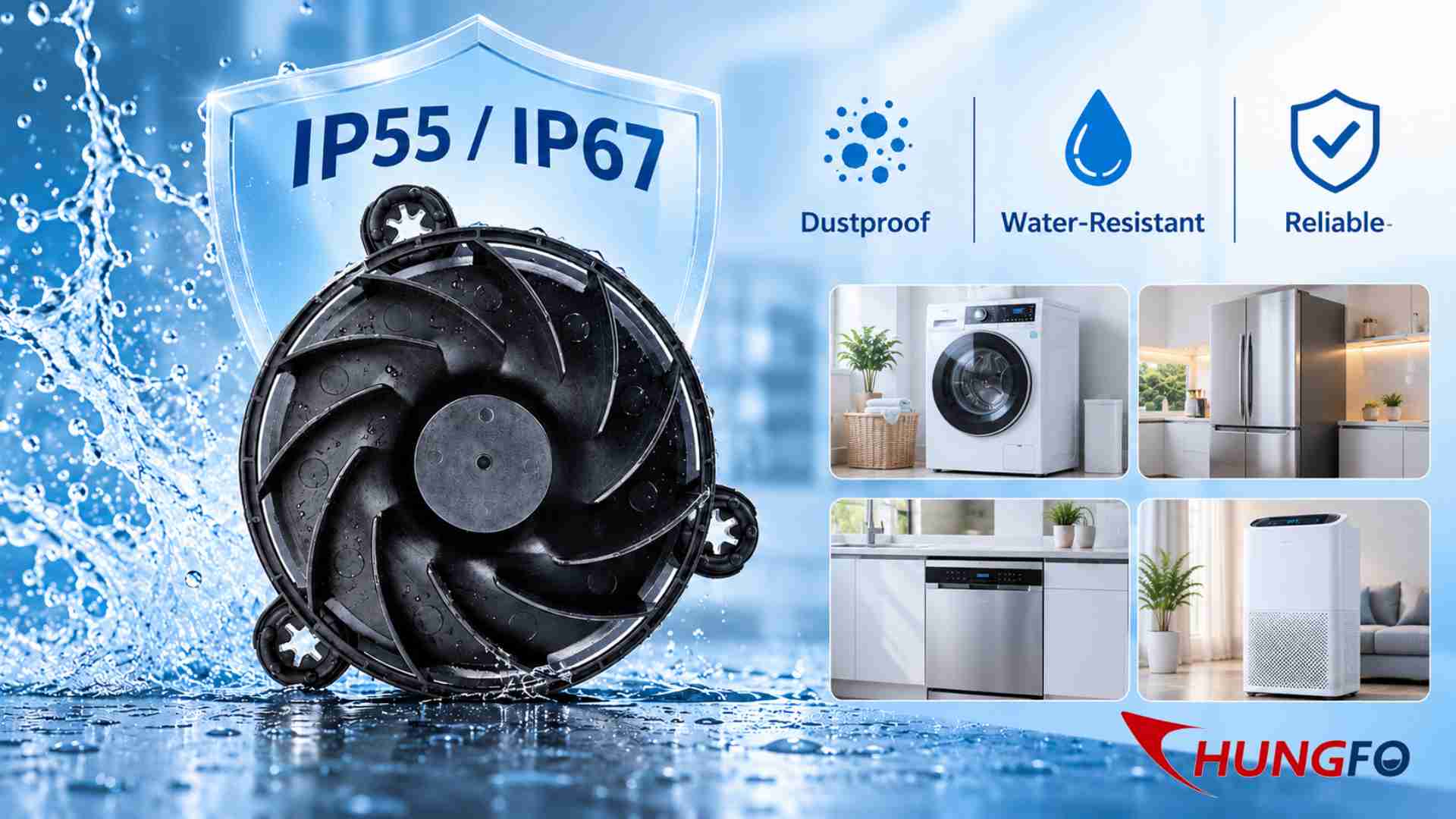
An IP rated cooling fan is a fan designed or constructed to provide a specified level of protection against the entry of solid particles and water into designated protected areas. The IP code follows the international IEC 60529 classification system, which establishes standardized methods for evaluating the protection provided by electrical enclosures.
The abbreviation IP stands for Ingress Protection. It is by two characteristic numbers. The first number represents protection against solid objects and dust, while the second number indicates protection against water ingress.
For example, an IP55 cooling fan has a first digit of 5 and a second digit of 5. The first digit indicates that the protected enclosure is dust-protected, while the second digit indicates protection against water jets from different directions under specified test conditions.
An IP67 cooling fan has a first digit of 6 and a second digit of 7. This means the designated protected enclosure is dust-tight and provides protection against the effects of temporary immersion in water under defined testing conditions.
It is important to understand that an IP rating does not automatically describe every environmental characteristic of a cooling fan. It does not independently guarantee resistance to corrosion, oil, chemical exposure, vibration, high temperatures, ultraviolet radiation, or continuous underwater operation. These characteristics require separate specifications and verification.
For cooling fan manufacturers, achieving a particular IP rating may involve improvements to motor construction, circuit protection, sealing materials, cable outlets, connector structures, and enclosure design. The exact protection method depends on the fan architecture and the intended application.
A properly selected IP rated fan helps reduce the risk of environmental damage while maintaining the airflow required by the equipment.
3. Understanding the Two Digits in an IP Rating
Before comparing IP55 and IP67, buyers should understand what the two digits represent.
The first digit describes protection against solid objects, including dust. Its classification ranges from 0 to 6.
A rating of 0 indicates no specified protection against solid ingress. Ratings from 1 to 4 address progressively smaller solid objects. A rating of 5 means dust ingress is not completely prevented, but any dust that enters must not interfere with satisfactory operation or compromise safety under the applicable test requirements. A rating of 6 represents a dust-tight enclosure under the specified test conditions.
The second digit describes protection against water. Depending on the classification, it ranges from 0 to 9, with additional classifications such as 9K appearing in certain standards and applications.
A rating of 1 indicates protection against vertically falling water drops. A rating of 2 covers dripping water when the enclosure is tilted up to 15 degrees. Ratings of 3 and 4 address spraying and splashing water. A rating of 5 covers water jets, while 6 covers more powerful water jets.
A rating of 7 addresses the effects of temporary immersion in water under specified conditions. A rating of 8 addresses continuous immersion under conditions agreed between the manufacturer and the customer. A rating of 9 addresses high-pressure and high-temperature water jets.
These classifications are not simply a universal ranking in which every higher second digit automatically includes all lower levels. Water jet protection and immersion protection involve different test methods. Therefore, buyers should verify the exact test results rather than assuming that an IP67 product automatically passes an IP55 water jet test.
Understanding this distinction is particularly important when a cooling fan may encounter both heavy rain or cleaning jets and temporary immersion.
4. What Does IP55 Mean for a Cooling Fan?
IP55 is a common protection level for electrical equipment used in industrial environments and outdoor installations.
The first digit, 5, means dust-protected. Dust may enter the enclosure under certain test conditions, but it must not enter in quantities that interfere with the satisfactory operation of the equipment or impair safety.
The second digit, 5, means protection against water jets from different directions under the specified test conditions.
For a cooling fan, this combination can be useful when the equipment operates in an environment where dust, rain, splashing, or occasional water cleaning may occur. It provides a balance between environmental protection and practical equipment design.
Typical applications include industrial control cabinets, outdoor electrical enclosures, ventilation equipment, automation systems, communication equipment, and certain commercial appliances.
However, IP55 should not be interpreted as waterproof under every condition. It does not mean that the fan can be submerged in water, exposed indefinitely to strong water pressure, or operated in a permanently flooded environment.
The actual performance also depends on how the fan is installed. An IP55 rated fan connected to an unprotected connector or installed in an enclosure with poorly sealed cable openings may not provide the expected system-level protection.
For B2B equipment manufacturers, IP55 can be a practical choice when the primary environmental risks involve dust and water jets rather than immersion.
5. What Does IP67 Mean for a Cooling Fan?
IP67 provides a higher level of dust protection than IP55 and adds protection against temporary immersion in water.
The first digit, 6, indicates that the designated protected enclosure is dust-tight under the applicable testing requirements. This is particularly valuable in applications where fine dust could damage sensitive electrical components, interfere with motor operation, or reduce product reliability.
The second digit, 7, indicates protection against the effects of temporary immersion in water under specified test conditions. A commonly referenced test condition involves immersion at a depth of up to one meter for 30 minutes, although the applicable standard and product documentation must be checked for the exact conditions.
IP67 is useful for equipment installed in demanding outdoor environments, locations that may experience temporary flooding, and products that require additional protection against water ingress.
Potential applications include outdoor monitoring equipment, specialized electrical devices, certain automotive electronic systems, sealed control modules, and equipment installed in locations where temporary immersion is a foreseeable risk.
Nevertheless, IP67 does not mean that every cooling fan can operate underwater. It does not automatically guarantee continuous underwater operation, and it does not independently establish resistance to high-pressure cleaning jets.
A cooling fan also requires air to move through its operating airflow path. If the complete fan assembly is submerged, normal air cooling cannot take place. Therefore, the immersion rating generally relates to protection against water ingress during the specified test, not the ability to provide normal cooling while underwater.
For manufacturers, achieving IP67 may require more extensive sealing, protected electrical components, specialized materials, and careful control of assembly quality.
6. IP55 vs IP67: What Are the Main Differences?
Although both ratings are used in applications requiring environmental protection, IP55 and IP67 address different exposure conditions.
IP55 is dust-protected and resistant to water jets. IP67 is dust-tight and protected against temporary immersion in water.
The most important difference is the degree of dust protection and the type of water exposure covered by the second digit.
IP55 allows limited dust ingress as long as it does not interfere with equipment operation or safety. IP67 requires the designated enclosure to prevent dust ingress under the applicable test conditions.
For water protection, IP55 focuses on water jets, while IP67 focuses on temporary immersion. Neither rating should be treated as an automatic substitute for the other when both types of exposure are expected.
For example, an industrial machine that is frequently cleaned using water jets may need a product specifically tested for jet exposure. A sealed outdoor device that may be temporarily submerged during flooding may require immersion protection.
The correct choice depends on the actual environmental risks rather than the number alone.
A buyer should also consider whether the rating applies to the complete fan assembly, the motor electronics, or a specific protected component. Some fan manufacturers specify protection for electrical components without claiming that the entire mechanical assembly is dust-tight or waterproof.
This distinction can significantly affect the final equipment design.
7. IP55 vs IP65 vs IP67: Which Protection Level Is More Suitable?
IP55 and IP67 are not the only options available to cooling fan buyers. IP65 is another important classification that often appears in industrial and outdoor equipment specifications.
IP65 combines dust-tight protection with resistance to water jets. It is often considered when the equipment must prevent dust ingress while also handling water exposure during cleaning or outdoor operation.
The main differences can be summarized as follows:
IP55: Dust-protected, with resistance to water jets.
IP65: Dust-tight, with resistance to water jets.
IP67: Dust-tight, with protection against temporary immersion in water.
For equipment installed in a relatively sheltered industrial environment, IP55 may provide sufficient protection. For dusty outdoor equipment exposed to rain or cleaning jets, IP65 may be more appropriate. For equipment that may experience temporary immersion, IP67 should be evaluated.
However, IP65 and IP67 do not automatically provide identical water protection. A product that needs to withstand both water jets and temporary immersion should have the relevant combined test results or an appropriate dual rating.
Choosing the correct rating helps prevent unnecessary engineering costs. Specifying a higher protection level than the application requires may increase component costs and create additional design challenges without providing meaningful operational benefits.
8. How Does an IP Rated Cooling Fan Protect Its Internal Components?
The protection performance of a cooling fan depends on its mechanical structure, electrical design, materials, and assembly process.
One important area is motor protection. The motor contains electrical windings and other components that must be protected from harmful moisture and contamination. Manufacturers may use protective coatings, sealing structures, or other methods to reduce the risk of environmental damage.
The second area is circuit protection. Many DC cooling fans contain electronic control circuits that regulate motor operation. Moisture entering sensitive electrical areas may cause corrosion, short circuits, or unstable operation. Depending on the design, manufacturers may use conformal coatings, potting materials, or sealed electronic compartments.
The third area is the cable outlet and connector. Even when the motor housing has a strong protection structure, an inadequately protected cable opening can become a potential ingress path. Cable glands, gaskets, connector sealing, and installation orientation must therefore be considered.
The fourth area is the housing and mechanical joints. The frame, cover, bearing support, and other structural components may contain small gaps through which dust or water can enter. Effective sealing requires suitable tolerances, materials, and manufacturing consistency.
Finally, assembly quality is critical. A sealing material that is incorrectly positioned, a damaged gasket, or an inconsistent fastening process can compromise the protection performance of the complete product.
For this reason, an IP rating should be supported by appropriate testing and product documentation rather than being treated as a marketing description.
9. Does a Higher IP Rating Affect Cooling Fan Airflow?
One of the most important questions for engineers is whether improved environmental protection affects cooling performance.
The answer depends on the fan design.
A conventional open-frame cooling fan is designed to move air through an unobstructed airflow path. Its performance is influenced by blade geometry, motor speed, frame dimensions, operating voltage, and system resistance.
An IP rated fan may incorporate sealing materials, protective covers, coated electronics, or modified structural components. These design changes can influence the overall airflow path, weight, manufacturing cost, and thermal characteristics.
However, it would be inaccurate to assume that every IP67 fan necessarily has lower airflow than an IP55 fan. Two products with different ratings may use completely different motor platforms and aerodynamic designs.
The correct approach is to compare actual performance data.
Important parameters include:
Airflow, usually expressed in CFM or cubic meters per hour.Static pressure, which indicates the fan's ability to overcome airflow resistance.Rotational speed, generally measured in RPM.Rated voltage and operating current.Power consumption.Noise level.Operating temperature range.Expected service life.
For equipment with filters, protective grilles, ducts, or narrow ventilation openings, static pressure may be just as important as free-air airflow.
Engineers should evaluate the complete fan performance curve and the resistance of the actual installation rather than selecting a product based only on its IP rating.
10. How to Choose Between IP55 and IP67 for Industrial Applications
The first step is to identify the actual operating environment.
If the fan is installed inside an industrial control cabinet located in a sheltered area, exposure may primarily involve airborne dust and occasional splashing. An IP55 solution may be sufficient, depending on the enclosure and installation requirements.
If the equipment is installed outdoors and exposed to frequent rain or water cleaning, buyers should evaluate IP65 or an appropriately tested water-jet protection solution.
If the product may be temporarily submerged because of flooding, installation conditions, or its intended use, IP67 may be more appropriate.
The second step is to assess the dust characteristics. Fine particles, metal dust, textile fibers, and other contaminants can affect fan performance differently. Even when a motor is protected, dust accumulation on the blades or surrounding airflow passages may reduce cooling efficiency.
The third step is to evaluate the water exposure pattern. Rain, splashes, low-pressure jets, powerful cleaning jets, condensation, and immersion are different conditions. A product suitable for one situation may not be suitable for another.
The fourth step is to examine installation details. The position of the fan, direction of airflow, cable routing, mounting surface, and sealing of the surrounding enclosure all influence system-level protection.
The fifth step is to confirm the required airflow and temperature performance. A fan that provides excellent environmental protection but insufficient cooling capacity cannot solve the equipment's thermal management problem.
Finally, buyers should confirm the manufacturer's testing scope, documentation, and customization capabilities.
11. Selecting the Right DC Cooling Fan for Different Voltage Requirements
In addition to the IP rating, operating voltage is an important factor when choosing a cooling fan.
DC cooling fans are widely used in electronic devices because they can be integrated into low-voltage power systems and controlled through electronic circuits.
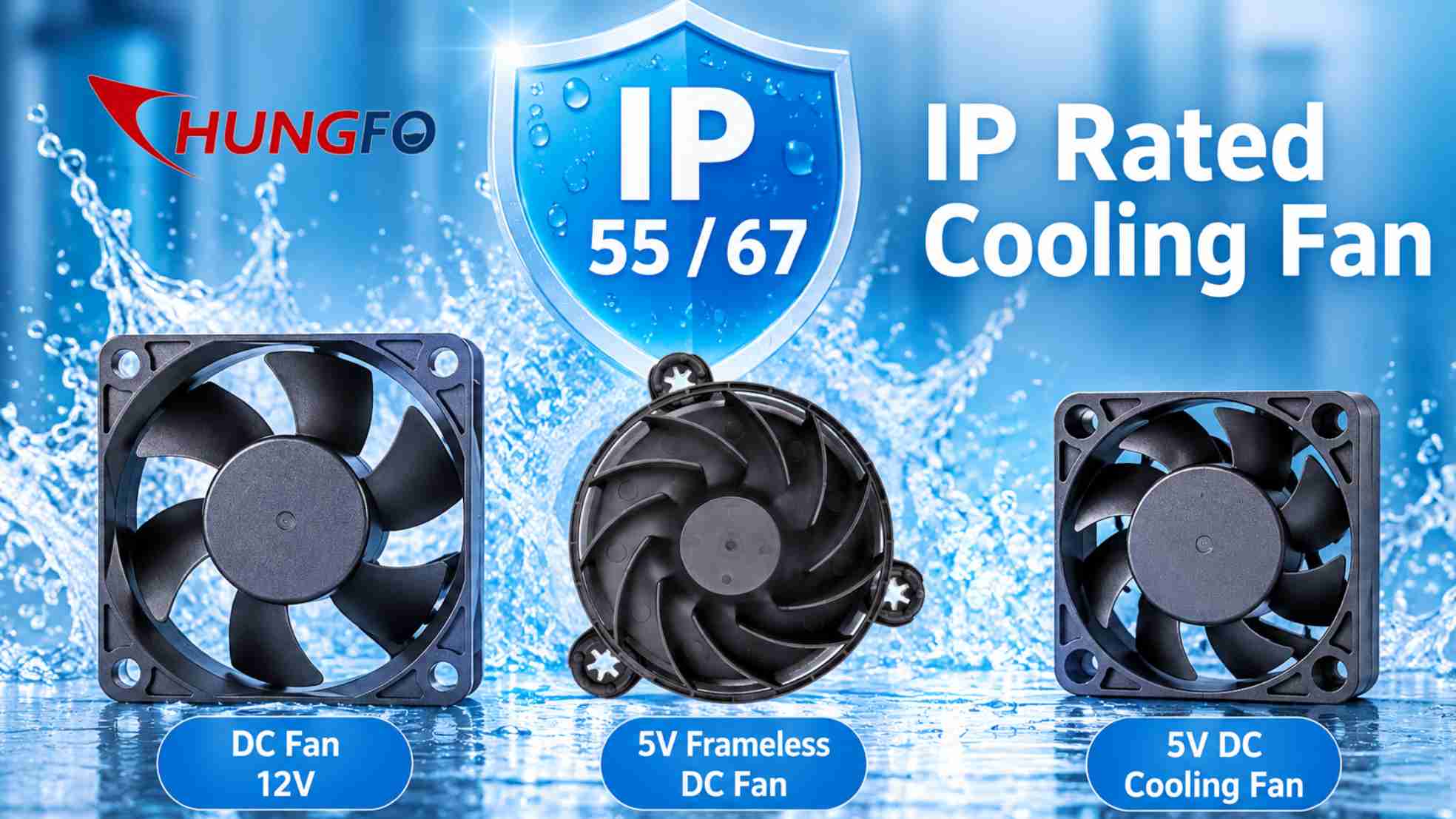
A dc fan 12v is a common option for industrial electronics, communication equipment, automotive-related applications, control systems, and various household appliances. Twelve-volt DC systems offer a practical balance between power requirements, control flexibility, and compatibility with many existing electronic platforms.
When selecting a 12V fan, engineers should check the rated voltage, operating voltage range, starting voltage, rated current, locked-rotor current, speed, airflow, and noise. The motor's electrical protection and the complete installation's environmental requirements should also be evaluated.
For compact electronics and low-power devices, a 5V DC cooling fan may be more appropriate. These fans are frequently used in small electronic enclosures, embedded systems, portable equipment, compact appliances, and other applications where a low-voltage power supply is available.
A 5v dc cooling fan can be selected for applications requiring compact dimensions and compatibility with a 5V power architecture. However, buyers should not assume that a 5V fan automatically provides sufficient airflow for every small device. Thermal load, available installation space, and ventilation resistance must still be calculated.
Another option is a 5v frameless dc fan. Frameless fan structures can be useful when equipment designers need a compact airflow component that can be integrated into a customized housing or a specialized mechanical structure.
Frameless designs may offer greater flexibility in certain installation arrangements, but their performance depends on the mounting structure, blade protection, motor support, and surrounding airflow channel. If the equipment requires an IP rating, the entire integrated assembly must be evaluated. A frameless motor or impeller should not automatically be considered IP55 or IP67 simply because it uses a protected motor design.
The voltage selection and IP protection selection should therefore be treated as two separate engineering decisions.
12. Common Applications of IP Rated Cooling Fans
IP rated cooling fans are used across many industries because electronic equipment increasingly operates in environments where dust and water exposure cannot be completely avoided.
Industrial automation is one important application. Control cabinets, machine enclosures, electrical distribution equipment, and automated production systems may be exposed to dust, oil mist, moisture, and cleaning activities. Selecting a suitable protection level helps protect sensitive components while maintaining stable thermal conditions.
Outdoor communication equipment is another major application. Wireless infrastructure, network cabinets, monitoring devices, and remote electronic systems may experience rain, temperature fluctuations, and airborne contaminants. A suitable cooling fan can help maintain the operating temperature of electronic components.
Automotive and transportation equipment also requires careful environmental protection. Electronic modules, power systems, and specialized equipment may operate in locations exposed to moisture, dust, and vibration. Fan selection must account for the actual environmental specifications and applicable automotive requirements.
Household appliances provide another area of application. Air purifiers, refrigeration equipment, ventilation systems, and other appliances may require compact fans with appropriate resistance to dust or moisture.
Renewable energy systems, including outdoor electrical cabinets associated with solar and energy storage installations, may also require environmental protection. In these applications, engineers should consider sunlight exposure, temperature variation, condensation, and the potential accumulation of contaminants.
The important point is that the IP rating must match the specific application. An industrial fan installed in a dry indoor enclosure may not require the same protection level as a fan used in an outdoor electrical cabinet.
13. What Should B2B Buyers Check Before Purchasing an IP Rated Cooling Fan?
B2B buyers should evaluate more than the advertised IP number when comparing cooling fan suppliers.
First, request clear documentation of the IP test. The document should identify the tested model, the applicable standard, the test conditions, and the protection scope. Buyers should verify whether the complete fan assembly or only selected electrical components were tested.
Second, check the airflow performance. A cooling fan must provide enough airflow and static pressure to meet the thermal requirements of the target equipment. A high IP rating does not replace aerodynamic performance testing.
Third, examine material selection. Housing materials, blade materials, sealing components, cable insulation, and bearing systems should be appropriate for the operating environment. Temperature resistance, chemical compatibility, and long-term aging should also be considered.
Fourth, confirm the electrical specifications. Voltage, current, power consumption, speed, starting performance, and control functions must match the equipment's power system.
Fifth, evaluate manufacturing consistency. Sealing structures require precise assembly. A supplier should have appropriate production controls and inspection procedures to maintain consistent product quality.
Sixth, consider customization. Different equipment projects may require special cable lengths, connectors, mounting dimensions, airflow directions, speed settings, and electrical functions. A manufacturer with engineering and production capabilities can help adapt the fan to the final product design.
Finally, assess long-term supply capability. For OEM and ODM projects, buyers should consider production capacity, quality management, engineering communication, sample testing, delivery schedules, and after-sales support.
14. Why IP Testing and Quality Control Are Important
An IP rating should be based on a defined test procedure rather than a visual inspection or a supplier's informal statement.
Testing helps determine whether the product can withstand the specified exposure conditions without harmful ingress. However, passing one test does not establish resistance to every possible environmental condition.
Cooling fan manufacturers should therefore establish a quality management process that covers incoming materials, component inspection, motor assembly, electronic control, sealing, functional testing, and final inspection.
Dynamic balancing is important for controlling vibration and improving mechanical stability. Electrical testing helps verify operating current, voltage characteristics, and motor functionality. Airflow and pressure testing provide information about the fan's aerodynamic performance. Temperature and humidity testing can help evaluate product behavior under environmental changes.
For IP rated products, the sealing structure and assembly process deserve additional attention. Gaskets, adhesives, protective coatings, and cable outlets must remain consistent between production batches.
A professional supplier should be able to explain the protection design and provide relevant documentation for the specific model. If the customer's application involves unusual environmental conditions, additional validation may be necessary.
This approach reduces the risk of selecting a product that appears suitable on paper but fails after installation.
15. How Does China Chungfo Fan Support Customized Cooling Fan Projects?
Selecting an IP rated cooling fan requires coordination between electrical performance, mechanical structure, environmental protection, and manufacturing quality.
China Chungfo Fan focuses on the research and development, manufacturing, and sales of DC fans, AC fans, blowers, cross-flow fans, frameless fans, and related motor products. The company provides fan solutions for different equipment structures and application requirements.
With an integrated manufacturing approach, China Chungfo Fan coordinates product design, mold development, injection molding, electronic production, assembly, inspection, and after-sales support. This manufacturing structure helps the engineering team evaluate product requirements from the early design stage.
For customized projects, important considerations include operating voltage, fan dimensions, airflow, static pressure, rotational speed, noise, bearing selection, cable configuration, connectors, mounting structures, and environmental protection requirements.
Customers developing equipment for outdoor or industrial applications can communicate their actual operating conditions to the engineering team. These details help determine whether an IP55, IP65, IP67, or another protection solution should be evaluated.
The company also emphasizes manufacturing inspection and product verification. Relevant testing equipment and quality procedures support the evaluation of electrical performance, airflow, pressure, noise, temperature characteristics, and other product requirements.
For OEM and ODM projects, customized solutions can be discussed according to the equipment's mechanical layout, power architecture, thermal load, and production requirements.
A suitable cooling fan should not simply meet a protection number. It should also provide reliable airflow, electrical compatibility, mechanical stability, and consistent manufacturing quality.
16. Frequently Asked Questions About IP Rated Cooling Fans
16.1 What Is the Difference Between IP55 and IP67 Cooling Fans?
IP55 provides dust protection and protection against water jets under specified test conditions. IP67 provides dust-tight protection and protection against temporary immersion in water under defined conditions. The two ratings address different water exposure tests, so neither should automatically be considered a complete replacement for the other.
16.2 Is an IP67 Cooling Fan Waterproof?
IP67 provides protection against the effects of temporary immersion under specified testing conditions. However, it does not automatically mean that the fan can operate continuously underwater or withstand every type of water pressure. Buyers should check the manufacturer's documentation and the exact scope of the test.
16.3 Is IP55 Suitable for Outdoor Cooling Fans?
IP55 may be suitable for outdoor equipment exposed to dust, rain, and water jets within the specified test conditions. However, the actual suitability depends on installation, connector protection, environmental exposure, and the equipment's complete enclosure design.
16.4 Is IP67 Better Than IP65?
IP67 provides a higher dust protection level and temporary immersion protection. IP65 provides dust-tight protection and water-jet protection. If equipment needs to withstand both water jets and immersion, buyers should verify that the product has been tested for both requirements.
16.5 Does a Higher IP Rating Reduce Airflow?
Not necessarily. The impact depends on the fan's aerodynamic design and protective structure. Buyers should compare actual airflow, static pressure, rotational speed, noise, and performance curves rather than assuming that a higher IP rating always reduces cooling performance.
16.6 Can a 12V DC Fan Have an IP67 Rating?
Yes. A 12V DC fan can be designed and tested for IP67 protection. However, the rating depends on the actual product construction and verification results, not simply the operating voltage.
16.7 Can a 5V DC Cooling Fan Be Used in Outdoor Equipment?
A 5V DC cooling fan can be used in outdoor equipment if its environmental protection, electrical characteristics, airflow performance, and installation design meet the application requirements. The voltage alone does not determine whether a fan is suitable for outdoor use.
16.8 Does IP67 Mean the Fan Can Work Underwater?
No. IP67 refers to protection against the effects of temporary immersion under specified test conditions. It does not mean that the fan can perform its normal air-cooling function while submerged.
16.9 Does an IP Rating Apply to the Entire Cooling Fan?
Not always. Some manufacturers specify that protection applies only to the electrical components or motor electronics. Buyers should confirm whether the frame, blades, bearings, cables, and connectors are included in the tested protection scope.
16.10 How Can I Select the Correct IP Rating for My Project?
Start by identifying the expected dust and water exposure. Determine whether the fan will encounter splashes, water jets, powerful cleaning, or temporary immersion. Then evaluate airflow, static pressure, voltage, installation structure, and testing documentation. A qualified fan manufacturer can help assess the appropriate solution.
17. Conclusion: Choose the Right IP Rating for Reliable Cooling Performance
Selecting an IP rated cooling fan is an important part of designing reliable electronic and industrial equipment. IP55 and IP67 provide different levels of environmental protection, and the correct choice depends on the actual conditions in which the fan will operate.
IP55 is a practical option for applications requiring dust protection and resistance to water jets. IP67 is more suitable when complete dust protection and protection against temporary immersion are required. IP65 may be an important alternative when dust-tight construction and water-jet resistance are the primary requirements.
However, the IP rating is only one part of the selection process. Airflow, static pressure, operating voltage, noise, temperature range, mechanical structure, and manufacturing quality must also be evaluated.
For equipment manufacturers and B2B buyers, the best solution is not necessarily the cooling fan with the highest IP number. It is the fan that provides the appropriate environmental protection while maintaining the cooling performance, electrical compatibility, and service reliability required by the application.
Working with an experienced manufacturer can help reduce design risks, improve product compatibility, and support long-term production requirements. China Chungfo Fan provides customized cooling fan manufacturing solutions for customers seeking reliable thermal management components for different industrial and electronic applications.