Categories
New Blog
How Can The Blower Enhance Operating Efficiency In Industrial Packaging And Sealing Machines?
September 04 , 2026Industrial packaging and sealing machines are becoming increasingly important as manufacturers pursue higher production speeds, better packaging consistency, lower energy consumption, and more reliable automated operation. Whether the equipment is used for food packaging, pharmaceutical packaging, consumer products, electronic components, household goods, or logistics applications, the performance of the packaging machine directly affects production capacity and product quality.
Among the many components inside modern packaging equipment, the blower is sometimes treated as a secondary component. In reality, properly selected and correctly integrated airflow equipment can have a significant influence on machine efficiency. A cooling blower can support cooling, air circulation, pneumatic assistance, film handling, heat management, shrink packaging, vacuum-related functions, and localized temperature control.
The importance of airflow becomes even more obvious in high-speed sealing machines. Heat sealing requires controlled temperature, pressure, and sealing time. When a machine operates continuously, heat generated by heating elements, motors, controllers, drives, bearings, and other components can accumulate inside the enclosure. If that heat is not removed effectively, component temperatures may rise, control systems may become unstable, and sealing performance may gradually deteriorate.
This is why blower selection should not be considered simply a matter of choosing a fan with a high airflow rating. Engineers need to evaluate airflow, static pressure, installation space, operating temperature, noise, voltage, speed, duty cycle, environmental conditions, and control requirements together.
For industrial packaging manufacturers, the right blower solution can help create a more stable thermal environment, improve machine reliability, reduce unnecessary downtime, and support consistent production.
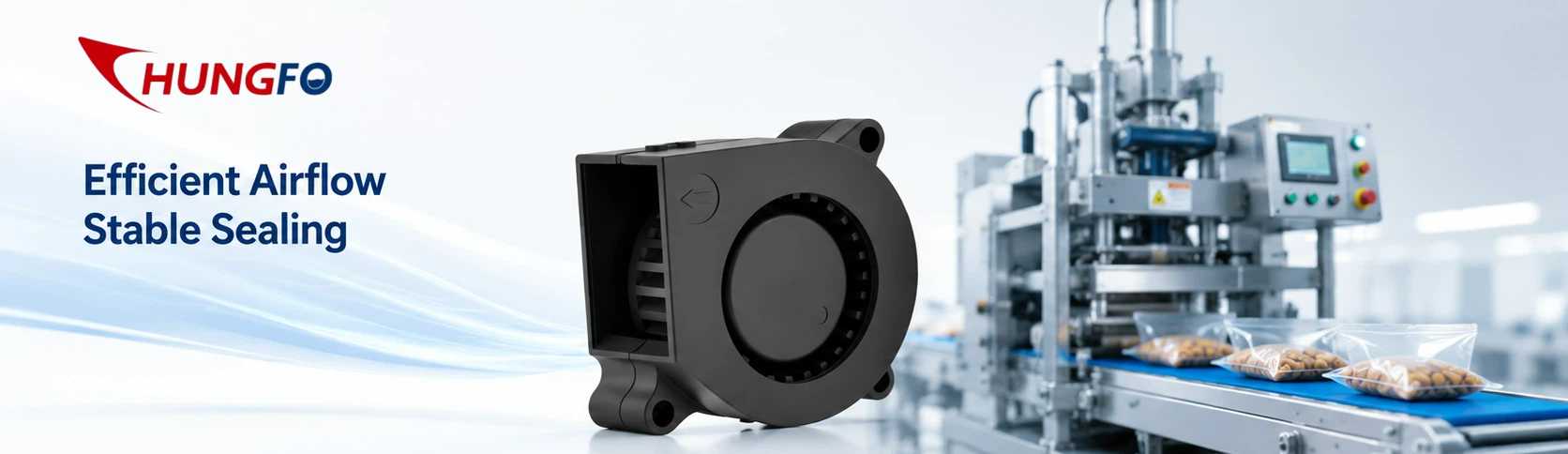
Why Airflow Matters In Industrial Packaging Machines
A packaging machine is essentially a combination of mechanical movement, electrical control, thermal processing, material handling, and automation. These systems operate simultaneously, which means that heat and airflow can become important engineering considerations.
A typical industrial sealing machine may include heating bars, sealing jaws, motors, conveyors, sensors, control boards, power supplies, variable frequency drives, pneumatic components, and electronic controllers. During continuous operation, these components generate heat at different rates.
The sealing area is particularly sensitive because it must maintain a specific temperature range. If heat spreads from the sealing area into surrounding components, it may increase the thermal load of the entire machine.
A blower can help establish a controlled airflow path. Instead of allowing hot air to remain trapped around sensitive components, the airflow can transport heat away from critical areas and replace it with cooler air.
This principle is particularly useful for machines operating at high production speeds. As production speed increases, the number of sealing cycles per hour also increases. More cycles can mean more continuous heat generation, making thermal management increasingly important.
Modern packaging machine designs already use air supply, air exhaust, circulation fans, and cooling systems in different sections of the equipment. Some packaging systems use blowers to circulate heated air, while other designs use fans or exhaust systems to remove unwanted heat.
A properly designed airflow system therefore becomes part of the overall machine architecture rather than an isolated accessory.
How A Blower Supports Heat Dissipation
One of the most important functions of a blower in packaging equipment is heat removal.
When a machine operates continuously, heat can accumulate inside enclosed spaces. The problem is not necessarily that any single component generates excessive heat. Instead, the combination of many heat sources can gradually increase the internal temperature.
A blower creates forced airflow that accelerates heat transfer.
For example, a blower can draw hot air away from a motor compartment and move it toward an exhaust outlet. At the same time, another airflow path can introduce cooler ambient air into the enclosure.
This creates a continuous air exchange process.
Compared with natural convection, forced airflow provides more predictable thermal management. Natural convection depends heavily on temperature differences, enclosure geometry, installation orientation, and available ventilation openings. A blower provides a more controlled airflow volume and direction.
This is particularly useful when packaging machines are installed in compact production environments where natural ventilation is insufficient.
In practical machine design, airflow should not simply be directed randomly toward the hottest component. Engineers should consider the complete airflow path from inlet to outlet.
If the blower is installed too far from the heat source, the cooling effect may be weaker than expected. If the outlet is poorly positioned, hot air may circulate back toward the equipment. If the enclosure has excessive leakage, the blower may fail to create the intended pressure or airflow pattern.
Therefore, blower performance depends not only on the blower itself but also on the surrounding air duct, filter, grille, enclosure, and exhaust structure.
Improving Sealing Stability Through Temperature Control
Heat sealing is highly dependent on process stability.
A packaging machine typically needs to coordinate sealing temperature, pressure, dwell time, and material movement. Small changes in these parameters can influence the final sealing result.
If the sealing system becomes excessively hot, packaging film may deform, burn, stick to the sealing surface, or produce inconsistent sealing edges. If the sealing system does not reach the required temperature, the seal may be weak or incomplete.
Cooling therefore has an important role even though the sealing process itself requires heat.
The objective is not to make the sealing zone as cold as possible. The objective is to keep the heat exactly where it is needed while preventing unnecessary thermal accumulation in surrounding areas.
A blower can support this balance by removing excess heat from the machine enclosure or cooling downstream components after the sealing operation.
For example, after a film is heat sealed, controlled cooling can help the sealed area stabilize before the packaged product continues to the next production stage.
Some packaging machines use forced-air cooling after heating to improve the stability and appearance of the finished package. Continuous band sealing systems can also use cooling fans to protect heating blocks and maintain reliable operation.
This demonstrates an important engineering principle: heating and cooling should be considered as two parts of the same thermal management system.
Increasing Production Efficiency
Production efficiency is not simply the maximum speed of a packaging machine. True efficiency also includes uptime, consistency, maintenance requirements, energy consumption, material waste, and product quality.
A machine that operates extremely quickly but frequently stops for overheating is not necessarily efficient.
A blower can contribute to efficiency by helping equipment operate within a more stable temperature range.
When electronic components remain within their recommended operating conditions, the likelihood of thermal protection events and temperature-related failures can be reduced. Motors, power supplies, control boards, sensors, and drives can benefit from appropriate airflow.
Stable operating temperatures can also support consistent machine behavior during long production runs.
This is especially important for automated packaging lines. When one machine in a production line stops, upstream and downstream processes may also be affected. A relatively small cooling problem can therefore create a much larger production problem.
Reducing thermal stress can help manufacturers maintain longer continuous operating periods.
For packaging machine manufacturers, this means blower selection should be considered during the initial equipment design stage rather than added later as an emergency cooling solution.
Blower Applications In Heat Shrink Packaging
Heat shrink packaging is another area where airflow plays an important role.
A typical shrink packaging process may involve film feeding, wrapping, sealing, cutting, heating, shrinking, cooling, and final product discharge. During the shrink stage, controlled hot air must be distributed around the product.
A blower can circulate heated air through the shrink tunnel and help create a more uniform temperature environment.
If airflow is uneven, some sections of the film may shrink faster than others. This can lead to wrinkles, uneven appearance, incomplete shrinkage, or excessive thermal exposure.
High-quality airflow distribution therefore becomes an important factor in shrink packaging performance.
Modern shrink systems may use high-velocity circulation blowers to distribute hot air throughout the tunnel. Other cooling fans can then be used after the heating process to stabilize the finished package.
The blower used for hot-air circulation needs to be selected for the actual system pressure and temperature rather than airflow alone.
Duct resistance, filters, heating chambers, air outlets, and internal circulation structures can all affect the operating point.
Why Static Pressure Is Important
One common mistake when selecting a blower is focusing only on maximum airflow.
Maximum airflow is usually measured under low-resistance conditions. In an actual packaging machine, however, the blower may have to push air through ducts, filters, grilles, narrow channels, heat exchangers, or other restrictions.
These restrictions create resistance.
Static pressure represents the blower's ability to maintain airflow against this resistance.
A blower with a high free-air airflow rating may perform poorly when connected to a restrictive duct system. Conversely, a properly selected blower with a suitable pressure-flow characteristic can maintain more useful airflow under real operating conditions.
This is why engineers should evaluate the blower's performance curve whenever possible.
The operating point is determined by the intersection between the blower performance curve and the system resistance curve.
If the selected blower cannot generate sufficient pressure, the actual airflow may be significantly lower than the catalog value.
For industrial packaging machines, this can result in insufficient cooling even though the blower appears powerful when tested outside the machine.
Compact Blowers For Limited Installation Space
Packaging machines often have limited internal space.
Control cabinets, motors, heating assemblies, conveyors, sensors, pneumatic components, and wiring all compete for installation space. A cooling solution therefore needs to provide adequate airflow without occupying excessive volume.
Compact blower designs can be useful in such situations because airflow can be directed through a specific channel.
Compared with a conventional axial fan, a centrifugal or blower-style solution can often be easier to integrate when the airflow must travel through ducts or overcome higher resistance.
However, this does not mean that a blower is always superior to an axial fan. The correct choice depends on the application.
An axial fan can be highly effective when the system requires large airflow with relatively low resistance. A blower may be more suitable when airflow needs to be redirected or when the system has higher pressure resistance.
The best solution is therefore determined by the machine's actual airflow requirements.
Using Small Cooling Fans Inside Packaging Equipment
Not every cooling position requires a large blower.
Small electronic compartments may need localized cooling rather than large-scale air circulation. Control boards, sensors, power supplies, communication modules, and compact motor controllers can benefit from small fans installed close to heat-generating components.
For example, a 40 x 40 x 20 mm fan can be considered for compact electronic areas where installation space is limited.
The advantage of a compact fan is not simply its small size. Small fans can provide targeted airflow to specific components and can be integrated directly into equipment housings.
In packaging equipment, such localized cooling can complement the main blower system.
The main blower can manage enclosure-level airflow while small fans handle localized hot spots.
This layered cooling approach can provide greater flexibility than relying on one large fan for the entire machine.
The Role Of Larger Fans In Industrial Equipment
Larger fans may be appropriate when the machine requires higher airflow through a large enclosure or when multiple heat-generating components operate simultaneously.
For example, a 160 mm case fan can be considered for applications requiring a larger volume of air movement inside an equipment cabinet or industrial enclosure.
The important point is that fan size should be matched with the thermal load and airflow path.
Installing a larger fan does not automatically guarantee better cooling.
If the enclosure cannot provide sufficient inlet area, the larger fan may operate against excessive resistance. If airflow is poorly distributed, much of the air may bypass the components that actually need cooling.
Therefore, airflow design should always be considered together with fan selection.
Fan Selection For Different Packaging Machine Zones
Different parts of a packaging machine can require different airflow solutions.
The heating zone may require controlled exhaust or circulation.
The control cabinet may require continuous cooling for electronic components.
The motor compartment may require high-volume air exchange.
The sealing area may require localized cooling after the heating cycle.
The shrink tunnel may require high-temperature air circulation.
The finished-product section may require cooling airflow to stabilize the packaging material.
Because these zones have different requirements, a single fan model may not be suitable for every location.
This is one reason professional packaging equipment manufacturers often use multiple airflow solutions within one machine.
The Relationship Between Blower Efficiency And Energy Consumption
Energy efficiency is another important consideration.
A blower consumes electrical energy to move air. If the blower is oversized, the machine may consume unnecessary power. If it is undersized, the cooling system may fail to maintain the desired temperature.
The best design is not necessarily the blower with the highest rated airflow. It is the blower that can achieve the required airflow and pressure at an appropriate electrical input.
Motor efficiency, operating voltage, speed, control method, and load conditions all influence energy consumption.
Variable-speed control can provide another opportunity for energy optimization.
When the machine is operating at low production speed, the cooling requirement may be lower. Instead of operating the blower continuously at maximum speed, the control system can adjust airflow according to temperature or machine operating conditions.
This can reduce unnecessary energy consumption while maintaining adequate cooling.
Noise Control In Packaging Machines
Industrial packaging machines are often installed in production areas where multiple machines operate simultaneously.
Noise from motors, conveyors, bearings, pneumatic systems, blowers, and fans can contribute to the overall workplace sound level.
Therefore, cooling performance should not be evaluated separately from acoustic performance.
A blower that produces excessive noise may create an undesirable working environment even if its airflow is sufficient.
Noise can be influenced by blade design, motor speed, bearing structure, airflow turbulence, vibration, mounting method, and duct geometry.
A properly selected fan combined with suitable mounting can help reduce unnecessary vibration and acoustic problems.
Reliability During Continuous Operation
Packaging machines frequently operate for long production periods.
A cooling fan may therefore run continuously for thousands of hours.
Bearing selection becomes important in such environments. Brushless DC motors are commonly used in compact cooling applications because they can provide efficient electronic commutation and long operating life when properly designed.
The fan's operating temperature also needs to be considered.
A fan installed near a heating element may experience much higher ambient temperatures than a fan installed inside a cool control cabinet.
Selecting a fan based only on room-temperature specifications can therefore create reliability problems.
Engineers should evaluate the actual ambient temperature, expected duty cycle, humidity, dust level, voltage fluctuation, and installation orientation.
Protection Against Dust And Contamination
Packaging environments can contain dust, film fragments, paper fibers, powders, or other particles depending on the industry.
These contaminants can accumulate on fan blades, filters, heat sinks, and air passages.
As contamination increases, airflow can decrease while motor load and operating temperature may increase.
Therefore, the cooling system should be designed with appropriate filtration and maintenance access.
The filter itself also introduces pressure resistance, which must be included when selecting the blower.
A filter that becomes increasingly blocked can cause system airflow to decline over time.
For high-reliability packaging equipment, maintenance indicators or scheduled filter inspection can help prevent gradual cooling performance degradation.

How Proper Airflow Can Reduce Downtime
Unexpected downtime is one of the most expensive problems in industrial production.
The direct cost may include lost production, labor waiting time, product waste, and emergency maintenance. There can also be indirect costs associated with delayed deliveries and reduced production capacity.
Thermal problems are sometimes difficult to identify because the machine may initially operate normally.
As the production run continues, internal temperatures gradually increase. A controller may then trigger protection, a motor may become thermally overloaded, or a sensor may behave abnormally.
Proper airflow can help reduce this type of thermal accumulation.
It does not eliminate every possible failure, but it can create a more stable operating environment for many components.
For packaging machine manufacturers, this makes airflow management an important part of reliability engineering.
Designing The Airflow Path
The airflow path should be designed before selecting the final blower.
Engineers should identify the main heat sources, sensitive components, air inlet locations, exhaust locations, potential recirculation zones, and areas where airflow may be obstructed.
The ideal airflow path should move air from a relatively clean and cooler intake area toward the target components and then discharge heated air outside the enclosure.
Air should not simply circulate inside the enclosure without a defined heat-removal path.
If hot air exits the machine but immediately returns through the intake, the effective cooling capacity can be greatly reduced.
This is why inlet and outlet positioning can be as important as blower performance.
Integrating Blower Control With Machine Automation
Modern packaging machines increasingly use PLCs, sensors, and intelligent control systems.
This provides opportunities to integrate blower operation with the machine's production cycle.
For example, the blower can operate continuously during production but reduce speed during standby.
Temperature sensors can also provide feedback to the control system.
If the internal temperature rises above a defined threshold, blower speed can increase.
If the temperature falls, speed can decrease.
This approach can balance cooling performance and energy consumption.
In more advanced equipment, airflow control can become part of the machine's overall thermal management strategy.
Selecting A Blower For A Packaging Machine
Several parameters should be considered before selecting a blower.
The first is required airflow.
The second is system static pressure.
The third is operating temperature.
The fourth is available installation space.
The fifth is electrical voltage and current.
The sixth is expected operating life.
The seventh is noise requirement.
The eighth is environmental protection.
The ninth is control method.
The tenth is maintenance accessibility.
It is also important to evaluate the complete system rather than selecting a blower based on one specification.
A blower with excellent airflow but poor pressure capability may fail in a restrictive system.
A blower with excellent pressure capability but excessive energy consumption may increase operating costs.
A very compact fan may fit perfectly but fail to remove enough heat.
The best solution is therefore a balanced design.
How China Chungfo Fan Can Support Packaging Equipment Applications
China Chungfo Fan focuses on cooling and airflow solutions for different industrial and electronic applications.
For packaging and sealing equipment manufacturers, the value of a fan supplier is not limited to providing a catalog model. A reliable supplier should also understand airflow requirements, installation limitations, operating conditions, noise considerations, electrical specifications, and long-term reliability.
Different packaging machines may require different airflow structures. Some systems need compact localized cooling, while others require larger airflow through an enclosure. Some applications require pressure-oriented blower performance, while others need high-volume circulation.
This is why application-based fan selection can be more effective than simply choosing a product by dimensions.
A suitable cooling solution can be designed around the machine's actual thermal load and airflow path.
Conclusion
The blower is an important component in industrial packaging and sealing machines because controlled airflow can influence cooling, thermal stability, sealing consistency, equipment reliability, and production efficiency.
The most important point is that airflow should be considered as part of the entire machine design.
A properly selected blower can remove accumulated heat, support stable operating temperatures, improve airflow distribution, assist heat shrink processes, protect electronic components, and reduce thermal stress during continuous operation.
At the same time, smaller cooling fans can provide localized airflow for compact electronic areas, while larger fans can support enclosure-level air exchange.
The correct solution depends on airflow, static pressure, temperature, installation space, electrical requirements, noise, environmental conditions, and expected operating life.
For packaging machine manufacturers, the objective should not simply be maximum airflow. The objective should be controlled, reliable, and efficient airflow that matches the real operating conditions of the equipment.
As packaging lines become faster and more automated, thermal management will become increasingly important. A well-designed blower and fan system can therefore become a valuable part of the machine's overall efficiency strategy.
Frequently Asked Questions
What is the main function of a blower in an industrial packaging machine?
The main function is to generate controlled airflow. Depending on the machine design, the blower can be used for cooling, air circulation, heat removal, film handling, shrink packaging, or other air-related processes.
Can a blower improve the efficiency of a heat sealing machine?
Yes. A properly selected blower can help control heat accumulation, protect electronic and mechanical components, and support stable operating conditions. Better thermal stability can contribute to more reliable continuous production.
Why is cooling important in a sealing machine if sealing requires heat?
The sealing process requires controlled heat, not uncontrolled heat. Cooling helps remove excess heat from surrounding components and can also stabilize the package after the heating and sealing process.
Is airflow or static pressure more important when choosing a blower?
Both are important. Airflow indicates how much air the blower can move, while static pressure indicates its ability to maintain airflow against system resistance. The correct blower should meet the actual operating point of the machine.
Can a small fan be used inside a packaging machine?
Yes. Small fans are useful for localized cooling of control boards, power supplies, sensors, communication modules, and other compact components. For example, a 40 x 40 x 20 mm fan may be suitable where installation space is limited.
When should a larger fan be considered?
A larger fan can be considered when the machine has a larger enclosure, multiple heat sources, or a greater requirement for air exchange. However, the enclosure inlet, outlet, resistance, and airflow path must also be considered.
Can one blower cool the entire packaging machine?
Sometimes, but not always. Different machine zones may have different thermal requirements. A combination of a main blower and smaller localized cooling fans can provide better airflow management.
How does a blower help reduce machine downtime?
By continuously removing excess heat, a blower can help maintain more stable operating temperatures for electronic, mechanical, and electrical components. This can reduce the risk of temperature-related interruptions.
Does blower speed affect energy consumption?
Yes. Higher speed generally requires more electrical power. Variable-speed control can allow the machine to provide only the airflow required under different operating conditions.
What environmental factors should be considered?
Temperature, humidity, dust, oil mist, particles, installation orientation, and voltage conditions should all be considered. Packaging environments with dust or film particles may require appropriate filtration and maintenance.
How should a blower be selected for a heat shrink machine?
The engineer should evaluate required airflow, static pressure, operating temperature, duct resistance, heating chamber temperature, air outlet configuration, and duty cycle. The blower should be capable of maintaining the required airflow under actual system resistance.
What is more important, a high airflow rating or a high-quality blower?
Neither specification alone determines suitability. A high-quality blower with the correct airflow and pressure characteristics is generally more useful than a larger blower that does not match the system.
Can China Chungfo Fan provide cooling solutions for packaging equipment?
China Chungfo Fan can provide fan and airflow solutions for different industrial equipment applications. The appropriate model should be selected according to the machine's airflow, pressure, thermal, electrical, dimensional, and environmental requirements.