Categories
New Blog
Case Study: Application of Environment-Resistant Cooling Fans in Residential PV Inverters
March 18 , 2026Cooling fans are fundamental thermal management components used in appliances, computing systems, and power electronics. As a category of industrial cooling DC fans, their reliability directly impacts system efficiency, failure rate, and service life.
In applications such as photovoltaic inverters, energy storage systems, and machine tools, cooling fans are frequently exposed to harsh environments including moisture, airborne dust, salt spray, and oil mist. Under these conditions, conventional designs often fail due to PCB corrosion, insulation degradation, or bearing contamination. This creates a strong demand for environment-resistant cooling fans with enhanced protection mechanisms.
1. Environmental Resistance Design and Encapsulation Technology
The primary failure modes of standard cooling fans include:
Lubricant degradation in ball bearings
Corrosion of exposed PCB circuits
Insulation breakdown caused by conductive contaminants
To address these issues, Chungfo implements multi-level protection designs and offers graded environment-resistant cooling fans based on application requirements.
A key solution is the encapsulated cooling fan, where epoxy resin is applied to fully seal the stator windings and control circuitry. This structure provides:
Physical isolation from moisture and particulates
Resistance to salt spray and sulfur-containing gases
Improved chemical resistance against industrial oils
Compared to conformal coating, encapsulation forms a continuous barrier, significantly improving long-term reliability in aggressive environments.
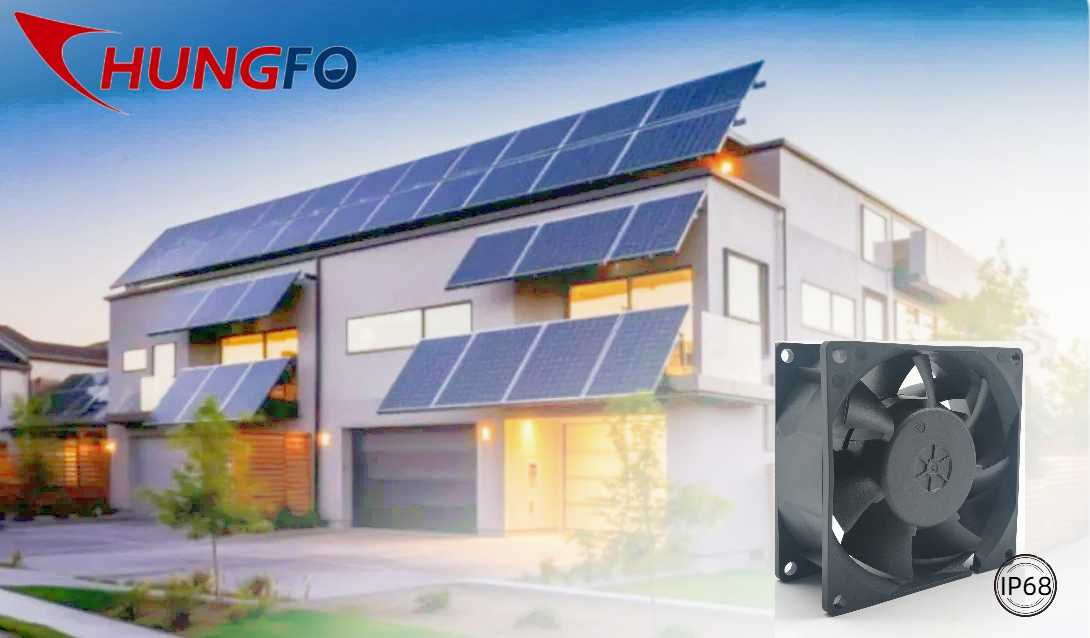
Case Study 1: Residential PV Inverters
Problem
Outdoor PV inverters operate under continuous exposure to rain, dust, and salt-laden air (especially in coastal regions). These factors accelerate PCB corrosion, leading to electrical failure and increased maintenance frequency.
Solution
A Level-3 environment-resistant cooling fan was implemented using an encapsulated cooling fan structure. The stator and PCB are enclosed and filled with epoxy resin, achieving IP68 protection.
Result
Reduced corrosion-related failures
Lower maintenance intervals
Improved system uptime
The product passed TÜV certification, confirming compliance with international safety and reliability standards.
Case Study 2: Machine Tools (Heat Exchanger Systems)
Problem
In machining environments, oil mist generated from cutting fluids penetrates the fan assembly. This leads to winding insulation failure and increased replacement frequency.
Solution
Chungfo deployed an industrial cooling fan with full encapsulation and IP69 protection. The design provides resistance to:
Oil mist contamination
Water ingress and high-pressure cleaning
Corrosive gases and salt exposure
Result
Internal validation testing indicates that the fan replacement cycle increased from approximately 1.5 years to 4.5 years under typical operating conditions.
This reduces:
Maintenance labor
Spare part consumption
System downtime
2. Design Implications and Application Value
Encapsulation-based designs are particularly suitable for:
Outdoor electronics (PV, telecom, energy storage)
Industrial environments with oil or chemical exposure
High-humidity or coastal installations
By improving environmental sealing at the component level, encapsulated cooling fans reduce dependency on system-level protection, simplifying overall thermal design.
Conclusion
Chungfo’s environment-resistant cooling fans, based on encapsulation technology, provide a robust solution for thermal management in harsh environments.
Through application-specific customization, these industrial cooling fans enable improved reliability, extended service life, and reduced total cost of ownership across a wide range of industries.