Categories
New Blog
How Can Vibration Analysis Predict Imminent Motor Failure In An Industrial Blower Fan?
July 22 , 2026Industrial blower fans are among the most critical components in modern manufacturing facilities, HVAC systems, energy storage equipment, automation machinery, and renewable energy installations. While these fans often operate reliably for years, motor failures rarely happen without warning. One of the earliest and most accurate indicators of impending failure is abnormal vibration.
As predictive maintenance becomes a global trend in Industry 4.0, vibration analysis has evolved from an advanced diagnostic technique into a standard maintenance practice. Companies that monitor vibration data can detect problems weeks or even months before a motor fails, significantly reducing unexpected downtime and maintenance costs.
Recent developments across global manufacturing in 2026 continue to emphasize intelligent predictive maintenance. As factories invest in digital monitoring systems, vibration analysis combined with AI-based diagnostics is becoming an essential part of industrial equipment management. This trend is especially important for blower fan systems operating continuously in demanding environments.
Why Vibration Matters in Industrial Blower Fans
Every rotating machine generates vibration. Under normal operating conditions, the vibration follows predictable patterns determined by the motor, bearings, shaft, impeller, and mounting structure.
When one of these components begins to deteriorate, the vibration signature changes. Even before temperature rises, unusual noise appears, or airflow decreases, vibration analysis can detect microscopic mechanical changes.
For an industrial DC Blower Fan, vibration monitoring offers several important advantages.
It identifies bearing wear before catastrophic failure.
It detects rotor imbalance caused by dust accumulation or damaged blades.
It reveals shaft misalignment after maintenance.
It uncovers loosened mounting bolts or structural fatigue.
It helps distinguish electrical motor issues from mechanical problems.
Because vibration changes occur much earlier than visible damage, maintenance teams can schedule repairs during planned shutdowns instead of emergency production stops.
How Vibration Analysis Works
Modern vibration monitoring uses accelerometers installed on the motor housing or bearing locations.
These sensors measure vibration in three axes.
Horizontal movement
Vertical movement
Axial movement
The collected data is analyzed using Fast Fourier Transform technology, converting vibration signals into frequency spectra.
Every mechanical defect generates unique frequency characteristics.
Bearing defects create high-frequency vibration spikes.
Rotor imbalance produces vibration at rotational speed.
Misalignment often generates harmonics.
Mechanical looseness creates irregular frequency patterns.
Broken fan blades produce repeating impact frequencies.
By comparing current vibration data with historical baselines, maintenance engineers can identify deterioration trends long before failures occur.
Common Causes of Motor Vibration
Bearing Wear
Bearings are responsible for supporting rotating shafts while minimizing friction.
Over time, lubrication degradation, contamination, or fatigue causes microscopic surface damage.
These defects generate characteristic vibration frequencies that become increasingly severe as wear progresses.
Rotor Imbalance
Dust accumulation, corrosion, damaged impellers, or manufacturing tolerances can shift the center of gravity.
Even slight imbalance increases centrifugal force dramatically at high rotational speeds.
This leads to higher vibration levels, increased bearing loads, and reduced motor life.
Misalignment
During installation or maintenance, motor shafts and fan shafts may become slightly misaligned.
Although the equipment continues operating, excessive radial and axial forces accelerate bearing deterioration.
Mechanical Looseness
Loose mounting bolts, worn brackets, or weakened structural frames create unstable vibration patterns.
If ignored, the vibration gradually damages additional components.
Electrical Problems
Motor winding defects, rotor bar damage, or electromagnetic imbalance can also produce vibration.
Unlike mechanical faults, electrical vibration often appears at frequencies related to electrical supply characteristics.
Why Predictive Maintenance Is Better Than Reactive Repairs
Many factories still replace motors only after failure occurs.
This reactive approach usually results in production interruptions, emergency labor costs, spare part shortages, and expensive equipment damage.
Predictive maintenance offers a far more economical strategy.
Instead of waiting for failure, vibration trends provide early warnings.
Maintenance teams can order replacement parts in advance.
Production schedules remain unaffected.
Repair costs decrease.
Equipment reliability improves.
Studies across industrial maintenance sectors consistently show that predictive maintenance significantly lowers maintenance expenses while increasing equipment availability.
Combining Vibration Analysis with Other Monitoring Technologies
Although vibration is extremely valuable, combining multiple monitoring methods provides even greater reliability.
Temperature monitoring identifies bearing overheating.
Current monitoring reveals motor loading conditions.
Noise analysis detects airflow abnormalities.
Infrared thermography identifies electrical hotspots.
AI algorithms analyze multiple sensor inputs simultaneously.
Together, these technologies create comprehensive equipment health monitoring systems capable of predicting failures with remarkable accuracy.
Applications Requiring Continuous Blower Reliability
Many industries cannot tolerate unexpected fan failures.
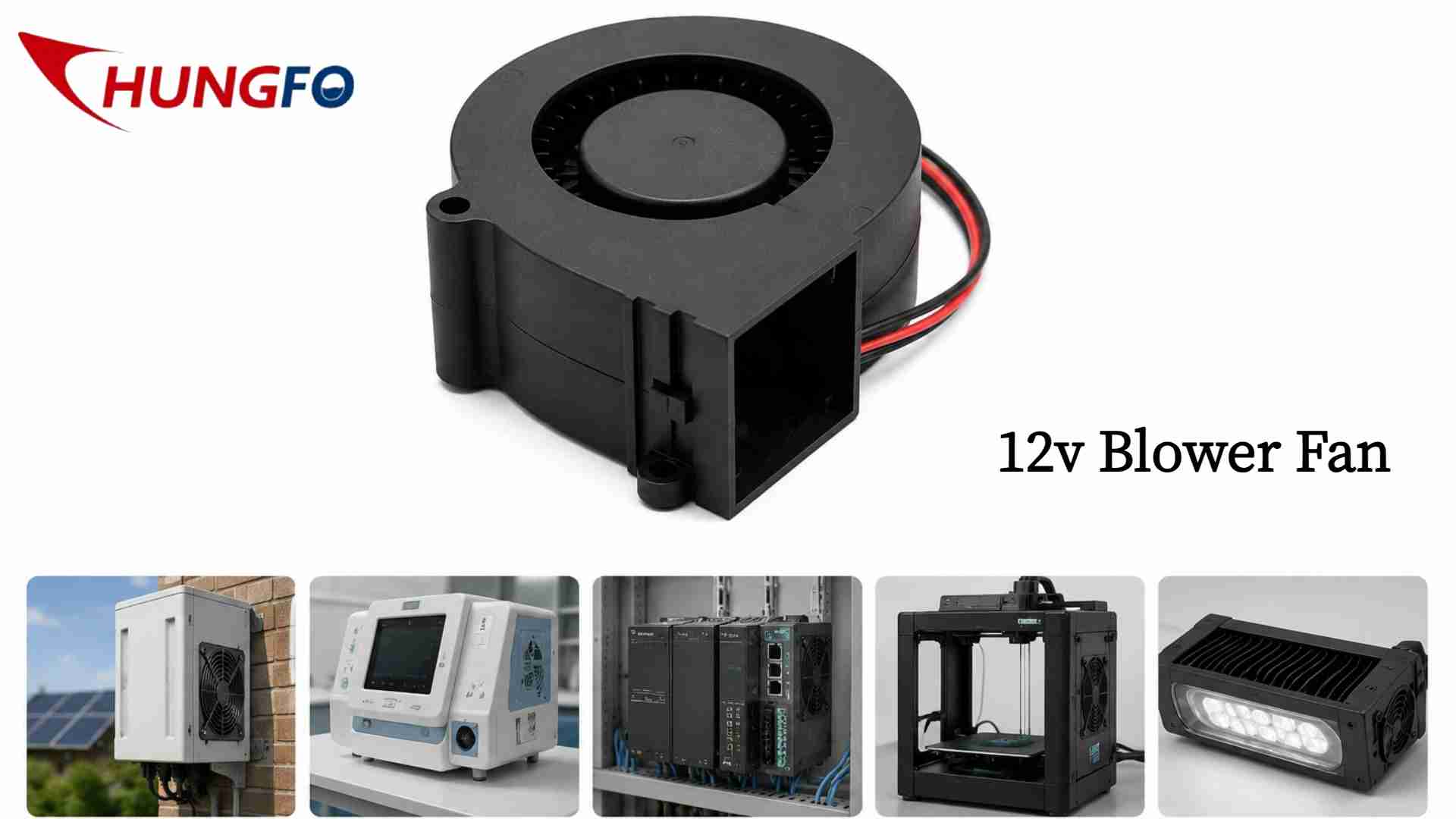
Data centers require continuous cooling.
Medical equipment depends on reliable airflow.
Industrial automation operates around the clock.
Battery energy storage systems require thermal management.
Telecommunication cabinets depend on stable ventilation.
Electric vehicle charging stations require reliable cooling.
Renewable energy systems increasingly depend on efficient airflow management.
For these applications, selecting a high-quality 24vdc fan with stable motor performance greatly reduces maintenance risks while extending equipment lifespan.
Solar Energy Systems Need Reliable Cooling
One rapidly expanding application is renewable energy.
Solar inverters continuously convert DC electricity into AC power, generating considerable heat during operation.
Without effective cooling, internal electronic components may experience overheating, efficiency loss, or premature aging.
A professionally designed Solar Inverter Cooling Fan provides stable airflow, excellent durability, low vibration, and long service life, helping maintain inverter reliability in demanding outdoor environments.
As global solar installations continue growing, reliable cooling fans have become essential components for renewable energy infrastructure.
Choosing a High-Quality Industrial Blower Fan
Not all blower fans provide the same vibration performance.
Manufacturers should evaluate several important factors.
Dynamic balancing accuracy
High-quality bearing systems
Precision motor assembly
Impeller manufacturing consistency
Strict vibration testing
Comprehensive quality inspection
Environmental durability testing
Products manufactured under strict quality control generally exhibit lower vibration throughout their operating life, reducing maintenance costs for end users.
Why Choose Chungfo Fan
Chungfo Fan is a professional manufacturer specializing in industrial cooling solutions for global customers.
Our factory integrates product research, mold development, injection molding, motor manufacturing, SMT production, assembly, and comprehensive testing into one complete production system.
Every fan undergoes multiple quality inspections, including dynamic balance testing, airflow measurement, noise testing, electrical performance verification, temperature testing, and long-term reliability evaluation.
Our product portfolio includes DC axial fans, AC axial fans, centrifugal blower fans, cross flow fans, frameless fans, EC fans, cooling motors, and customized thermal management solutions.
These products are widely used in industrial automation, medical equipment, refrigeration systems, communication equipment, energy storage systems, EV charging stations, intelligent manufacturing, household appliances, and renewable energy equipment.
With years of manufacturing experience and continuous investment in technology, Chungfo Fan provides reliable cooling solutions for customers in more than 100 countries worldwide.
Conclusion
Motor failures rarely occur without warning. Vibration analysis provides one of the earliest, most reliable, and most cost-effective methods for identifying developing mechanical problems before they become catastrophic failures.
By combining vibration monitoring with predictive maintenance strategies, industrial facilities can reduce downtime, extend equipment life, lower maintenance costs, and improve production efficiency.
Equally important is selecting high-quality blower fans from experienced manufacturers. Precision manufacturing, strict quality control, and comprehensive testing all contribute to lower vibration levels and longer service life.
As industrial automation and intelligent manufacturing continue advancing, vibration analysis will remain one of the most valuable tools for ensuring reliable operation of industrial blower fan systems.