
Categories
New Blog
Comprehensive Analysis on the Structure of Dryer Air Duct System and the Relationship with Fan Selection
May 08 , 2026In modern household and industrial drying equipment, the air duct system acts like the respiratory system of the human body, determining the heat exchange efficiency, energy consumption, and service life of the device. As the core driving component of the air duct, the selection and matching of the fan are the most critical aspects of the entire dryer design. This article starts from the basic principles of air duct structure, deeply explores the key parameters of fan selection, and analyzes the roles and optimization strategies of Dryer Cooling Fans, Small 12v Blowers, and Dryer DC Fans in the system in combination with practical application scenarios.
Chapter 1: Basic Architecture of Dryer Air Duct Systems
1.1 Functional Composition of the Air Duct System
The air duct system of a dryer mainly consists of an air inlet, a filter screen, a heating device cavity, a drum or drying chamber, an exhaust duct, a condenser (for heat pump or condensing models), and an exhaust fan or circulating fan. The basic working process is as follows: air is driven by the fan, heated by the heating element, enters the drum to take away moisture from the clothes, and the humid air is either condensed or directly discharged outside the machine.
Depending on the airflow path, air duct systems can be divided into three main types: vented, condensing (air-cooled/water-cooled), and heat pump types. The vented type has the simplest structure. Air passes through the heater, enters the drum, and is directly discharged outdoors. The condensing type adds a condenser to condense the humid air into water, which is then discharged into a water tank or sewer, while the air circulates inside the machine. The heat pump type introduces a heat pump system based on the condensing type, achieving low-temperature, high-efficiency dehumidification.
1.2 Aerodynamic Characteristics
The airflow state inside a dryer air duct is usually within the low subsonic incompressible flow range, with Reynolds numbers between 10^4 and 10^5, belonging to turbulent or transitional flow. Air duct resistance mainly comes from:
Frictional resistance along the path: Determined by wall roughness and length.
Local resistance: Pressure losses caused by elbows, sudden cross-section changes, filter screens, heater fins, clothes inside the drum, etc.
The total resistance (static pressure) of the air duct system has a quadratic relationship with the airflow rate (volumetric flow rate), i.e., ΔP = K × Q², where K is the impedance coefficient of the air duct. This characteristic is crucial for fan selection.
Chapter 2: Fan Classification and Working Principles
2.1 Centrifugal Fans vs. Axial Fans
The fan types commonly used in dryers include centrifugal fans (also known as blowers) and axial fans.
Axial Fan: Air flows in and out axially, with blades rotating to push the air. It is characterized by high airflow rate and relatively low static pressure, suitable for applications with low resistance and high airflow requirements. In some older vented dryers, the exhaust fan uses an axial design.
Centrifugal Fan: Air enters axially into the impeller, is accelerated by the rotating impeller, and exits radially. It can generate higher static pressure, making it suitable for overcoming complex resistance in the air duct, such as filter screens, heaters, drums, and long pipes. Modern dryers, especially condensing and heat pump models, almost exclusively use centrifugal fans as the main circulating fan.
2.2 Differences Between Brushless DC Motors and AC Motors
Fan performance depends not only on the impeller structure but also on the drive motor.
AC Motor: Low cost and simple structure, but difficult to control speed and low efficiency, mostly used in low-end, fixed-speed, fixed-airflow models.
Brushless DC Motor: High efficiency (up to 80–90%), wide speed control range, long life, and low noise. With PWM control, precise airflow adjustment is possible. Currently, mainstream high-efficiency dryers generally adopt the Dryer DC Fan solution, which is a centrifugal fan driven by a brushless DC motor.
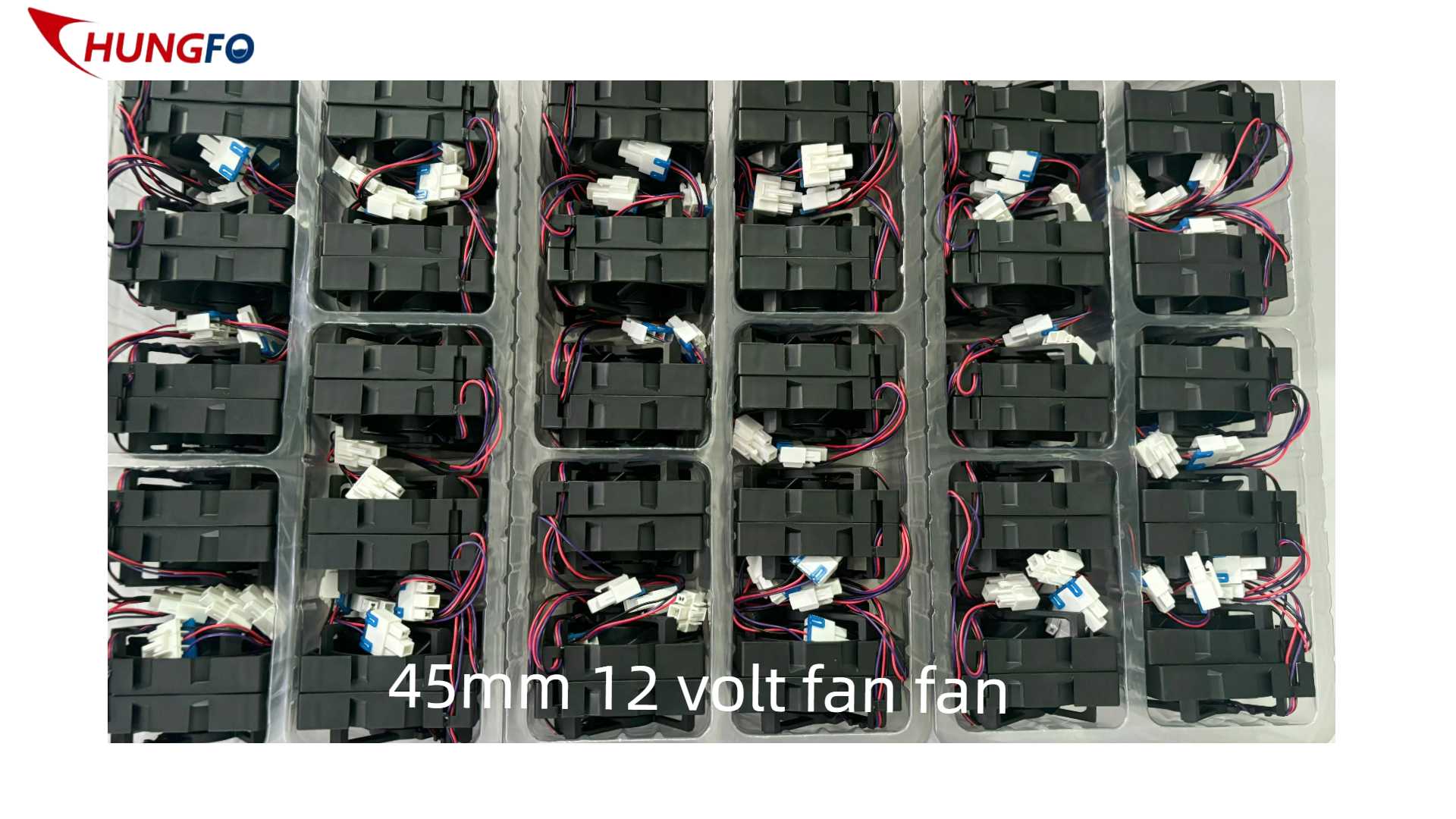
Among them, the Small 12v Blower is a type of low-voltage DC centrifugal fan, widely used in portable drying equipment, small clothing care machines, and special drying modules. The 12V voltage level offers advantages such as low-voltage safety, compatibility with battery power, and easy integration.
Chapter 3: Coupling Relationship Between Air Duct Structure and Fan Selection
3.1 Influence of Air Duct Resistance Characteristics on Fan Operating Point
The core of fan selection is to match the fan’s performance curve (P-Q curve) with the resistance characteristic curve of the air duct system. The actual operating point of the fan is the intersection of these two curves.
Case Study: A Condensing Dryer
Air duct system impedance coefficient K = 22222 Pa/(m³/s)²
Target design airflow Q = 0.12 m³/s (432 m³/h)
Required static pressure ΔP = 22222 × 0.12² ≈ 320 Pa
If a Dryer DC Fan is selected, its P-Q curve should be relatively flat near this operating point to avoid a sharp drop in airflow due to filter clogging or load changes.
3.2 Fan Selection Strategies for Different Air Duct Topologies
3.2.1 Vented Air Duct
Characteristics: Short air path, low resistance (typically 50–150 Pa), low static pressure requirement, but high exhaust airflow requirement for rapid moisture removal.
Recommended Fan Type: Axial fan or low-static-pressure centrifugal fan. Due to cost sensitivity, some models still use AC centrifugal fans. However, if multi-speed adjustment is needed to match different fabric types, a Dryer DC Fan is recommended to obtain smooth airflow adjustment capability.
3.2.2 Condensing (Air-Cooled) Air Duct
Characteristics: Addition of a condenser unit, zigzag air path, dense fins, significantly increased resistance (200–500 Pa). The fan must overcome the pressure losses of the heater, drum, and condenser.
Recommended Fan Type: High-static-pressure centrifugal fan, typically with a forward-curved multi-blade impeller design, 30–50 blades, outer diameter 120–160 mm. The motor should be brushless DC, with a speed range of 2000–4000 RPM. Here, the Dryer DC Fan has a distinct advantage: it maintains sufficient airflow under high static pressure and can achieve constant airflow through closed-loop control.
3.2.3 Heat Pump Air Duct
Characteristics: Incorporates two heat exchangers (evaporator and condenser), requiring airflow to pass through dense fins twice, plus heat dissipation needs from the compressor. The air duct is the most complex, with static pressure reaching 400–800 Pa.
Recommended Fan Type: Dual centrifugal fans or series-connected centrifugal fan solution. Some high-end models use dual independent fans—one drives the circulating air (drum side), and the other drives cooling air through the heat pump heat exchanger. For low-voltage auxiliary circuits (e.g., control board cooling, compressor compartment ventilation), a Small 12v Blower is often used as a local cooling unit, leveraging its low-voltage safety to be directly powered by the main control board’s 12V supply.
3.3 Noise Control and Fan Selection
The main noise sources in a dryer include fan aerodynamic noise, motor electromagnetic noise, mechanical vibration, airflow impact, and clothes tumbling noise. Among fan-related noise, blade passing frequency and its harmonics dominate.
Noise reduction measures:
Blade number optimization: Increasing the number of blades can reduce blade loading and vortex shedding noise, but too many blades increase friction loss. Typically, centrifugal fans have 32–40 blades.
Unequal blade spacing: Disperses the peak energy at the blade passing frequency, making the noise spectrum more uniform and the subjective sound softer.
Volute tongue gap optimization: Increasing the gap between the volute tongue and the impeller can significantly reduce rotational noise, but slightly reduces efficiency. The empirical gap is 5–10% of the impeller outer diameter.
Use brushless DC motors: Compared to AC motors, DC motors have no 50/60 Hz electromagnetic hum. When combined with sinusoidal wave drive, commutation noise can be further reduced.
China Chungfo Fan uses its own noise laboratory during product development to test A-weighted sound pressure levels for different blade shapes and volute structures, ensuring that fan noise at the rated operating point is kept below 45 dB(A) (for household dryers).
Chapter 4: Detailed Explanation of Engineering Parameters for Fan Selection
4.1 Airflow Rate
The airflow rate is measured in m³/h or CFM and determines the dehumidification rate of the dryer. Theoretically, a higher airflow rate removes more water vapor per unit time, but excessive airflow can lead to heat loss, increased energy consumption, and may disrupt clothes.
Engineering empirical values:
Household 3–5 kg dryers: 150–250 m³/h
6–8 kg models: 250–400 m³/h
9–12 kg models: 400–600 m³/h
When selecting, note that the fan’s rated airflow is typically the maximum value under free-air conditions. In practice, the airflow decreases as back pressure increases. Therefore, the system impedance curve must be considered.
4.2 Static Pressure
Static pressure reflects the fan’s ability to overcome resistance, measured in Pa or mmH₂O. The static pressure of dryer fans is usually in the range of 100–600 Pa. A common mistake is blindly pursuing high static pressure, which leads to insufficient airflow and sharply increased noise and power consumption.
4.3 Speed and Power
DC fans offer flexible speed control. Dryer DC Fans typically operate in the speed range of 1500–4500 RPM. In terms of power, the main circulating fan usually consumes 20–60 W, while a Small 12v Blower used for auxiliary cooling consumes only 1–5 W.
4.4 Life and Reliability Requirements
The dryer operating environment is characterized by high temperature (up to 80–90°C), high humidity, and dust (lint). Fan bearings and motor insulation are critical.
Bearings: Double ball bearings are recommended, with a life of up to 50,000 hours and better high-temperature resistance than sleeve bearings.
Motor insulation class: Should reach Class F (155°C) or Class H (180°C).
Protection rating: The fan motor part should be at least IP42, and the entire air duct design should consider lint filtration.
China Chungfo Fan uses high-temperature-resistant enameled wire, high-temperature grease, and anti-corrosion treatment for dryer applications. It validates long-term operational stability in the range of -20°C to 90°C through high and low-temperature environmental test equipment. Additionally, salt spray corrosion tests ensure no rusting in high-humidity, high-salt coastal environments.
Chapter 5: Practical Selection Case Studies
Case 1: Main Circulating Fan for a 7 kg Condensing Dryer
Design requirements: Airflow ≥320 m³/h @ 380 Pa static pressure; Noise ≤47 dB(A); Life ≥20,000 hours; Operating temperature 60–85°C
Selection solution: Forward-curved multi-blade centrifugal fan, impeller outer diameter 140 mm, 36 blades, optimized volute design. Motor uses brushless DC, rated voltage 24 V (note: 24V DC fans are widely used in dryers, but 12V versions are also common for lower power applications). The selected Dryer DC Fan model CFM-14048B has a moderately sloped P-Q curve at the operating point, with PID speed control maintaining constant airflow. Measured airflow 335 m³/h, static pressure 395 Pa, noise 46.2 dB(A).
Key point: To address increasing impedance due to filter clogging, the fan controller can increase speed compensation to ensure dehumidification performance does not degrade.
Case 2: Control Board and Compressor Compartment Cooling for a Heat Pump Dryer
Design requirements: Compact space; forced air cooling required for IGBT module and compressor top; Voltage 12V; Airflow ≥20 m³/h @ 50 Pa static pressure; Small size
Selection solution: A Small 12v Blower—specifically, the China Chungfo Fan model CFB-75S12, a centrifugal micro-blower with dimensions 75x75x30 mm, rated voltage 12V, power 3.6W, free airflow 28 m³/h, airflow 22 m³/h at 50 Pa static pressure, meeting cooling requirements. This 12V blower can be directly powered by the main control board without additional power conversion, and operates at a low noise level of only 32 dB(A).
Application result: The compressor top temperature decreased from 78°C to 62°C, and the control board temperature dropped by 15°C, significantly improving reliability.
Case 3: Portable Drying Hanger
Design requirements: Battery-powered, voltage 12V, total power consumption ≤15W, airflow ≥50 m³/h, lightweight
Selection solution: Customized Small 12v Blower with a backward-curved centrifugal impeller design for higher efficiency, efficient brushless motor, integrated drive IC. China Chungfo Fan optimized the blade angle and volute gap according to customer requirements, achieving an airflow of 55 m³/h and static pressure of 120 Pa at 12V 1.2A input, with overall noise of 41 dB(A). This case fully demonstrates the migration application of the Dryer Cooling Fan concept in non-traditional drying equipment—cooling fans can also be broadly used to guide hot air flow.
Chapter 6: Common Misunderstandings and Optimization Suggestions for Fan Selection
Misunderstanding 1: Focusing Only on Maximum Airflow and Ignoring Operating Point Matching
Many engineers are attracted by the advertised free airflow of a fan, ignoring the actual system back pressure. As a result, after installation, the airflow drops sharply, leading to poor drying performance.
Countermeasure: Obtain a detailed P-Q curve of the fan and intersect it with the measured or simulated system impedance curve. When necessary, request multiple curves at different speeds from the fan manufacturer or use a wind tunnel test system for verification. China Chungfo Fan can provide accurate performance data based on its wind tunnel testing system.
Misunderstanding 2: Believing That 12V Fans Are Always Inferior to Higher-Voltage Fans
Small 12v Blowers are often perceived as having “low power.” However, at the same power level, a 12V system only draws a higher current. By optimizing the motor winding and impeller design, it can still achieve the desired airflow and static pressure. Moreover, 12V offers high safety, making it suitable for humid environments.
Misunderstanding 3: Ignoring the Impact of Environmental Factors on Life
In high-temperature, high-humidity environments, lint easily adheres to the impeller and volute, causing rotor imbalance and increased vibration. Moisture absorption by the motor winding can lead to insulation degradation.
Optimization suggestions:
Add an efficient filter screen at the front of the air duct and remind users to clean it regularly.
Use anti-static materials or coatings on the impeller to reduce lint adhesion.
Apply varnish impregnation treatment to the motor stator to achieve moisture resistance level B or above.
Chapter 7: Future Trends: Intelligence and Customization
7.1 Sensor Fusion and Adaptive Control
New-generation dryers are beginning to integrate airflow sensors, pressure sensors, and temperature & humidity sensors inside the air duct. The fan controller (usually an MCU) dynamically adjusts the speed of the Dryer DC Fan based on real-time data, keeping the air duct operating at the optimum efficiency point. For example, when the filter screen is severely clogged, the controller can first increase the speed to compensate for the airflow and simultaneously issue a cleaning reminder to the user.
7.2 Modularization and One-Stop Customization Services
Different dryer brands and even different models from the same brand have varying requirements for fan mounting dimensions, interface definitions, control logic, and noise levels. Fan manufacturers need to provide one-stop services from design and development to mass production and delivery.
As demonstrated by China Chungfo Fan, the company focuses on providing efficient heat dissipation solutions for multiple industries, with products covering DC/AC fans, blowers, and motor systems, widely used in household appliances, medical equipment, automotive, sports equipment, smart devices, and other fields. The company is customer-oriented, offering one-stop services from design and development to mass production delivery. It can perform customized optimization according to different application scenarios, achieving a balance in airflow, noise, life, and energy efficiency. Through continuous technological innovation and strict quality control, the company’s products maintain stable performance in the global market.
Relying on advanced testing equipment such as wind tunnel testing systems, salt spray corrosion testers, high and low-temperature environmental test equipment, and noise laboratories, the company can accurately evaluate airflow, static pressure, life, and stability, ensuring long-term reliable operation in complex application environments. At the same time, the company has fully implemented ISO9001, ISO14001, and IATF16949 management systems. Its products have obtained CE, UL, TÜV, and CCC certifications and comply with REACH and RoHS environmental standards. Currently, the company has established long-term cooperative relationships with well-known domestic and international brands such as Midea, Chigo, Samsung, and Hitachi, continuously creating value for customers with high-quality products and professional services.
Conclusion
The relationship between the dryer air duct system and fan selection is a typical fluid-mechanical-electrical coupling optimization project. Reasonable air duct design must be deeply matched with the fan’s aerodynamic characteristics, taking into account airflow, static pressure, noise, efficiency, and environmental tolerance. The selection of a Dryer Cooling Fan should not be done in isolation but should define performance targets at the whole-machine level. The Small 12v Blower has unique advantages in low-voltage auxiliary cooling and portable equipment. Meanwhile, the Dryer DC Fan, with its high efficiency and controllability enabled by brushless DC motors, has become the mainstream choice for mid-to-high-end dryers.
By thoroughly understanding the resistance characteristics of the air duct, scientifically interpreting fan performance curves, and incorporating rigorous environmental reliability testing, engineers can design optimal solutions that meet drying performance requirements while balancing energy consumption and user experience. In the future, as drying technology evolves toward heat pump systems and intelligence, fan selection will shift from “selection matching” to “co-design,” bringing consumers a quieter, more efficient, and more durable drying experience.