Categories
New Blog
How Does A 12V Cross Flow Fan Improve CADR Performance In Smart Air Purifiers?
July 17 , 2026Indoor air quality has become a global concern as people spend more time inside homes, offices, schools, hospitals, and commercial buildings. According to recent environmental reports published through 2025 and 2026, governments and public health organizations continue encouraging the use of high-efficiency air purification systems to reduce exposure to airborne particles, allergens, smoke, volatile organic compounds, and other indoor pollutants. At the same time, consumers are demanding quieter, more energy-efficient, and smarter air purifiers that can operate continuously without significantly increasing electricity consumption.
As the market for intelligent home appliances continues to expand, manufacturers are no longer competing solely on filtration efficiency. Instead, airflow management has become one of the most important factors influencing the overall performance of an air purifier. Even the highest-grade HEPA filter cannot deliver excellent purification results if sufficient air does not pass through it.
This is where the Cross Flow Fan has become increasingly important.
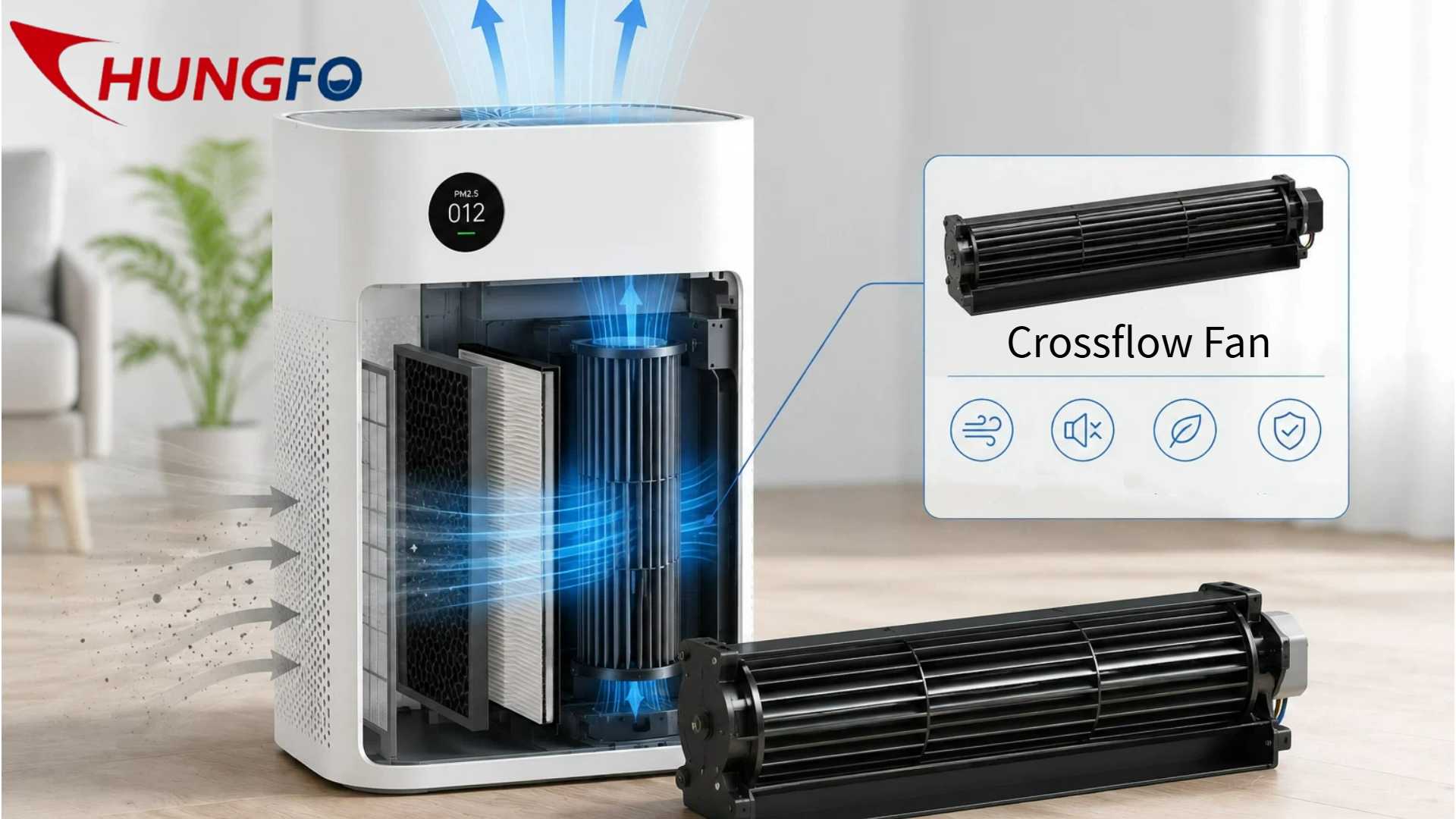
Unlike conventional axial fans that concentrate airflow in a relatively narrow direction, a Cross Flow Fan generates a long, uniform air curtain that distributes airflow evenly across the entire width of the filter. This unique airflow pattern allows more contaminated air to pass through the filtration system while reducing turbulence, improving both purification efficiency and user comfort.
Among today's intelligent air purification systems, the 12V Cross Flow Fan has become one of the preferred airflow solutions because it combines stable performance, compact dimensions, low operating noise, and excellent compatibility with intelligent electronic control systems.
Understanding how a Cross Flow Fan influences CADR can help product designers optimize purifier performance while enabling purchasing managers to select the most suitable airflow solution for their next-generation products.
What Is CADR and Why Does It Matter?
CADR, or Clean Air Delivery Rate, is one of the most important performance indicators used to evaluate air purifiers.
Rather than measuring only filter efficiency, CADR represents the actual volume of clean air an air purifier can deliver within a specific period of time. It combines filtration efficiency with airflow performance into a single measurable value.
For example, an air purifier equipped with an extremely efficient HEPA filter may still produce a relatively low CADR if insufficient air flows through the filter.
Conversely, a powerful airflow system without effective filtration cannot achieve a high CADR because contaminants remain suspended in the air.
For this reason, CADR reflects the complete performance of an air purification system rather than any individual component.
Consumers often compare CADR values before purchasing an air purifier because higher CADR ratings generally indicate faster air cleaning, larger recommended room coverage, and improved overall purification efficiency.
Manufacturers therefore devote considerable attention to optimizing every component affecting airflow, especially the fan system.
Why Airflow Is the Foundation of Air Purification
Many people assume that replacing the filter with a more efficient model automatically improves purification performance.
In reality, airflow is equally important.
Every air purifier relies on a continuous circulation process.
Contaminated indoor air enters the purifier through intake vents.
The fan pulls air through pre-filters, activated carbon filters, HEPA filters, and sometimes additional sterilization technologies such as ultraviolet light or plasma modules.
Finally, purified air returns to the room.
If airflow becomes restricted at any stage, the total amount of purified air decreases regardless of filter quality.
As filters gradually accumulate dust, airflow resistance increases even further.
A properly designed airflow system must therefore provide sufficient static pressure while maintaining efficient air circulation throughout the purifier.
This explains why engineers spend significant effort optimizing fan performance during product development.
A high-performance Brushless Fan not only improves airflow but also allows the purification system to maintain stable performance as filter resistance changes over time.
Why Cross Flow Fans Are Becoming Popular in Smart Air Purifiers
Traditional air purifiers often use axial fans or centrifugal blowers.
Although these fan types perform well in many applications, modern smart air purifiers increasingly require quieter airflow, thinner product profiles, and more uniform air distribution.
The Cross Flow Fan offers several advantages that directly address these design goals.
First, the elongated cylindrical impeller produces airflow across nearly the entire width of the purifier.
Instead of concentrating air into a narrow stream, the fan creates a smooth air curtain that covers a much larger filtration surface.
This allows the entire HEPA filter to participate in air purification rather than only localized areas.
Second, airflow generated by a Cross Flow Fan remains remarkably consistent across the outlet.
Uniform airflow improves filtration efficiency because every section of the filter experiences similar loading conditions.
Third, Cross Flow Fans generally operate at lower rotational speeds than many conventional cooling fans while still delivering substantial airflow.
Lower rotational speed contributes to reduced vibration and significantly quieter operation.
For residential air purifiers placed in bedrooms or living rooms, low acoustic noise has become a major purchasing factor.
Finally, the compact rectangular structure of a Cross Flow Fan allows manufacturers to design thinner, more attractive smart air purifiers without sacrificing airflow performance.
As minimalist home appliances become increasingly popular, this structural advantage has become particularly valuable.
How a 12V Cross Flow Fan Improves CADR Performance
The primary purpose of any air purifier is to process the maximum amount of contaminated air while maintaining excellent filtration efficiency.
A well-designed 12V Cross Flow Fan contributes to higher CADR through several mechanisms.
The first is increased airflow consistency.
Instead of creating concentrated high-velocity airflow, the fan distributes air evenly across the entire filter surface.
This reduces dead zones where air movement would otherwise remain limited.
The second advantage is improved filter utilization.
Because airflow reaches more of the filter area, dust loading becomes more evenly distributed.
Uniform loading extends filter service life while maintaining stable airflow over longer operating periods.
The third factor is lower turbulence.
Excessive turbulence wastes energy and generates unnecessary acoustic noise.
The smoother airflow produced by a Cross Flow Fan allows more air to pass through the filtration system with lower pressure loss.
The fourth advantage involves intelligent speed regulation.
Modern Brushless Fan technology allows the airflow system to adjust automatically according to indoor air quality detected by integrated particle sensors.
During periods of low pollution, the controller reduces fan speed to minimize noise and electricity consumption.
When particulate concentration rises rapidly, the purifier automatically increases airflow to maximize CADR.
This adaptive operation provides users with both excellent purification performance and superior energy efficiency.
Why Brushless Fan Technology Is Essential
The performance of a Cross Flow Fan depends not only on blade design but also on motor technology.
Modern smart air purifiers almost universally employ Brushless Fan motors because they deliver significant advantages over traditional brushed motors.
Brushless motors eliminate mechanical brush wear, resulting in much longer operating life and reduced maintenance requirements.
Electronic commutation provides smoother speed control, allowing airflow to respond precisely to changing indoor air quality.
Energy efficiency also improves substantially, an important consideration for appliances designed to operate continuously throughout the day.
Lower operating temperatures further enhance long-term reliability of both the motor and surrounding electronic components.
As intelligent home appliances become increasingly connected through IoT platforms, Brushless Fan technology provides the precise digital control necessary for advanced airflow management.
Static Pressure Is Just as Important as Airflow
Many people believe that increasing airflow alone will automatically improve CADR. In reality, airflow is only one part of the equation. Static pressure is equally important because every air purifier forces air through multiple layers of filtration material.
A modern smart air purifier typically contains a pre-filter, an activated carbon filter, a HEPA filter, and in some models, additional deodorizing or antibacterial layers. As air passes through these filters, resistance gradually increases. Dust accumulation over weeks or months of operation creates even greater airflow resistance.
If the fan cannot generate sufficient static pressure, airflow decreases significantly, causing the CADR rating to drop even though the filtration material remains highly efficient.
A well-designed Cross Flow Fan combines stable airflow with sufficient static pressure to overcome filter resistance while maintaining quiet operation. Engineers carefully optimize blade geometry, impeller diameter, motor torque, and airflow channels to achieve the ideal balance between airflow volume and pressure.
This balance allows the purifier to continue delivering clean air efficiently throughout the filter's service life rather than only when the filter is brand new.
Intelligent PWM Control Improves Both Performance and Energy Efficiency
Modern smart air purifiers no longer operate at a fixed speed throughout the day.
Instead, they continuously monitor indoor air quality using PM2.5 sensors, VOC sensors, humidity sensors, or other environmental monitoring devices.
The controller automatically adjusts the motor speed using Pulse Width Modulation, commonly known as PWM.
When indoor air remains relatively clean, the controller reduces motor speed. Lower airflow decreases operating noise while reducing electricity consumption.
When pollution levels suddenly increase because of cooking, smoking, seasonal pollen, or outdoor air entering the room, the controller immediately increases fan speed to process more air through the filtration system.
This intelligent adjustment allows the Cross Flow Fan to maintain excellent CADR while minimizing unnecessary energy use.
Because PWM provides highly accurate speed control, the Brushless Fan responds quickly without frequent mechanical stress, contributing to longer service life and improved user experience.
The combination of PWM control and brushless motor technology has therefore become one of the defining characteristics of today's premium smart air purifiers.
Why DC Cooling Fan Technology Continues to Grow
The rapid development of smart appliances has accelerated demand for high-efficiency DC Cooling Fan technology.
Compared with traditional AC motors, DC motors provide several significant advantages.
Power consumption is considerably lower.
Electronic speed regulation is much more precise.
Operating noise is reduced.
Motor efficiency improves across a wide speed range.
These characteristics are particularly important for products designed to operate continuously, such as air purifiers.
Lower electricity consumption reduces operating costs while helping manufacturers comply with increasingly strict global energy-efficiency regulations.
The compact structure of modern DC Cooling Fan products also gives industrial designers greater flexibility when creating thinner and more attractive smart appliances.
As intelligent temperature management and airflow control continue advancing, DC motor technology is expected to remain the preferred solution for future residential and commercial air purification equipment.
Comparing 12V and Fan 5 Volt Solutions
Product designers often ask whether a 12V airflow system or a fan 5 volt solution is the better choice.
The answer depends largely on the intended application.
A fan 5 volt design is commonly used in compact desktop air purifiers, portable personal air cleaners, USB-powered devices, automotive accessories, and other products where portability and low power consumption are priorities.
Although these systems provide adequate airflow for small enclosed spaces, their airflow capacity is naturally limited by the available electrical power.
For larger smart air purifiers designed to clean bedrooms, offices, conference rooms, or commercial environments, a 12V Cross Flow Fan generally provides much stronger airflow and higher static pressure.
The additional motor power enables the fan to overcome dense HEPA filters while maintaining stable airflow throughout long operating periods.
Consequently, most medium-sized and large air purification systems continue selecting 12V airflow solutions to achieve higher CADR ratings and larger room coverage.
Designing the Airflow System Around the Entire Purifier
Achieving a high CADR rating involves much more than selecting a powerful fan.
Engineers must optimize the entire airflow path inside the purifier.
The intake openings should minimize airflow resistance while preventing excessive noise.
Internal air channels should distribute airflow evenly across the complete filter surface.
The outlet design should reduce turbulence while directing purified air efficiently back into the room.
Even small design improvements can significantly increase overall purification efficiency.
Computational Fluid Dynamics, commonly known as CFD simulation, has become an essential engineering tool for optimizing airflow before physical prototypes are manufactured.
By analyzing airflow velocity, pressure distribution, turbulence, and dead zones, engineers can identify opportunities to improve performance while reducing unnecessary energy consumption.
When combined with a high-quality Cross Flow Fan and an efficient Brushless Fan motor, careful airflow design enables manufacturers to maximize CADR without increasing overall product size.
Why Global Manufacturers Choose Chungfo Fan
Reliable airflow begins with reliable manufacturing.
Chungfo Fan has focused on developing high-performance cooling and airflow solutions for more than twenty years, supplying OEM and ODM customers across Europe, North America, Southeast Asia, the Middle East, and many other international markets.
Our product range includes Cross Flow Fans, DC axial fans, AC axial fans, centrifugal blowers, frameless fans, and customized airflow systems designed for a wide variety of industrial and consumer applications.
Modern manufacturing facilities are equipped with automated production lines, precision balancing equipment, airflow laboratories, static pressure testing systems, acoustic testing rooms, high and low temperature chambers, and comprehensive quality inspection procedures.
Every Brushless Fan undergoes rigorous testing before shipment, including airflow measurement, speed verification, vibration analysis, electrical safety inspection, endurance testing, and reliability validation.
Our engineering team works closely with customers throughout every stage of product development.
We provide customized impeller design, PWM parameter optimization, motor performance adjustment, connector selection, cable customization, waterproof solutions, and OEM branding services.
Whether customers require a compact fan 5 volt solution for portable air purification products or a high-performance DC Cooling Fan for advanced smart air purifiers, Chungfo Fan delivers reliable manufacturing capabilities supported by experienced engineering expertise.
By combining precision manufacturing with continuous product innovation, we help customers improve purifier performance, reduce development time, and strengthen competitiveness in rapidly growing global markets.
Future Trends in Smart Air Purification
The future of air purification is becoming increasingly intelligent.
Artificial intelligence, Internet of Things technology, cloud connectivity, and environmental monitoring are transforming how air purifiers operate.
Instead of simply reacting to indoor pollution, future systems will predict changes in air quality by analyzing weather forecasts, outdoor pollution indexes, occupancy levels, and historical operating patterns.
Airflow systems will automatically adjust before pollution reaches uncomfortable levels.
At the same time, governments around the world continue introducing stricter energy-efficiency requirements and indoor air quality standards.
Manufacturers are therefore placing greater emphasis on intelligent airflow management, quieter operation, and reduced power consumption.
The Cross Flow Fan is expected to play an increasingly important role because its uniform airflow distribution, compact structure, and compatibility with Brushless Fan technology align perfectly with these future design trends.
As consumer expectations continue rising, intelligent airflow management will become just as important as filtration technology itself.
Conclusion
The CADR rating of a smart air purifier depends on far more than the quality of its HEPA filter. Airflow design, static pressure, motor efficiency, electronic speed control, and overall airflow distribution all work together to determine how much clean air a purifier can actually deliver.
A well-engineered 12V Cross Flow Fan significantly improves CADR by distributing airflow evenly across the entire filter surface, reducing turbulence, maintaining stable airflow under increasing filter resistance, and supporting intelligent PWM speed regulation.
Combined with advanced Brushless Fan technology and efficient DC Cooling Fan motor design, today's smart air purifiers achieve higher purification performance while operating more quietly and consuming less energy.
Selecting the right airflow solution requires careful consideration of airflow requirements, filter resistance, product dimensions, acoustic performance, energy efficiency, and long-term reliability.
With decades of manufacturing experience, advanced production capabilities, and a commitment to continuous innovation, Chungfo Fan continues providing dependable airflow solutions for global manufacturers of smart air purifiers. Whether developing compact products using a fan 5 volt configuration or large intelligent purification systems requiring high-performance 12V Cross Flow Fans, our engineering team is dedicated to delivering customized solutions that help customers achieve superior CADR performance, excellent product reliability, and lasting market success.