Categories
New Blog
Why Do Headlight Cooling Fans Produce a Buzzing Noise?
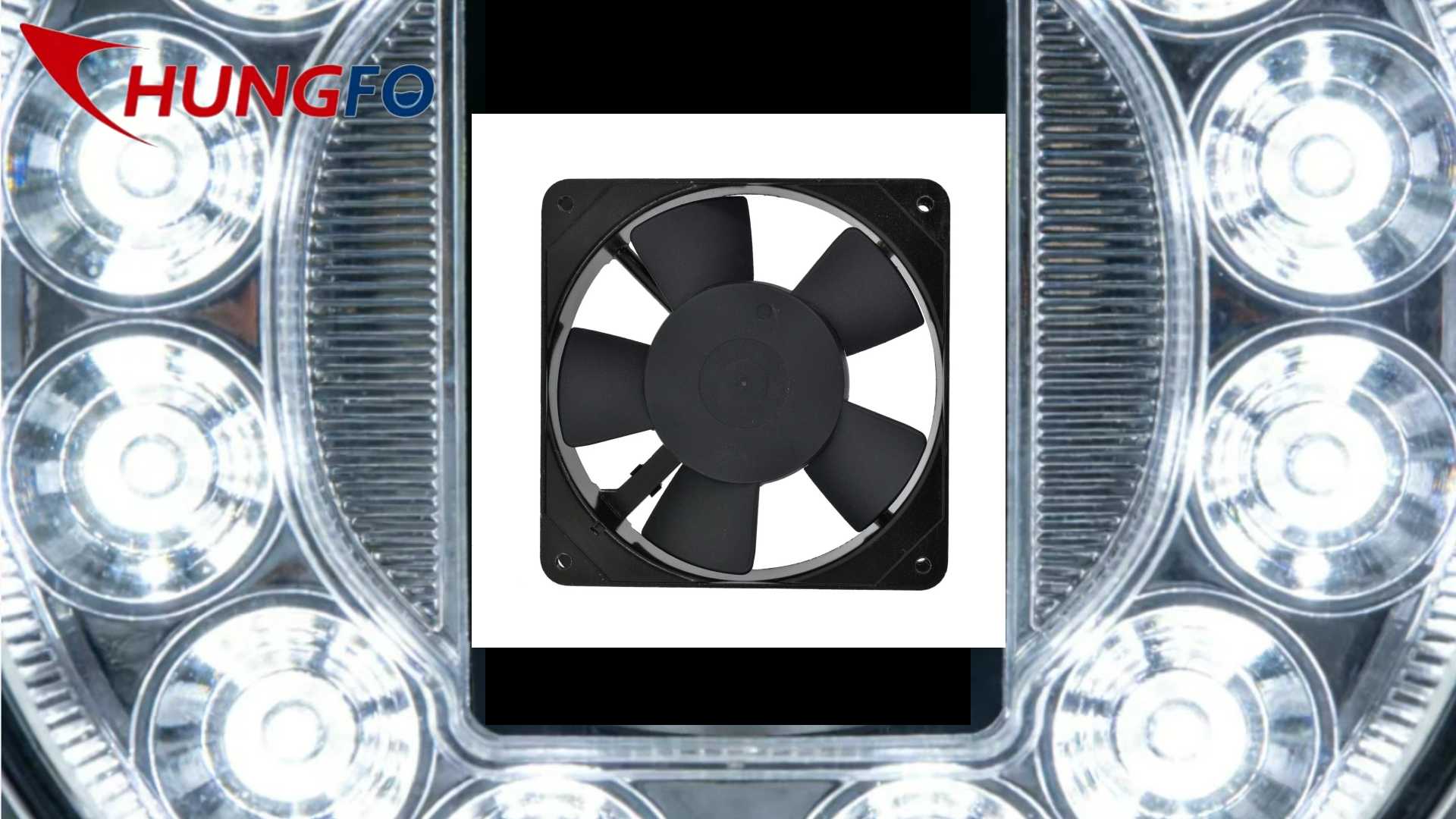
March 13 , 2026As LED automotive lighting continues to increase in brightness and power consumption, thermal management has become a critical aspect of headlight design. The headlight cooling fan is now widely used to ensure stable performance and prevent overheating in high-power LED systems.
However, engineers often notice that a DC cooling fan operates quietly during individual testing but becomes noticeably louder after being installed inside the headlight housing. This phenomenon is common in automotive lighting systems and is usually caused by multiple factors working together rather than a single problem.
Understanding the noise sources of a cooling fan can help manufacturers improve product design and reduce acoustic issues in automotive applications.
Aerodynamic Noise in Headlight Cooling Fans
Aerodynamic noise is one of the main contributors to noise in a headlight cooling fan. When the fan rotates at high speed, the blades interact with the surrounding air, creating turbulence and pressure fluctuations.
As the dc cooling fan blades cut through the air, vortices form behind the blades and generate airflow disturbances. In small high-speed fans commonly used in automotive lighting systems, aerodynamic noise increases rapidly with rotational speed. In many cases, the noise level rises exponentially as the fan speed increases.
Another important factor is airflow resonance inside the headlight housing. The headlight assembly often forms a semi-enclosed cavity. When the operating frequency of the cooling fan approaches the natural frequency of the enclosure, acoustic resonance occurs and amplifies the sound.
This explains why a fan measuring around 35 dB during open-air testing may reach more than 45 dB after installation in the headlight structure.
Mechanical Noise and Bearing Structure
Mechanical noise is another important factor affecting the acoustic performance of a dc cooling fan.
The bearing type used in a headlight cooling fan greatly influences noise characteristics and durability. Sleeve bearings are usually quiet in the beginning but may suffer from lubrication degradation at high temperatures. Single ball bearings provide moderate durability, while dual ball bearings offer longer service life and better temperature resistance, making them suitable for automotive environments.
However, if the bearing precision or lubrication quality is insufficient, high-frequency friction noise may occur.
In addition, electromagnetic noise generated by the brushless fan motor can contribute to overall sound levels. Magnetic switching and stator vibration during motor operation may create subtle high-frequency noise, especially when combined with structural resonance.
PWM Control and Hidden Noise Sources
Many automotive lighting systems control fan speed using PWM signals. While PWM control is efficient, improper settings can create unexpected acoustic issues.
If the PWM frequency is too low, the dc cooling fan motor may experience periodic torque pulsations, which lead to low-frequency humming noise. To avoid this problem, PWM frequencies above 20 kHz are typically recommended because they exceed the audible range of human hearing.
High-frequency PWM or voltage-based speed regulation can significantly improve the acoustic performance of a cooling fan in headlight applications.
Reducing Noise in Headlight Cooling Systems
Reducing noise in a headlight cooling fan requires a system-level approach rather than focusing on a single component.
Engineers can improve acoustic performance by optimizing blade design, reducing fan speed through larger fan sizes, and improving airflow pathways inside the headlight housing. Vibration isolation materials such as silicone pads can also help prevent structural resonance.
In addition, complete system testing is essential. Evaluating a dc cooling fan only under open-air conditions may not accurately represent real-world operating noise inside the headlight assembly.
By combining aerodynamic optimization, mechanical design improvements, and proper speed control strategies, manufacturers can significantly reduce noise in automotive headlight cooling systems.