Categories
New Blog
How Do EC Fans Improve Thermal Management in Battery Energy Storage Systems?
November 11 , 2026Quick Answer
EC fans improve thermal management in Battery Energy Storage Systems (BESS) by providing efficient, controllable, and reliable airflow for battery enclosures, electrical compartments, power conversion systems, and air-cooled heat exchangers. Their electronically commutated motors combine efficient motor operation with flexible speed control, allowing cooling output to respond to changing thermal loads.
Unlike conventional fixed-speed ventilation fans, EC fans can operate at different speeds according to temperature signals or external control commands. This helps reduce unnecessary fan energy consumption, maintain more consistent equipment temperatures, and support the long-term operating stability of energy storage installations.
However, EC fans are only one part of a complete thermal management strategy. Depending on battery chemistry, system capacity, enclosure design, and operating conditions, a BESS may require forced-air cooling, liquid cooling, dedicated HVAC equipment, or a combination of these technologies.
1. Introduction: Why Thermal Management Matters in Battery Energy Storage Systems
Battery Energy Storage Systems have become an important part of modern energy infrastructure. They help store electricity generated from renewable energy sources, balance power demand, stabilize electrical grids, and provide backup power for commercial, industrial, and residential applications.
As energy storage technology develops, battery systems are becoming larger, more compact, and more power-dense. Containerized battery storage installations can integrate thousands of battery cells, battery management systems, power conversion equipment, electrical protection components, and communication devices within a limited enclosure.
Although these systems provide significant energy management benefits, they also create a major engineering challenge: heat management.
During charging and discharging, battery cells generate heat because of internal resistance and electrochemical processes. Power conversion systems, inverters, transformers, and electrical control equipment also generate heat during operation.
If this heat is not effectively managed, temperatures inside the equipment enclosure may become uneven or exceed the recommended operating range of individual components.
High operating temperatures can accelerate battery degradation, reduce energy efficiency, increase cooling requirements, and shorten the service life of electrical equipment. Temperature differences between battery modules can also affect system consistency and performance.
For energy storage manufacturers and system integrators, thermal management is therefore not simply an auxiliary function. It is an important part of system design, operational reliability, and lifecycle cost management.
This is where Electronically Commutated (EC) fans become valuable.
EC fans combine efficient motor technology with electronic control functions. They can provide adjustable airflow according to actual cooling requirements, making them suitable for various ventilation and heat exchange applications in modern energy storage systems.
For BESS manufacturers, selecting an appropriate EC fan is not only about achieving a specified airflow rate. It also involves evaluating static pressure, operating temperature, control interfaces, installation dimensions, environmental protection, noise, and long-term reliability.
2. Understanding the Thermal Management Structure of a BESS
Before discussing the role of EC fans, it is necessary to understand how a typical Battery Energy Storage System manages heat.
A complete BESS generally includes several interconnected subsystems.
2.1 Battery Modules and Battery Racks
Battery modules are the primary energy storage units. Multiple modules are connected to form battery racks, which are installed inside cabinets or containerized enclosures.
During charging and discharging, battery cells produce heat. The amount of heat depends on several factors, including:
Battery chemistry and internal resistance.Charging and discharging current.Ambient temperature.State of charge.Operating duration.Battery age and condition.
The thermal management system must help maintain the battery modules within the temperature range specified by the battery manufacturer.
It must also minimize temperature differences between different modules and locations within the battery enclosure.
In air-cooled configurations, circulation fans can help move conditioned air through designated airflow channels. Proper airflow distribution is essential because a fan with high nominal airflow does not necessarily guarantee uniform cooling throughout the battery rack.
2.2 Battery Management System (BMS)
The Battery Management System monitors important battery operating parameters, including voltage, current, temperature, and state of charge.
Temperature sensors installed at different positions provide information about the thermal condition of battery cells and modules.
Based on these measurements, the BMS can communicate with higher-level controllers to adjust cooling requirements or trigger protective actions.
EC fans can work as part of this control architecture when their electrical interfaces and control functions are compatible with the system design.
For example, an external controller may use temperature measurements to adjust fan speed through a compatible PWM or 0-10V control interface.
The exact control strategy depends on the BMS, HVAC controller, and fan specifications.
2.3 Power Conversion System (PCS)
The Power Conversion System converts electrical energy between the battery and the AC power grid or connected loads.
It commonly includes power electronic components such as inverters, converters, semiconductor devices, and associated control circuits.
These components generate heat during power conversion.
Unlike battery modules, which may use liquid or dedicated air cooling, PCS compartments often use forced-air ventilation or dedicated heat exchange systems.
EC axial fans and EC centrifugal blowers can support airflow through these compartments, depending on the enclosure structure and required static pressure.
2.4 HVAC and Air Distribution Systems
Large energy storage installations may use integrated HVAC equipment to regulate internal temperature and humidity.
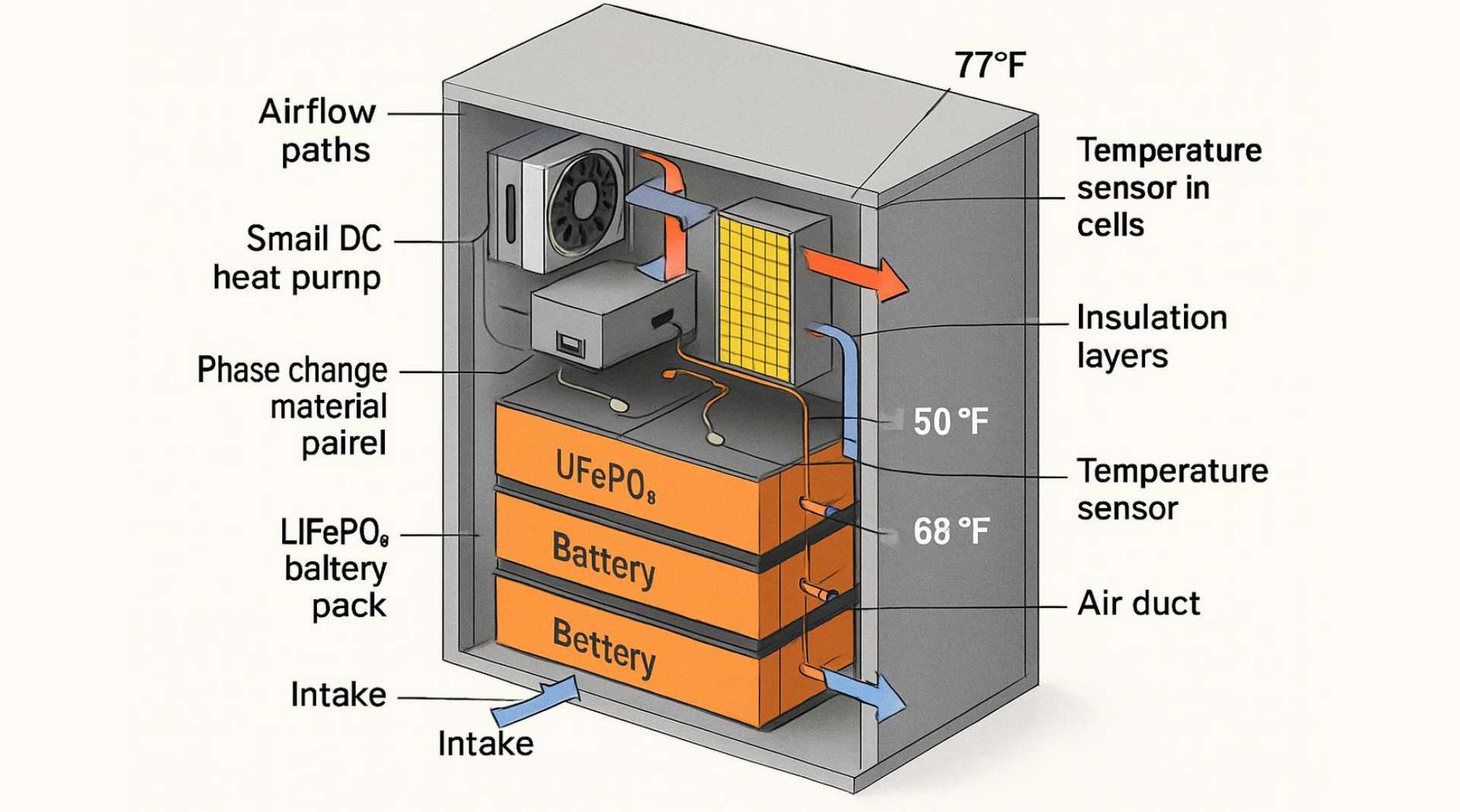
In air-cooled systems, fans circulate air through battery racks, cooling coils, heat exchangers, filters, and ventilation channels.
In liquid-cooled systems, pumps circulate coolant through battery modules or cold plates. The heated coolant then transfers energy to a heat exchanger, where fans can help reject heat to the surrounding air.
This means EC fans can still play an important role in liquid-cooled BESS installations, particularly in the air-side heat rejection process.
2.5 Environmental and Safety Monitoring
BESS installations may include smoke detection, gas detection, pressure monitoring, fire suppression, and dedicated exhaust ventilation.
These systems serve different safety functions and should not be confused with normal thermal management.
Cooler dc brushless fan used for temperature regulation are not automatically suitable for emergency gas extraction or hazardous-event ventilation.
The ventilation architecture must follow the applicable battery technology requirements, project hazard analysis, and local regulations.
3. How EC Fans Improve Thermal Management in BESS
EC fans provide several technical advantages that can support the thermal management requirements of energy storage systems.
3.1 Adjustable Airflow According to Cooling Demand
One of the most important advantages of EC fan technology is adjustable speed operation.
Traditional fixed-speed AC fans are often operated at a limited number of predefined speeds or through additional control equipment.
EC fans integrate electronic motor control functions, allowing their speed to be adjusted through compatible control signals.
In an energy storage system, cooling demand changes according to battery charging and discharging conditions, ambient temperature, electrical load, and operating schedules.
For example:
During standby operation, the thermal load may be relatively low.
During normal charging, battery temperatures may gradually increase.
During high-power charging or discharging, additional cooling may be required.
During high ambient temperatures, the cooling system may need to operate at a higher capacity.
An EC fan control system can adjust airflow according to these changing conditions.
Instead of operating continuously at maximum speed, the fan can run at an appropriate operating point based on the actual cooling requirement.
This can reduce unnecessary energy consumption while helping maintain stable internal temperatures.
3.2 Improved Energy Efficiency
Energy efficiency is an important consideration for BESS operators.
An energy storage installation consumes electricity not only through battery operation and power conversion but also through auxiliary systems such as cooling fans, pumps, controllers, and HVAC equipment.
Although individual cooling fans may have relatively small power ratings, their combined energy consumption can become significant when multiple fans operate continuously.
EC motors are designed to achieve efficient operation through electronic commutation and motor control.
When combined with variable-speed operation, EC fans can reduce unnecessary power consumption during periods of lower cooling demand.
Fan power consumption is strongly affected by operating speed. Under ideal fan-system conditions, airflow, pressure, and power approximately follow the fan affinity laws:
Airflow is approximately proportional to rotational speed.
Pressure is approximately proportional to the square of rotational speed.
Power is approximately proportional to the cube of rotational speed.
For example, under comparable operating conditions, reducing fan speed to 80% may reduce the theoretical fan power requirement to approximately 51.2% of the original value.
This relationship is an engineering approximation. Actual results depend on fan efficiency, system resistance, operating point, motor characteristics, and control strategy.
For BESS manufacturers, this means EC fans can help improve auxiliary cooling efficiency when the airflow system is properly designed.
3.3 More Stable Temperature Distribution
Temperature uniformity is an important objective in battery thermal management.
If certain battery modules receive insufficient airflow while other areas receive excessive airflow, the enclosure may develop localized temperature differences.
These differences can affect battery consistency and increase thermal management challenges.
EC fans can help address this issue through adjustable airflow and properly designed fan arrangements.
For example, multiple EC fans can be installed in a cabinet or container ventilation system to provide airflow across different battery rack sections.
When combined with suitable air ducts, baffles, sensors, and control logic, fan speed can be adjusted to improve airflow distribution.
However, temperature uniformity cannot be achieved through fan selection alone.
System designers must also evaluate:
Battery rack arrangement.Air inlet and outlet positions.Air duct dimensions.Pressure losses.Cooling coil locations.Air leakage.Temperature sensor distribution.
Computational Fluid Dynamics (CFD) analysis and prototype testing can help evaluate airflow distribution before mass production.
3.4 Support for Compact and Modular Energy Storage Designs
Modern BESS products increasingly use modular architectures.
Battery modules, electrical control units, and power conversion equipment are often installed in compact cabinets or standardized container structures.
Limited installation space creates challenges for fan selection.
A cooling fan must provide sufficient airflow while fitting the available mounting dimensions and airflow channels.
EC axial fans are suitable for many ventilation applications where relatively direct airflow paths are available.
EC centrifugal fans and blowers can be considered when the system contains filters, narrow air ducts, heat exchangers, or other components that create relatively high airflow resistance.
Their performance must be evaluated using the actual fan performance curve and the system resistance curve.
The goal is to achieve the required airflow at the actual operating static pressure rather than selecting a fan only by its maximum free-airflow rating.
3.5 Lower Operating Noise
Noise is another consideration in energy storage installations, especially for commercial buildings, residential backup systems, and projects located near populated areas.
Fan noise is affected by rotational speed, blade geometry, airflow turbulence, installation structure, and vibration.
Because EC fans support adjustable speed operation, their noise output can often be reduced during low-load operating conditions.
Appropriate fan selection and airflow design can also help prevent unnecessary turbulence.
For BESS manufacturers, low-noise cooling solutions can improve the overall acoustic performance of energy storage equipment.
However, noise performance should be evaluated using actual product test data under specified operating conditions.
3.6 Flexible Integration with Intelligent Control Systems
Modern energy storage systems rely on electronic monitoring and control.
EC fans with compatible interfaces can be integrated into broader control architectures.
Depending on the product configuration, possible control methods include:
PWM speed control.0-10V analog control.Temperature-based control through an external controller.Tachometer speed feedback.Alarm output.
Communication interfaces, where supported.
These functions can help system integrators coordinate cooling output with temperature monitoring and equipment operating conditions.
For example, when the temperature of a PCS compartment rises above a predefined threshold, the controller can increase fan speed.
When the temperature decreases, fan speed can be reduced.
If the selected fan supports speed feedback or fault signaling, the system may also monitor abnormal fan operation.
The availability of these functions must be confirmed against the specific EC fan model.
4. Where Are EC Fans Used in Battery Energy Storage Systems?
EC fans can be integrated into different parts of a BESS depending on the cooling architecture.
4.1 Battery Cabinet Cooling
Battery cabinets are commonly used in commercial and industrial energy storage applications.
Inside these cabinets, battery modules are arranged in compact spaces, making airflow distribution an important design consideration.
EC axial fans can provide forced airflow through ventilation channels or help circulate conditioned air inside the cabinet.
For air-cooled configurations, the design should ensure that air reaches the intended cooling surfaces rather than bypassing battery modules.
The selection process should consider cabinet dimensions, required airflow, pressure losses, temperature distribution, and environmental conditions.
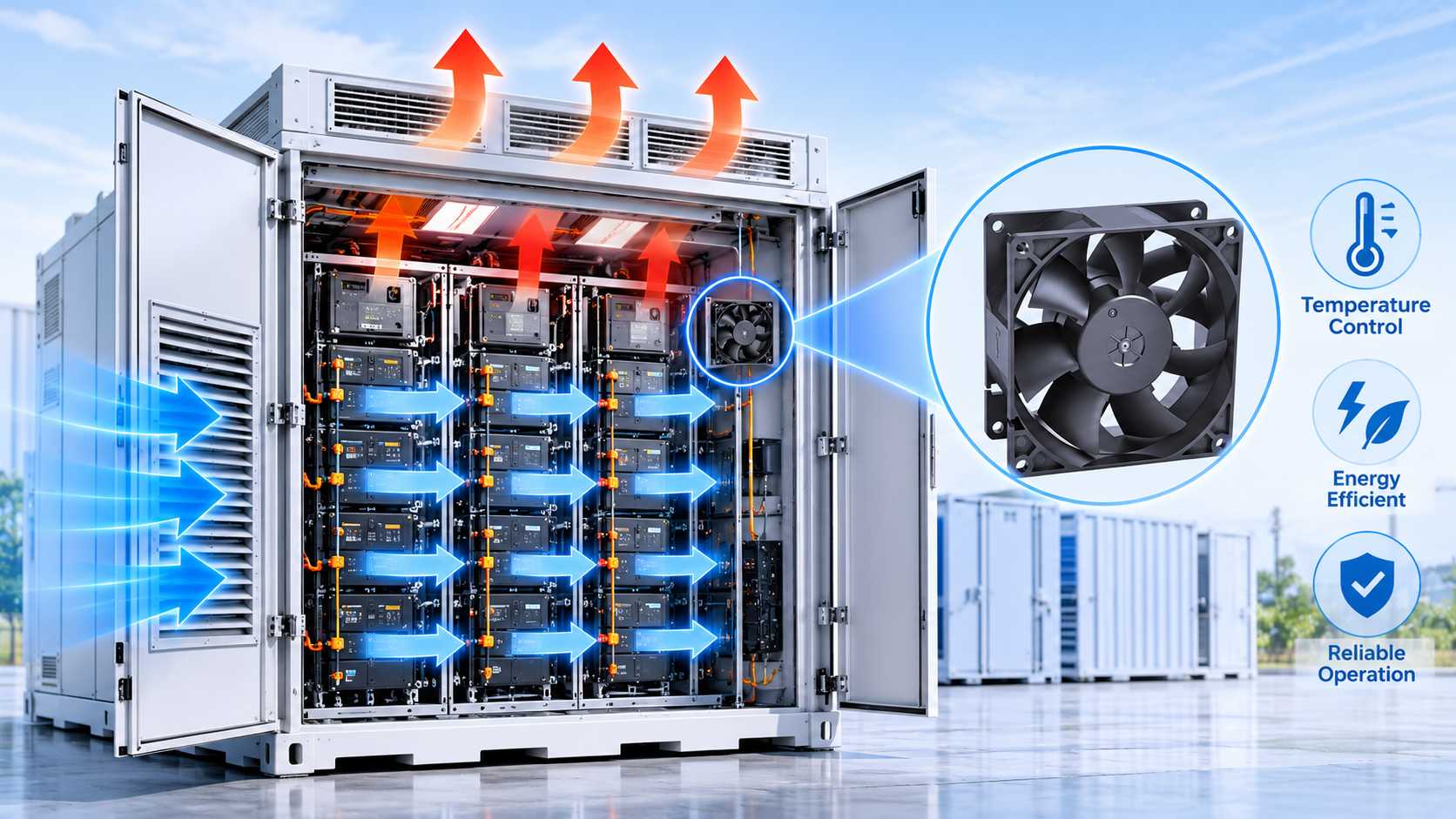
4.2 Containerized Energy Storage Systems
Containerized BESS installations integrate multiple battery racks and supporting equipment inside standardized outdoor enclosures.
Their thermal management systems may include HVAC units, cooling coils, circulation fans, ventilation openings, and external heat rejection equipment.
EC fans can be used in air circulation systems or integrated into HVAC equipment to support controlled airflow.
Large installations may use multiple fans working together.
In these cases, fan redundancy, maintenance accessibility, vibration, and the impact of a single fan failure should be evaluated during system design.
4.3 Power Conversion System Cooling
PCS equipment contains power electronic components that require effective heat dissipation.
EC axial fans can support ventilation through electrical cabinets, while EC centrifugal blowers can be considered for more complex internal air paths.
The selection depends on the heat generation of the equipment, required airflow, available installation space, and static pressure.
Proper cooling can help prevent excessive component temperatures and support stable power conversion performance.
4.4 Heat Exchanger and Liquid Cooling Systems
Liquid cooling is increasingly used in high-capacity battery storage systems.
A liquid cooling system transfers heat from battery modules to a coolant circuit.
The heated coolant then passes through a heat exchanger, where heat is released to the surrounding air.
EC fans can provide the airflow needed for the air-side heat exchange process.
In this configuration, fan performance affects the heat exchanger's ability to reject heat.
Engineers must consider the heat exchanger's air resistance, required airflow, ambient temperature, and acceptable noise level.
This is an important application because it demonstrates that EC fans are relevant to both air-cooled and liquid-cooled BESS architectures.
4.5 Electrical Control Cabinets and Auxiliary Equipment
In addition to battery modules and PCS equipment, energy storage systems contain control cabinets, communication devices, power supplies, and monitoring equipment.
These components may also require localized cooling.
Compact EC fans can provide ventilation for small electrical enclosures where installation space is limited.
The fan should be selected according to the enclosure's heat generation, ventilation requirements, ingress protection needs, and operating environment.
5. EC Axial Fans vs. EC Centrifugal Fans for BESS Applications
Different cooling positions require different airflow characteristics.
Choosing the correct fan type is important for system efficiency and thermal performance.
5.1 EC Axial Fans
EC axial fans move air mainly along the direction of the fan shaft.
They are commonly used in applications requiring relatively high airflow and comparatively straightforward ventilation paths.
Typical BESS applications include:
Battery cabinet ventilation.
Electrical cabinet cooling.
Container air circulation.
HVAC heat exchanger cooling.
Outdoor equipment enclosure ventilation.
Their advantages include compact installation, relatively direct airflow, and flexible speed control.
However, the fan must be selected according to the actual static pressure requirement.
An axial fan that provides high airflow in free-air conditions may deliver significantly less airflow when installed behind filters, grilles, or restrictive ducts.
5.2 EC Centrifugal Fans and Blowers
EC centrifugal fans use an impeller to accelerate air outward and convert rotational energy into airflow pressure.
They are suitable for applications where air must pass through relatively restrictive airflow paths.
Typical applications include:
Air handling units.
Filtered ventilation systems.
Compact cooling modules.
Heat exchanger airflow systems.
Internal equipment cooling channels.
Compared with many axial fan configurations, centrifugal fans can provide higher pressure capability in appropriately designed systems.
Their actual performance depends on impeller geometry, housing design, motor characteristics, and operating speed.
5.3 Comparison Table
|
Evaluation Factor |
EC Axial Fan |
EC Centrifugal Fan |
|
Airflow direction |
Along fan shaft |
Radial discharge |
|
Typical application |
Cabinet and container ventilation |
Ducted and high-resistance airflow |
|
Installation |
Often straightforward |
May require a designed housing |
|
Static pressure |
Depends on design; often moderate |
Suitable for higher-resistance systems |
|
Common BESS position |
Battery cabinets, HVAC units |
Filters, ducts, compact cooling modules |
|
Selection priority |
Airflow and installation dimensions |
Airflow and operating pressure |
Neither type is universally better.
The correct choice depends on the actual airflow path, thermal load, installation structure, and system operating conditions.
6. EC Fans vs. Traditional AC Fans in Energy Storage Systems
Energy storage manufacturers often need to balance cooling performance, energy consumption, control flexibility, and maintenance requirements.
|
Comparison Factor |
EC Fan |
Traditional AC Fan |
|
Motor technology |
Electronically commutated motor |
AC induction or other AC motor design |
|
Speed adjustment |
Electronic control depending on model |
May require additional control equipment |
|
Partial-load operation |
Supports flexible speed operation |
Depends on motor and control configuration |
|
Energy efficiency |
Generally offers strong efficiency potential |
Varies by motor and operating point |
|
Control integration |
PWM, 0-10V, or other supported interfaces |
Depends on product and external equipment |
|
System design |
Requires compatible electronic control |
May offer simpler fixed-speed installation |
|
Application |
Intelligent and variable-load systems |
Fixed-speed or conventional ventilation |
EC fans are particularly attractive when cooling requirements change frequently.
For example, a battery energy storage installation may operate under different charging, discharging, and standby conditions.
A variable-speed fan can adapt airflow to these changes rather than continuously operating at a fixed speed.
However, replacing an existing AC fan with an EC fan does not automatically guarantee energy savings.
Engineers must compare actual operating points, fan curves, input power, control strategies, and installation conditions.
7. How to Select the Right EC Fan for a Battery Energy Storage System
Selecting an EC fan for BESS applications requires more than checking the fan diameter and rated voltage.
System integrators should evaluate several technical parameters.
7.1 Airflow Requirement
Airflow is usually expressed in CFM or m³/h.
The required airflow depends on the amount of heat that must be removed and the acceptable temperature difference between the incoming and outgoing air.
For a simplified air-cooling calculation:
Q = ρ × Cp × V × ΔT
Where:
Q = Heat transfer rate.
ρ = Air density.
Cp = Specific heat capacity of air.
V = Volumetric airflow rate.
ΔT = Air temperature difference.
This formula provides an initial engineering estimate.
Actual BESS cooling calculations must also consider heat distribution, thermal resistance, air leakage, heat exchanger performance, ambient conditions, and the battery manufacturer's operating limits.
7.2 Static Pressure
Static pressure is essential when a fan operates inside a restrictive enclosure.
Filters, protective grilles, ducts, cooling coils, and heat exchangers all introduce airflow resistance.
A fan should be selected according to the airflow required at the system's actual operating static pressure.
The fan performance curve should be compared with the system resistance curve to identify the operating point.
Selecting a fan solely according to its maximum airflow can lead to insufficient cooling after installation.
7.3 Operating Voltage and Power Consumption
The rated voltage and electrical input must match the system power architecture.
Common fan power configurations may include different DC voltage ratings or integrated EC motor configurations.
Engineers should confirm:
Rated voltage.Operating voltage range.Rated current.Input power.Starting characteristics.Maximum operating conditions.
The electrical design should also account for startup behavior, power supply capacity, and protection requirements.
7.4 Speed Control and Feedback
For intelligent BESS applications, control compatibility is particularly important.
Before selecting an EC fan, buyers should confirm whether the product supports the required control method.
Possible requirements include PWM input, 0-10V input, tachometer output, alarm signals, or communication functions.
Not every EC fan provides all these functions.
Therefore, the control interface should be clearly specified during the design and quotation process.
7.5 Operating Temperature
Energy storage systems may be installed in regions with significant seasonal temperature changes.
The fan's permitted operating temperature range must be suitable for the actual installation environment.
Engineers should consider both ambient temperature and the temperature of air entering the fan.
The motor, electronic components, bearings, housing materials, and wiring should all be evaluated for the expected operating conditions.
7.6 Ingress Protection and Environmental Resistance
Outdoor energy storage systems may be exposed to dust, moisture, rain, condensation, and temperature fluctuations.
Depending on the installation environment, an appropriate IP protection level may be required.
The required protection should be determined according to the enclosure design and project conditions.
Engineers should also consider corrosion resistance, material compatibility, cable protection, and connector sealing.
An IP rating should never be assumed simply because a fan is intended for industrial use.
7.7 Noise and Vibration
Noise and vibration can affect the overall performance and serviceability of energy storage equipment.
Fan imbalance, inappropriate mounting, turbulence, and structural resonance can increase noise.
Dynamic balancing, suitable mounting structures, and optimized airflow paths are important.
For installations close to commercial or residential buildings, acoustic requirements should be included in the initial fan selection process.
7.8 Service Life and Reliability
Energy storage systems are generally designed for long-term operation.
Cooling fans may operate for extended periods and experience repeated changes in speed and environmental conditions.
Buyers should evaluate bearing technology, motor design, thermal protection, insulation, vibration performance, and reliability test data.
It is also important to understand the fan's maintenance requirements and the availability of replacement models.
8. The Role of EC Fans in Energy Efficiency and Lifecycle Cost Reduction
The energy consumption of a BESS is not limited to the battery and power conversion system.
Auxiliary equipment also contributes to the total operating cost.
Cooling fans, pumps, HVAC systems, and control equipment consume electricity during normal operation.
For large installations, even relatively small improvements in auxiliary equipment efficiency can become meaningful over an extended operating period.
EC fans can contribute to lifecycle cost optimization in several ways.
First, variable-speed operation allows the cooling system to respond to changing thermal loads.
Second, efficient motor operation can reduce the electricity consumed by ventilation equipment.
Third, intelligent control can help avoid unnecessary maximum-speed operation.
Fourth, suitable fan performance can support the overall efficiency of heat exchangers and air distribution systems.
A simplified annual energy consumption calculation is:
E = P × t
Where:
E = Annual electrical energy consumption.
P = Average electrical input power.
t = Annual operating time.
For variable-speed fans, average power should be calculated using the actual operating schedule rather than the rated maximum input.
A proper comparison should consider the total energy consumed by the cooling system, not only the fan motor.
This is especially important when comparing air-cooled and liquid-cooled energy storage designs.
The pump, heat exchanger, HVAC equipment, and other auxiliary components should all be included in the analysis.
9. Safety Considerations: EC Fans and Battery Thermal Management
Safety is one of the most important aspects of BESS engineering.
Battery thermal management should not be treated as a simple ventilation problem.
The design must distinguish between normal heat removal, abnormal temperature protection, gas management, and emergency response.
9.1 Normal Operating Temperature Control
During normal operation, cooling equipment helps maintain battery and electrical components within their specified temperature ranges.
EC fans may provide controlled airflow through battery cabinets, HVAC equipment, or heat exchangers.
Temperature sensors and control systems should be positioned appropriately to detect relevant thermal conditions.
9.2 Thermal Runaway Is a Different Safety Challenge
Thermal runaway is a serious battery failure event involving self-heating and potentially rapid heat release.
It may result in gas generation, fire, and propagation to nearby battery cells or modules.
Normal cooling fans cannot be considered a complete thermal runaway prevention or mitigation system.
The BESS safety design must be based on battery chemistry, cell-level test data, system architecture, hazard analysis, and applicable safety standards.
9.3 Gas Detection and Emergency Ventilation
Some battery failure scenarios may produce gases that create fire or explosion hazards.
Gas detection and ventilation requirements depend on battery chemistry, enclosure design, and the applicable codes.
Emergency exhaust ventilation may require dedicated equipment, special construction, redundant power, monitoring, and interlocks.
It should not automatically share the same design assumptions as ordinary temperature-control fans.
The fan selected for normal HVAC cooling is not necessarily suitable for emergency gas extraction.
9.4 Relevant Standards and Testing
BESS manufacturers and project developers should evaluate applicable standards and regulations, including:
UL 9540: Energy Storage Systems and Equipment.
UL 9540A: Test Method for Evaluating Thermal Runaway Fire Propagation in Battery Energy Storage Systems.
NFPA 855: Standard for the Installation of Stationary Energy Storage Systems.
Applicable electrical safety, environmental, and installation requirements.
These standards address different aspects of energy storage system safety and installation.
Fan selection should be coordinated with the overall system certification and safety engineering process.
An EC fan's own product certification does not automatically certify the complete BESS or its thermal management architecture.
10. Why Customized EC Fan Solutions Matter for BESS Manufacturers
Different energy storage systems have different structures and operating requirements.
A residential battery cabinet, a commercial energy storage unit, and a utility-scale containerized BESS may require completely different cooling configurations.
Standard fan products can meet many basic requirements, but some applications need customized solutions.
10.1 Customized Dimensions and Mounting Structures
The available installation space may be limited by battery racks, electrical components, and enclosure structures.
Fan dimensions, mounting hole positions, housing thickness, and connector locations may need to match the equipment design.
A suitable customized fan can help simplify installation and improve compatibility with the cooling module.
10.2 Customized Airflow and Static Pressure
Different cooling applications require different airflow characteristics.
Some systems prioritize high airflow, while others require higher static pressure to overcome resistance from ducts and filters.
Fan blade geometry, impeller structure, motor performance, and housing design all influence the final result.
The selected fan should be evaluated at the intended operating point.
10.3 Electrical and Control Customization
OEM customers may require specific voltage configurations, wire arrangements, connectors, control signals, or feedback functions.
These requirements should be discussed before mass production.
For intelligent cooling systems, electrical compatibility is just as important as airflow performance.
10.4 Material and Environmental Requirements
Fan housing materials, impeller materials, wire insulation, bearings, and connectors should be selected according to the installation environment.
Outdoor equipment may require enhanced environmental resistance.
High-temperature applications may require materials and components suitable for the actual operating conditions.
10.5 Testing and Quality Management
For long-term industrial applications, product consistency and testing are essential.
Important evaluation items may include:
Airflow and static pressure testing.Electrical performance testing.Temperature rise testing.Noise testing.Vibration and dynamic balancing.High-temperature and low-temperature testing.Humidity testing.Salt spray testing where relevant.Insulation and electrical safety testing.
The specific test program should be established according to product specifications and customer requirements.
11. How China Chungfo Fan Supports Industrial Fan Applications
China Chungfo Fan is engaged in the research and development, manufacturing, and sales of DC and AC fans, blowers, cross-flow fans, and related motor products.
For industrial customers, fan selection involves more than choosing a standard model.
Different equipment manufacturers may have different requirements for airflow, static pressure, installation dimensions, voltage, electrical connections, noise, and operating environments.
China Chungfo Fan supports customers through product development, technical communication, OEM customization, and manufacturing coordination.
11.1 Integrated Manufacturing Capabilities
China Chungfo Fan benefits from an integrated manufacturing structure covering product design and development, mold development, injection molding, SMT, fan assembly, sales, and after-sales service.
This manufacturing structure helps coordinate different production stages and supports product customization requirements.
11.2 Product Testing and Quality Control
Industrial fan applications require consistent product performance.
Manufacturing and quality evaluation can involve equipment such as dynamic balancing testers, wind tunnel and pressure testing equipment, high- and low-temperature chambers, noise testing facilities, salt spray testing equipment, and electrical testing instruments.
These testing capabilities support product evaluation and manufacturing quality management.
The required inspection and validation procedures should be determined according to the customer's product specifications.
11.3 OEM and Customized Fan Development
For BESS manufacturers and industrial equipment developers, customized fan solutions may involve:
Fan dimensions and mounting structures.
Rated voltage and electrical parameters.
Airflow and static pressure requirements.
Wire length and connector configuration.
Motor and impeller design.
Control and feedback requirements.
Environmental protection requirements.
China Chungfo Fan can communicate with customers about these requirements and evaluate suitable fan solutions according to the application.
11.4 Supporting Different Industrial Cooling Applications
In addition to energy storage equipment, industrial fans and blowers are used in various applications, including HVAC systems, refrigeration equipment, electrical enclosures, air purification systems, medical equipment, and industrial machinery.
Experience in different fan structures and manufacturing processes provides a foundation for evaluating customized cooling requirements.
For customers developing new energy storage equipment, early communication about airflow, pressure, electrical specifications, and installation conditions can help improve fan selection and system integration.
12. Future Trends: Intelligent and Energy-Efficient Cooling for BESS
The energy storage industry is moving toward higher energy density, larger installation capacity, improved system integration, and more intelligent operation.
These developments will continue to increase the importance of thermal management.
Several trends are particularly relevant to EC fan applications.
12.1 Intelligent Variable-Speed Cooling
Future cooling systems will increasingly use temperature monitoring and control algorithms to adjust fan operation.
Rather than relying on fixed-speed operation, fans may respond to multiple temperature zones and equipment operating conditions.
This can improve cooling flexibility and reduce unnecessary auxiliary energy consumption.
12.2 Modular Cooling Architecture
Modular battery designs require flexible cooling solutions.
Fan modules may be integrated into standardized battery cabinets, PCS units, and containerized equipment.
Modular fan arrangements can also simplify maintenance and replacement.
12.3 Integration with Liquid Cooling
Air cooling and liquid cooling are not necessarily competing technologies.
Many modern systems use liquid cooling for battery modules and air-side fans for heat exchanger operation.
This combined architecture creates opportunities for efficient EC fan applications.
12.4 Improved Monitoring and Predictive Maintenance
EC fans equipped with appropriate feedback functions can provide operating information such as rotational speed or fault status.
When integrated with the system controller, this information can help identify abnormal operating conditions.
Future systems may combine fan operating data, temperature measurements, and maintenance records to improve equipment monitoring.
However, predictive maintenance requires suitable sensors, reliable data collection, and effective diagnostic algorithms.
12.5 Higher Expectations for Reliability and Environmental Adaptability
Energy storage projects are installed in different climates and environments.
Cooling equipment must therefore be selected according to ambient temperature, humidity, dust exposure, corrosion risks, and operating duration.
Reliability testing and environmental adaptability will remain important considerations for fan manufacturers and system integrators.
13. Frequently Asked Questions About EC Fans for Battery Energy Storage Systems
Q1: What is the main function of EC fans in battery energy storage systems?
EC fans provide controlled airflow for battery enclosure ventilation, electrical equipment cooling, HVAC systems, and heat exchanger applications. They help remove heat and maintain appropriate operating conditions for system components.
Q2: Can EC fans be used in containerized battery energy storage systems?
Yes. EC fans can be integrated into air circulation systems, HVAC equipment, and heat exchangers in containerized BESS installations. The fan type and performance must match the system's airflow and pressure requirements.
Q3: Are EC fans more energy-efficient than traditional AC fans?
EC fans generally offer strong energy efficiency potential, particularly in applications requiring variable-speed operation. Actual energy savings depend on the fan design, operating point, system resistance, control strategy, and operating schedule.
Q4: Can EC fans replace liquid cooling in BESS?
Not necessarily. EC fans and liquid cooling serve different thermal management functions. Liquid cooling may remove heat directly from battery modules, while EC fans can support air-side heat rejection through heat exchangers. The appropriate architecture depends on battery capacity, thermal load, and system design.
Q5: Which is better for BESS applications: EC axial fans or EC centrifugal fans?
EC axial fans are often suitable for relatively direct ventilation paths and high-airflow applications. EC centrifugal fans are useful in systems with filters, ducts, and higher airflow resistance. Selection should be based on the actual system operating point.
Q6: Can EC fans adjust their speed automatically?
Yes, if the fan and control system support the required control interface. PWM, 0-10V, and other control methods may be available depending on the model. Automatic adjustment usually requires a suitable external controller or compatible temperature-control system.
Q7: What fan specifications should BESS manufacturers check?
Important specifications include rated voltage, current, input power, airflow, static pressure, speed, control interface, operating temperature, IP protection, noise, vibration, dimensions, and expected service life.
Q8: Are standard industrial fans suitable for outdoor energy storage systems?
Not automatically. Outdoor installations may require appropriate protection against dust, moisture, temperature fluctuations, and corrosion. The fan and enclosure protection should be evaluated together.
Q9: Can EC fans prevent battery thermal runaway?
No. EC fans can support normal thermal management but cannot independently prevent or control thermal runaway. BESS safety requires a comprehensive design incorporating battery protection, monitoring, hazard mitigation, fire protection, and applicable safety standards.
Q10: Why should BESS manufacturers work with an experienced fan supplier?
A qualified fan supplier can help evaluate airflow requirements, static pressure, motor performance, installation dimensions, electrical compatibility, and customization needs. Early technical communication can reduce integration difficulties and improve the suitability of the cooling solution.
Conclusion
Thermal management is a fundamental requirement for reliable Battery Energy Storage Systems.
As energy storage installations become larger and more sophisticated, manufacturers need cooling solutions that combine efficient operation, flexible control, suitable airflow, and long-term reliability.
EC fans provide important advantages through electronically controlled motor operation and adjustable airflow. They can support battery cabinet ventilation, containerized BESS cooling, PCS equipment ventilation, HVAC systems, and liquid-cooling heat exchangers.
However, successful thermal management depends on the complete system design. Airflow, static pressure, heat distribution, control compatibility, environmental conditions, and safety requirements must all be considered.
For BESS manufacturers and industrial equipment developers, selecting the right fan supplier is an important part of product development.
With its fan manufacturing capabilities, product development experience, and OEM customization support, China Chungfo Fan aims to provide suitable industrial fan solutions for customers with different cooling requirements.
As the global energy storage industry continues to expand, efficient and intelligently controlled fan technology will remain an important part of modern thermal management systems.