
Categories
New Blog
Refrigerator Cooling Showdown: Under-Frame vs. Side Heat Dissipation, and the Hardcore Decoding of the "Fan Technology"
May 11 , 2026In modern home aesthetics, kitchen integration has become an irreversible trend. Refrigerators, which once had to maintain an awkward distance from cabinets due to "whooshing" hot air, are now undergoing a profound technological transformation. When we shop for refrigerators, we often see the terms "under-frame cooling" or "side heat dissipation" on the spec sheet.
This is not just a difference in installation methods. Behind it lies a comprehensive technological evolution involving fluid mechanics, thermodynamics, and core components—specifically, the refrigerator cooling fan. Today, we will delve into the underlying logic, deeply analyze the differences between these two cooling methods, and reveal what qualities the silent worker behind efficient cooling truly needs.
1. First Generation vs. Advanced: The Principle Debate of Two Cooling Methods
To understand the difference, we must first look at how a refrigerator works. Refrigerators don't create cold; they are "porters" of heat. The compressor compresses the refrigerant into a high-temperature, high-pressure gas, which then passes through the condenser (the pipe or panel that feels hot) to release heat into the outside air. If the refrigerator doesn't dissipate heat well, the cooling effect suffers.
1. Side Heat Dissipation: The Classic "Natural Convection"
Traditional refrigerators mostly use side heat dissipation. In these, the condenser is usually attached to the inner walls of the refrigerator's sides.
Principle: Using thermal conduction, heat transfers from the refrigerant to the steel outer shell of the refrigerator, and then radiates into the air.
Characteristics: Being passive, the efficiency is relatively low. To ensure air circulation, a gap of 10-20 cm must be reserved on both sides; otherwise, the refrigerator can overheat and even burn out the compressor. This explains why many people struggle with the "hard-to-clean dust" issue-1-9.
2. Under-Frame Cooling: The "Black Technology" of the Built-in Era
Under-frame cooling is the mainstream solution for high-end built-in refrigerators in recent years. It moves the condenser from the sides to the bottom front of the refrigerator.
Principle: Instead of relying on passive radiation, under-frame cooling forcibly activates the refrigerator cooling fan. The fan draws cool air from the bottom, forces it over the condenser, and expels the heat directionally from the bottom vent-9.
Characteristics: This is active heat exchange. Because the air is forced out, the heat dissipation efficiency is extremely high. Consequently, the sides of the refrigerator can be placed flush against the cabinets (requiring only 0.5-2 cm) to achieve a "zero-embed" or "flat-embed" look, enhancing aesthetics and saving space.
2. Deep Dive: Which Cooling Method is Better?
Many people wonder: since under-frame cooling is the newer technology, does that mean side cooling is "obsolete"?
In reality, both have pros and cons, and the best choice depends on your specific living scenario.
1. Heat Dissipation Efficiency and Space Utilization
From a physics perspective, under-frame cooling has clear advantages. By utilizing a refrigerator cooling fan, the heat carried away by the airflow is much higher than natural radiation. This allows designers to make refrigerators thinner and larger in capacity without worrying about side panels overheating and deforming kitchen countertops.
While side cooling takes up more space, it has a hidden advantage: because it relies on a large metal surface for heat dissipation, it can be completely silent during winter or low-load conditions. Without a fan running, besides the slight hum of the compressor, you hear almost no noise.
2. The Trade-off Between Energy Consumption and Maintenance
There's an open secret in the industry: many entry-level under-frame cooling refrigerators can actually consume more electricity than side-cooling models of the same size.
Why? Because under-frame cooling heavily relies on the fan's operation. If the fan is inefficient or has insufficient air pressure, heat builds up at the bottom, causing inaccurate temperature control and frequent compressor cycling. Thus, the quality of the refrigerator cooling fan directly determines the success or failure of an under-frame cooling refrigerator.
Side-cooling refrigerators have a much simpler structure with fewer potential failure points, often leading to a longer lifespan. They are better suited for budget-conscious users or those placing the refrigerator in well-ventilated areas like living rooms or dining rooms.
3. Core Hardware: The Strict Demands of Different Cooling Solutions on "Fans"
Whether you are a refrigerator engineer or a DIY enthusiast, when dealing with an under-frame cooling refrigerator or planning to modify a cooling system, you'll find that in this micro-world, small dc fan, refrigerator cooling fan, and brushless fan dc 12v are the core keywords.
1. Why is the Fan the "Achilles' Heel" of Under-Frame Cooling?
In an under-frame cooling system, the air path is "inlet air → condenser → outlet air." The space is extremely narrow and presents significant resistance.
Heat Dissipation Requirement: The condenser typically operates at 40°C to 60°C, and its environment is often a magnet for dust accumulation.
Longevity Requirement: Refrigerators typically run continuously for over a decade, meaning the fan needs durable, round-the-clock operation capabilities.
2. Side vs. Under-Frame: Differentiated Fan Requirements
Side Cooling (Fanless/high-end frost-free) : Rarely relies on a fan; depends on natural convection.
Under-Frame Cooling (Forced Air Cooling) : Must be equipped with a high-performance fan. Here, the refrigerator cooling fan becomes the primary choice.
4. Technical Deep Dive: Why is the Axial Fan the Golden Partner for Refrigerator Cooling?
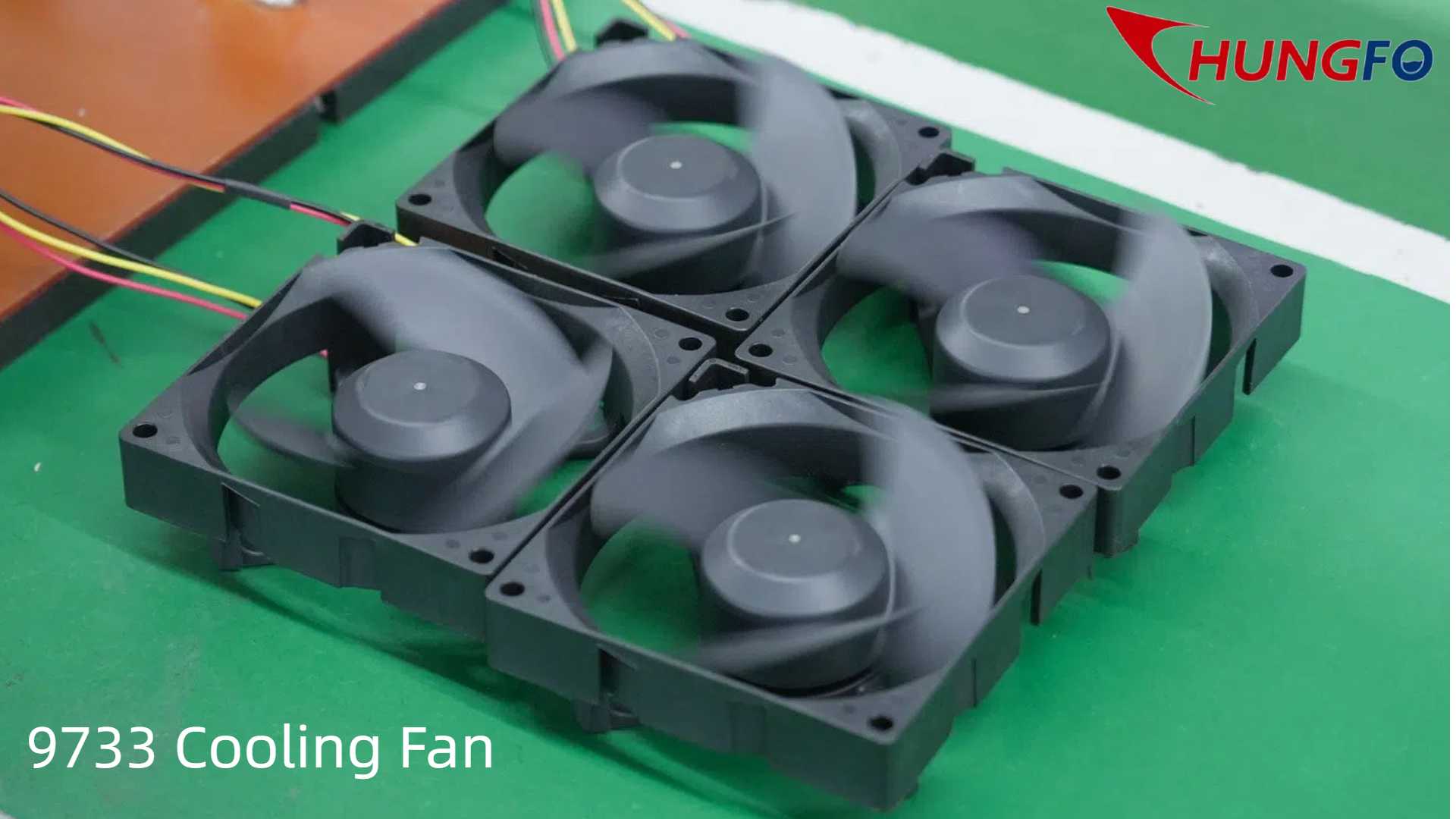
Not just any airflow-generating device can work in that cramped space at the bottom of a refrigerator. Here we need to introduce the concept of the axial flow fan.
Compared to a centrifugal fan (turbofan), the axial flow fan (like a propeller or exhaust fan blade) has the following characteristics:
High Airflow: It generates a large volume of airflow parallel to its axis.
Low Pressure Head: Although the pressure isn't as high as a centrifugal fan, for a refrigerator condenser's not-very-dense fin structure, the static pressure of an axial fan is just right.
Low-Profile Design: It fits perfectly into spaces only a few centimeters high at the bottom of a refrigerator.
In the technical labs of China Chungfo Fan, engineers have conducted thousands of hours of simulation tests for refrigerator cooling scenarios. These tests show that a high-quality refrigerator cooling solution must precisely match the following parameters:
Compact Design: Standard sizes like 60mm, 80mm, or 92mm square, with thicknesses of only 15mm-25mm.
High Static Pressure: must be able to "penetrate" the resistance of the condenser fins.
Reference Case:
The D12038 series axial flow fan from China Chungfo Fan, in a 120mm form factor, achieves static pressure of 11.00 mmAq and airflow up to 144 CFM. This means even if your refrigerator is fully embedded in a cabinet, it can still powerfully draw in cool air from the bottom and expel the heat-2.
5. Selection Bible: Why is the 12v Fan the Mainstream Voltage for Refrigerator Cooling?
In fan selection, voltage rating is the primary consideration.
Today, the vast majority of refrigerator main control boards use brushless fan dc 12v as the cooling driver.
Why 12V?
Safety and Compliance: 12V DC is a safety extra-low voltage. In a humid kitchen environment, even if damage occurs, the risk of electric shock to people is far lower than with 220V AC.
Speed Control Flexibility: Refrigerators need to adjust cooling intensity based on ambient temperature and compressor load.
Market Availability: Over 90% of standard refrigerator cooling fan components on the market are 12V.
There is a known repair case: a technician found that the cause of poor cooling wasn't the compressor but a brushless fan dc 12v whose sleeve bearing had dried out, causing it to slow down or even stop. The heat couldn't be expelled, leading to compressor overheating protection and causing the fresh food compartment to become a "warm room."
The Advantages of the Brushless DC Motor (BLDC)
Modern high-quality small dc fan components generally use brushless DC motors.
Lifespan: Sleeve bearings last about 20,000-30,000 hours, while dual ball bearing designs can last 50,000-70,000 hours.
Noise: A high-quality refrigerator fan must control noise between 23dB-30dB at a distance of 1 meter. If the noise exceeds 35dB, you'll clearly hear the refrigerator "roaring" in the dead of night-8.
6. Practical Guide: How to Choose a Fan for Your Refrigerator or DIY Project?
Suppose you are repairing a refrigerator yourself or building a wine cooler/small thermoelectric refrigerator (Peltier). In that case, you need to purchase cooling components. Follow these three steps:
Step 1: Determine Size and Mounting
Measure the reserved space at the bottom or back.
If replacing a factory-damaged fan, strictly adhere to the size (e.g., 80x80x25mm).
Brushless fan dc 12v is the most versatile choice. If extremely high pressure is needed (e.g., a long and winding air duct), a centrifugal blower might be needed, but for standard under-frame cooling, an axial flow fan is sufficient.
Step 2: Determine Electrical Parameters
Voltage: Choose brushless fan dc 12v. This is the golden standard voltage for household cooling, making power supplies easy to find and ensuring safety and stability.
Connector: Is it 2-Pin (positive/negative) or 3-Pin (with speed sensor/alarm)? OEMs typically need the speed sensor wire for feedback to prevent the main control board from making misjudgments.
Step 3: Focus on Bearings and Noise
This is the dividing line between "industrial garbage" and "quality components."
Scenario: If the refrigerator is in a living room or open kitchen, choose a fan with FDB (Fluid Dynamic Bearing) or dual ball bearings for long-term, silent operation under alternating low and high temperatures.
Performance Threshold: For small compressor compartments (50L-200L refrigerators), 20-40 CFM is sufficient. For large side-by-side refrigerators, 80-150 CFM is recommended-10.
7. Practical Case: China Chungfo Fan Industry Solutions
To better understand the real-world application of these parameters, let's look at an industry benchmark.
China Chungfo Fan features dedicated models for refrigerator cooling in its product catalog (like the D0925 or D12038 series). These fans are widely adopted by OEM manufacturers because they solve three core pain points:
Low/High Temperature Start-up: The internal refrigerator airflow path can reach as low as -10°C, while the bottom compressor compartment can reach as high as 70°C. Chungfo's design guarantees stable start-up and operation in environments ranging from -10°C to 70°C-2.
Ingress Protection (IP) Rating: Targeting kitchen oil and dust, these fans often feature better dust-proof and moisture-proof coatings.
PWM Speed Control: This type of brushless fan dc 12v supports smart speed control. The fan runs at full speed during hot summer days and drops to 800rpm or even stops during late-night low-load conditions, achieving extreme energy savings and silence.
8. Conclusions and Buying Advice
If you are renovating your kitchen, which refrigerator should you choose?
If you love minimalism, want a built-in kitchen, have a flexible budget, and want to avoid cleaning dust: Choose an under-frame cooling refrigerator.
Prerequisite: Verify that the refrigerator cooling fan used by the brand comes from a reputable supplier (like Chungfo, Nidec, etc.) with dual ball bearings.
If you have a limited budget, need a large capacity, or plan to place the refrigerator in a separate space or well-ventilated dining room: Side cooling offers better value, is more structurally robust, and lasts longer.
If you are a repair technician or DIY enthusiast:
Don't replace a refrigerator cooling fan with a cheap computer case fan! Computer fans cannot withstand high humidity and continuous operation. Always look for professional small dc fan components. Stick with the brushless fan dc 12v specification, and choose the axial flow fan type to ensure adequate airflow in high-static-pressure environments.
The evolution of refrigerator cooling technology essentially reflects humanity's increasing pursuit of space utilization and quality of life. From the silently heating "hot sides" to the powerful "bottom cyclone," the humble small dc fan and sophisticated axial flow fan designs are safeguarding the freshness of our food, one degree at a time.