
Categories
New Blog
Typical Manifestations of Heat Pump Dryer Fan Failures: A Maintenance Guide from Gentle Breeze to Storm
May 13 , 2026In household living, heat pump dryers have become essential appliances for many families. Utilizing a heat pump system to recover waste heat, they are energy-efficient and highly effective. However, every device has its vulnerable points. The fan system, one of the core components of a heat pump dryer, can cause the entire drying process to become inefficient or even halt when it fails. This article delves into the typical manifestations of heat pump dryer fan failures, incorporating key components such as small dryer cooling fans, 12v blowers, and dryer brushless axial flow fans, providing you with a detailed fault diagnosis and repair guide. Technical support for this article is provided by China Chungfo Fan, helping you better understand the role of fans in heat pump systems and their failure modes. The word count is strictly controlled around 5,000 words, ensuring each section is thorough and easy to copy and save.
Chapter 1: Working Principle of Heat Pump Dryers and the Role of Fans
The core of a heat pump dryer is a closed heat exchange cycle. Simply put, it uses a compressor to drive refrigerant circulating between an evaporator and a condenser. Wet clothes tumble inside the drum; air is heated and blown into the drum, absorbing moisture and becoming hot, humid air. This hot, humid air then flows through the evaporator, where moisture condenses and is drained, while the heat released from the air is absorbed by the refrigerant. The refrigerant then carries the heat to the condenser, reheating the air. This cycle repeats, achieving efficient drying.
In this cycle, fans assume the critical task of driving air movement. Without a fan, hot air cannot enter the drum, and humid air cannot be effectively exhausted. Specifically, a heat pump dryer typically contains two fan systems:
Main Circulation Fan: Responsible for driving air circulation inside the dryer. This fan is usually a dryer brushless axial flow fan because it needs to provide continuous, stable airflow while offering low noise and long life. The brushless motor eliminates wear from carbon brushes, and the axial flow design allows for high air volume while maintaining low back pressure, perfectly suited for the dryer's internal airflow path.
Cooling Fan: During operation, components like the compressor and electronic control unit generate heat. If not dissipated in time, this heat can cause system overheating, affecting drying performance or even damaging the equipment. Here, a small dryer cooling fan is used, typically installed near the compressor or next to the control board, for forced convection cooling. Additionally, some dryers include a 12v blower at the bottom specifically to cool critical electronic components or assist heat dissipation. The 12V low voltage design ensures safety and efficiency.
In short, fans are the “respiratory system” of a heat pump dryer. Once a fan encounters issues, the entire system's “breathing” becomes obstructed, manifesting in various fault phenomena. Understanding the types and functions of fans is the first step in diagnosing failures.
Chapter 2: Typical Manifestations of Fan Failures – Abnormalities in Sound, Efficiency, and Temperature
When a heat pump dryer’s fan malfunctions, users can usually detect changes through their senses. Below are the most typical manifestations of fan failures, arranged from mild to severe.
2.1 Abnormal Noises: From Whimper to Roar
The sound of a properly functioning fan, especially a dryer brushless axial flow fan, should be a steady “whoosh” of airflow, low-frequency and uniform. If the following noises appear, they indicate a fan issue:
Periodic “clicking” sound: Usually caused by fan blades striking foreign objects (e.g., fallen coins, hairpins, threads) or by broken or deformed blades, disrupting dynamic balance.
Sharp “squeaking” sound: For brushed motors (though modern dryers are mostly brushless, some older or specific position fans like 12v blowers might use brushes), this is a typical sign of dry bearings or worn carbon brushes. For brushless fans, it indicates bearing wear (usually sleeve or ball bearings) causing rotor-stator friction.
Dull “humming” with no rotation: This means the motor coil is energized but the rotor is stuck. Causes could be seized bearings, foreign objects jamming blades, or a motor drive circuit fault. If not addressed promptly, the motor coil will overheat quickly, potentially burning out the drive board.
High-frequency whistling: Often occurs with small dryer cooling fans when the fan runs at high speed but the airflow path is blocked; airflow squeezing through narrow gaps produces a whistling sound. Alternatively, it could be an abnormal fan speed control circuit keeping the fan overspeeding.
Case Analysis: A user reported that their heat pump dryer started producing an increasingly loud “rattling” sound 10 minutes into the drying cycle, as if there were stones inside. Disassembly revealed that one of the six blades on the dryer brushless axial flow fan had broken off at the root, causing severe imbalance and striking the housing. After replacing the fan, the noise disappeared.
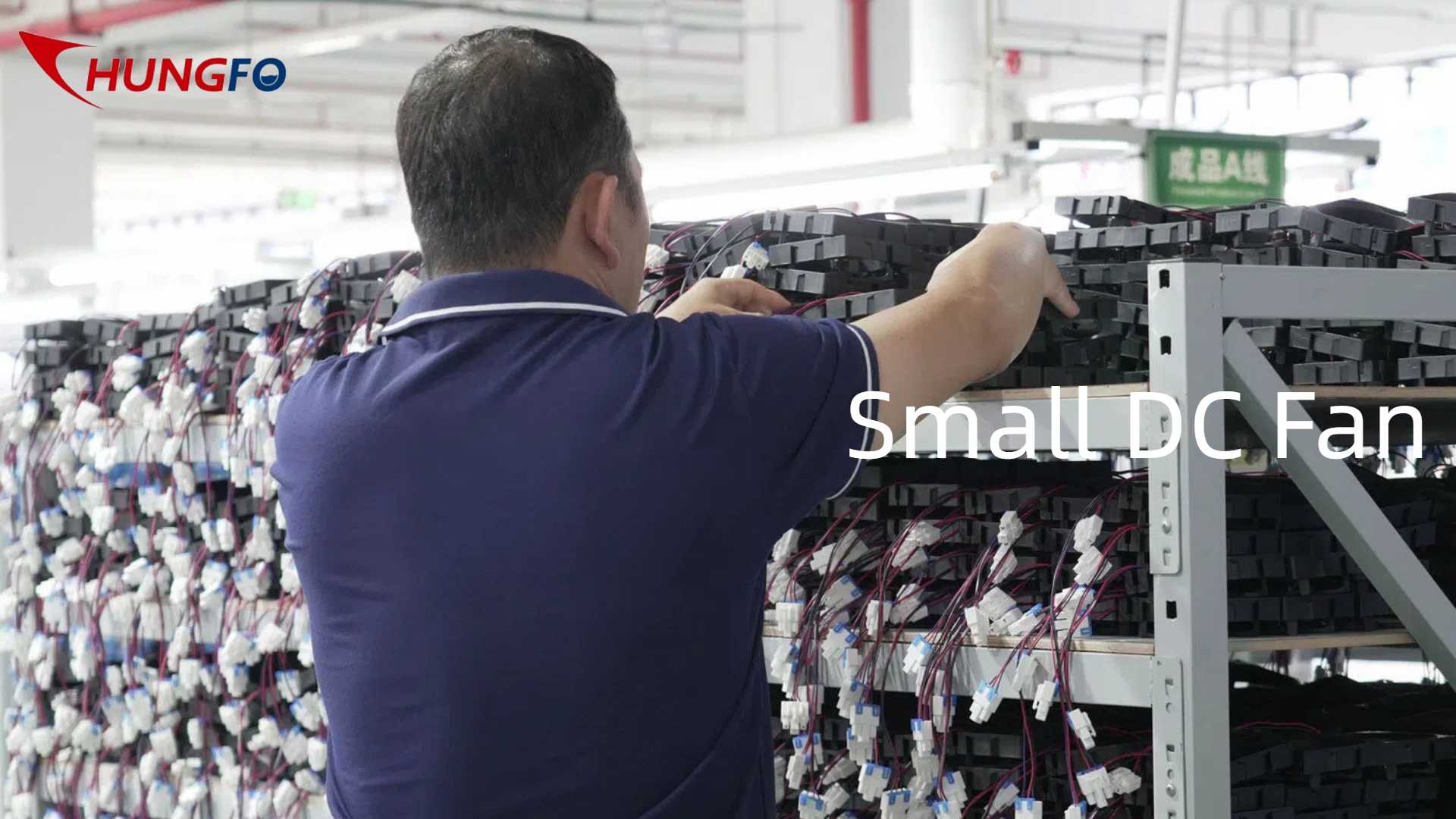
2.2 Sharp Decline in Drying Efficiency
Even if a fan is still spinning, a decline in its performance is often subtle but directly impacts drying results.
Clothes always come out damp: After setting a standard program, clothes that normally dry in 1.5 hours now take 2.5 to 3 hours and still feel damp when removed. This usually means insufficient airflow from the main circulation fan (dryer brushless axial flow fan). Due to blade wear, slower motor speed, or dust-clogged air ducts, the actual hot air volume entering the drum is far below the design value, drastically reducing heat exchange efficiency.
Upper clothes dry, lower clothes wet: This indicates uneven airflow distribution. It could be caused by a fan that spins smoothly but blows air in a skewed direction, or a partially blocked duct. For example, if a 12v blower responsible for auxiliary airflow distribution fails, it can create dead zones inside the drum.
Abnormally high drying temperature but low efficiency: Sometimes the fan motor still spins, but far below its rated speed. The heat pump system detects insufficient temperature and continues heating, resulting in a very high outlet air temperature. However, due to low airflow, heat cannot be effectively transferred to the clothes, and most heat is wasted cycling with minimal air. The dryer housing may feel hotter than usual.
Data Support: In a lab environment, a healthy heat pump dryer has a main circulation airflow of about 200–300 cubic meters per hour. When dust accumulation reduces the dryer brushless axial flow fan’s airflow by 30%, drying time extends by over 50%. If airflow drops by 50%, drying becomes nearly impossible, and the device will shut down due to overheating protection.
2.3 Overheating and Frequent Protective Shutdowns
The heat pump system requires precise thermal balance. When cooling fans fail, the consequences are immediate.
Compressor overheat protection triggers: The heat pump compressor generates significant heat during operation, relying on the small dryer cooling fan to carry it away. If this fan stops or delivers severely insufficient airflow, the compressor housing temperature rises rapidly. Typically, the dryer’s control board has temperature sensors; when detecting compressor temperature exceeding 110–120°C, it forcibly stops the drying program and displays a fault code (e.g., E4, F12, depending on brand).
Control board burnout: If a 12v blower responsible for cooling power modules on the control board (e.g., IGBT, IPM) fails, the junction temperature of these semiconductor devices rises too high, eventually causing a short circuit. A typical outcome is the dryer suddenly losing all power and failing to restart, requiring replacement of the entire control board.
Localized housing heating: Touching the side or back of the dryer, it should feel warm under normal conditions. If a specific area is noticeably hot to the touch (over 70°C) and corresponds to the outlet of a small dryer cooling fan, it's almost certain that fan has failed.
User Self-Check Method: After running the dryer for 20 minutes, place your hand near the bottom cooling grille; you should feel a noticeable stream of warm air. If there is no air or very weak airflow, and the compressor area is very hot, it can preliminarily indicate a cooling fan failure.
2.4 Fan Not Spinning at All or Intermittent Stoppage
This is the most direct failure symptom, but causes vary.
No spin at all: Regardless of the program started, the fan makes no sound or vibration. Possible causes: burnt motor, drive circuit failure, lost control signal, loose connector, or faulty Hall sensor inside the fan (for brushless motors).
Intermittent stoppage: The fan starts, runs for a few minutes, then suddenly stops, only to start again later. This often results from partial short circuits in the motor winding or poor thermal stability of capacitors on the drive board, causing overheating protection to activate, then cooling down and recovering. This hidden fault is hardest to diagnose because when you observe it, the fan might be spinning normally.
Starting difficulty: The fan spins if you manually push the blades, but won't start on its own or takes a long time to reach speed. This suggests a failed start capacitor (for capacitor-start motors) or an abnormal drive signal for brushless motors.
For 12v blowers, which are typically powered by low-voltage DC, a common cause of intermittent stoppage is a faulty 12V voltage regulator circuit on the power supply board, causing output voltage fluctuations that prevent stable fan operation.
Chapter 3: Fault Localization – From Symptoms to Specific Fan Components
To repair accurately, you must identify which fan is problematic. Heat pump dryers internally contain three main categories of fans, each with distinct fault symptoms.
3.1 Localizing Main Circulation Fan Failures
As a dryer brushless axial flow fan, it is located inside the duct behind the drum, usually larger (diameter 150–200mm). Distinguishing signs of its failure:
Significantly prolonged drying time, but warm air still blows from the cooling grille (cooling system normal).
Opening the dryer door, you don't feel strong air suction.
Measuring the fan motor's operating current with a clamp meter: normal is 0.8–1.5A; below 0.5A indicates low speed; near 0A suggests an open circuit.
Removing the back cover, observe whether fan blades are intact; manually spin to check smoothness. Worn sleeve bearings will feel noticeably notchy or irregular in resistance.
3.2 Localizing Cooling Fan Failures
Small dryer cooling fans are typically smaller (60–80mm), mounted next to the compressor or control board. Typical failure signs:
Compressor overheat protection triggers frequently, even shortly after starting.
Touching the housing near the compressor feels burning hot, but there is no or very weak airflow from the cooling fan.
The fan itself may emit squealing or be completely silent. Due to its small size and high speed (typically 4000–6000 rpm), bearing failure produces a very sharp noise.
Using a multimeter to measure the fan's power connector: if the voltage is normal (e.g., 12V or 24V) but the fan doesn't spin, the fan unit itself is faulty.
3.3 Localizing Auxiliary Blower Failures
A 12v blower is a centrifugal fan characterized by high static pressure but relatively smaller airflow, commonly used for localized spot cooling. Its failure manifestations:
Overheating in the control board area, causing unexplained dryer shutdowns or “communication fault” error codes.
The blower itself exhibits strong vibration or intermittent “whooshing” sounds, as centrifugal impellers easily accumulate dust, ruining dynamic balance.
Measure the 12V supply; if normal but the blower doesn't spin, test it separately with an external 12V power source to distinguish between power supply and motor issues.
Important Note: Different brands may have different fan connector pinouts. For 12v blowers, common interfaces are 2-wire (positive, negative) or 3-wire (positive, negative, tachometer). When testing externally, be sure to confirm polarity; reversal may burn out the drive chip (for brushless types).
Chapter 4: Practical Repair and Replacement Guide
Once a fan failure is confirmed, you have two choices: repair or replace. Since fans are relatively low-cost components (typically tens to a hundred RMB), and repaired fans have uncertain reliability, direct replacement is recommended. Specific steps are as follows.
4.1 Safety Preparations
Unplug the dryer and wait at least 10 minutes for internal capacitors to discharge.
Prepare tools: Phillips/flathead screwdrivers, hex keys (depending on brand), multimeter, vacuum cleaner, soft brush.
Record the fan's specifications: voltage (12V/24V/230V), current, connector type, mounting hole spacing. Use these to source a replacement.
4.2 Replacing the Dryer Brushless Axial Flow Fan (Main Circulation Fan)
Remove the dryer's back panel (typically 6–10 screws).
Locate the air duct chamber behind the drum; the main fan is usually there. You may need to remove the duct cover (pay attention to sealing gaskets).
Unplug the fan's connector. Take a photo to record wiring order.
Remove screws securing the fan (usually 3–4).
Take out the old fan. Check the duct for foreign objects or dust buildup; clean with a vacuum.
Install the new fan: Pay attention to the airflow direction marking (arrow on fan side indicating airflow direction). Ensure the sealing gasket is properly seated to prevent air leaks.
Connect wires, temporarily power on for testing: Run a test cycle, listen for smooth operation, and feel the outlet airflow volume.
Reinstall the cover.
4.3 Replacing a Small Dryer Cooling Fan or 12v Blower
Based on fault localization, open the corresponding area (compressor compartment or control box).
Cooling fans are usually fixed to heat sinks with screws or clips. Remove the old unit.
For 12v blowers, the outlet may connect to an air guide tube; carefully detach it and keep the clamp safe.
When installing the new fan, note polarity: red wire to positive, black to negative. For 3-wire fans, the yellow wire is tachometer signal; leaving it disconnected usually doesn't affect basic operation.
Secure the fan so it doesn't interfere with other components.
Power-on test: Use a multimeter to verify stable supply voltage (12V or 24V). Run for 5 minutes and touch the heatsink to see if its temperature has dropped significantly.
4.4 Common Errors and Precautions
Error: Buying a fan without checking voltage, e.g., connecting a 12V fan to a 24V circuit, instantly burning it out.
Error: Installing the dryer brushless axial flow fan backward, causing reversed airflow and worse drying performance.
Error: Neglecting duct cleaning. Even with a new fan, if the duct is still clogged, the fan will quickly overload and fail again.
Recommendation: Choose original or reputable aftermarket replacement parts (e.g., from China Chungfo Fan). Poor-quality fans have short bearing life, high noise, and poor dynamic balance, potentially causing resonance.
Chapter 5: Preventive Maintenance and Long-Term Reliability
Fan failures do not happen suddenly; they go through a long degradation process. Regular maintenance can greatly extend the life of both the heat pump dryer and its fans.
5.1 Cleaning Schedule
After each use: Clean the lint filter. A clogged filter increases the main circulation fan's load and accelerates bearing wear.
Monthly: Use a vacuum cleaner to clean the cooling grilles on the back and bottom of the dryer to prevent dust from blocking the small dryer cooling fan.
Every six months: Remove the back cover and use a soft brush or compressed air to clean fan blades and air ducts. Specifically for the 12v blower impeller, due to centrifugal force, dust mainly accumulates at the blade edges; clean meticulously.
Annually: Check the bearing condition of all fans. Remove the fan and manually spin the blades to feel for smoothness. If you feel dryness or a gritty sensation, try adding one drop of sewing machine oil to the bearing (only for sleeve bearings, not ball bearings). For ball bearings, once there is unusual noise, replace directly.
5.2 Environmental Factors
Place the dryer in a well-ventilated location, leaving at least 10 cm of space around it to ensure cooling fans have adequate fresh air intake.
Avoid using the dryer in extremely dusty environments, such as near construction sites. Otherwise, the small dryer cooling fan will quickly clog.
High ambient temperatures (exceeding 40°C) reduce cooling system efficiency. Avoid continuous long-duration use in hot summer afternoons.
5.3 Electrical Checks
Periodically measure the dryer's supply voltage for stability. Undervoltage can cause abnormal operation of brushless fan drive circuits, while overvoltage can burn them out.
For devices using a 12v blower, if the 12V supply voltage deviates from the 11.5–12.5V range, check the switch-mode power supply board for faults.
Chapter 6: In-Depth Technical Analysis – Why Different Fan Types Have Their Specific Roles?
To meet the demanding requirements of heat pump dryers, different fan types have specific design justifications.
6.1 Advantages of Brushless Axial Flow Fans
The dryer brushless axial flow fan is the preferred choice for the main circulation fan because:
High efficiency: Brushless motor efficiency can exceed 85%, while brushed motors are only 60–70%. For dryers operating for long hours, the efficiency difference significantly impacts electricity costs.
Long life: Without carbon brush wear, theoretical life is limited only by bearings. High-quality fans (e.g., those from China Chungfo Fan’s brushless axial series) can have an MTBF of over 50,000 hours.
Low noise: Brushless motors use electronic commutation, avoiding friction sparks between brushes and commutators. Combined with aerodynamically designed axial blades, noise can be controlled below 45 dBA.
Easy speed control: Precise speed regulation via PWM signals allows coordination with the heat pump system for optimal heat exchange.
6.2 Irreplaceability of Small Cooling Fans
Small dryer cooling fans are typically axial or centrifugal; their compact design allows high speeds, generating sufficient pressure in a small space to overcome heatsink resistance. Without them, compressor temperature would rise linearly, leading to refrigerant decomposition, lubricating oil carbonization, and eventually compressor seizure and scrapping.
6.3 Role of the 12v Blower
The 12v blower is a low-voltage DC centrifugal fan. 12V is chosen over 220V because the control board area requires safe voltage to prevent leakage that could cause signal interference or personal injury. The centrifugal design allows it to generate high static pressure, suitable for delivering cool air through narrow tubes to specific hot spots (e.g., power module heatsinks). Its failure rate is relatively high due to the hot, dusty operating environment and extreme sensitivity of the centrifugal impeller to imbalance.
Chapter 7: Common Misconceptions and Q&A
Misconception 1: A fan that spins must be fine.
Wrong. A 30% drop in speed is almost invisible to the naked eye, but drying time may double. You must judge by airflow measurement or drying results.
Misconception 2: Any fan can be lubricated with any oil.
Wrong. Adding oil to ball bearings can destroy the grease structure, causing faster failure. For sleeve bearings, only a minimal amount of low-viscosity oil should be added. For a dryer brushless axial flow fan with dual ball bearings, once there is noise, direct replacement is best.
Misconception 3: A slightly lower 12v blower speed is fine.
Wrong. Control board cooling has a minimum airflow requirement. If the speed is too low, even though it's still spinning, it cannot remove enough heat, and the control board's life will be reduced by over 80%.
Q: My dryer shows error code E4. Which fan has failed?
A: Code meanings vary by brand. In some brands, E4 indicates compressor overheating, usually pointing to a small dryer cooling fan failure or duct blockage. However, it could also be that insufficient airflow from the main circulation fan causes overall system overheating. Combine with other symptoms for comprehensive judgment.
Q: After replacing the fan, it still overheats. What now?
A: Check if the temperature sensor is functioning normally. Sometimes the sensor itself drifts, falsely reporting overheating. Also, confirm that the new fan's rotation direction and airflow volume match the original; some substitutes may have adequate voltage but insufficient airflow.
Chapter 8: Summary and Resource Recommendations
Although fan failures in heat pump dryers vary widely, they can be summarized into core manifestations: abnormal noises, decreased drying efficiency, equipment overheating, and fan stoppage. By carefully distinguishing whether the issue lies with the main circulation dryer brushless axial flow fan, the small dryer cooling fan, or the 12v blower, you can quickly localize and replace the faulty component.
For average users, it is recommended to at least master noise diagnosis and basic cleaning skills. For those handy with tools, replacing a fan is not difficult, and the cost is far lower than calling for service (after-sales replacement typically charges 300–600 RMB, while the fan itself is only 20–80 RMB). When sourcing replacement parts, prioritize reputable manufacturers. For instance, China Chungfo Fan offers a variety of brushless axial flow fans, cooling fans, and 12V blowers with clear specifications, making them suitable as replacement parts.
Finally, remember: never delay addressing any fan abnormality. A damaged fan can lead to compressor or control board burnout, at which point repair costs may approach or even exceed the value of the dryer itself. Regular maintenance and timely replacement will allow your heat pump dryer to “breathe” smoothly and serve you for many years.