
Categories
New Blog
Choosing the Right Cooling Fan for Industrial Electronic Enclosures
August 19 , 2026As industrial automation, smart manufacturing, power electronics, renewable energy, telecommunications, and intelligent control systems continue to develop, electronic components are increasingly being installed inside compact industrial enclosures and control cabinets. Variable frequency drives, servo drives, PLCs, power supplies, relays, contactors, communication modules, inverters, and other power electronic components all generate heat during normal operation.
When this heat cannot be removed effectively, the internal temperature of the enclosure gradually increases. Excessive heat can affect component performance, accelerate aging, reduce operating life, increase failure rates, and eventually affect the reliability of the entire industrial system.
For this reason, selecting the right enclosure cooling fan is an important part of industrial equipment design. Choosing a fan should not be based only on its physical size or maximum airflow. Engineers also need to evaluate heat load, airflow, static pressure, airflow direction, voltage, noise, installation space, environmental conditions, maintenance requirements, and long term reliability.
A properly designed cooling system can help maintain a stable internal temperature, protect sensitive electronic components, reduce unexpected downtime, and improve the overall reliability of industrial equipment.
Why Do Industrial Electronic Enclosures Need Cooling Fans?
Industrial electronic equipment continuously generates heat during operation. This is especially important for variable frequency drives, servo drives, power supplies, inverters, converters, transformers, and other high power electronic components.
During electrical energy conversion and transmission, part of the energy is inevitably converted into heat. When these components are installed inside a closed or semi closed enclosure, the generated heat can accumulate.
If the heat is not removed efficiently, the temperature inside the cabinet can become significantly higher than the ambient temperature.
High operating temperatures can affect many electronic components. Capacitors may age faster, semiconductor devices may operate closer to their thermal limits, power modules may experience increased thermal stress, and control circuits may become less stable.
For equipment designed to operate continuously for many hours or even around the clock, thermal management becomes a critical part of product reliability.
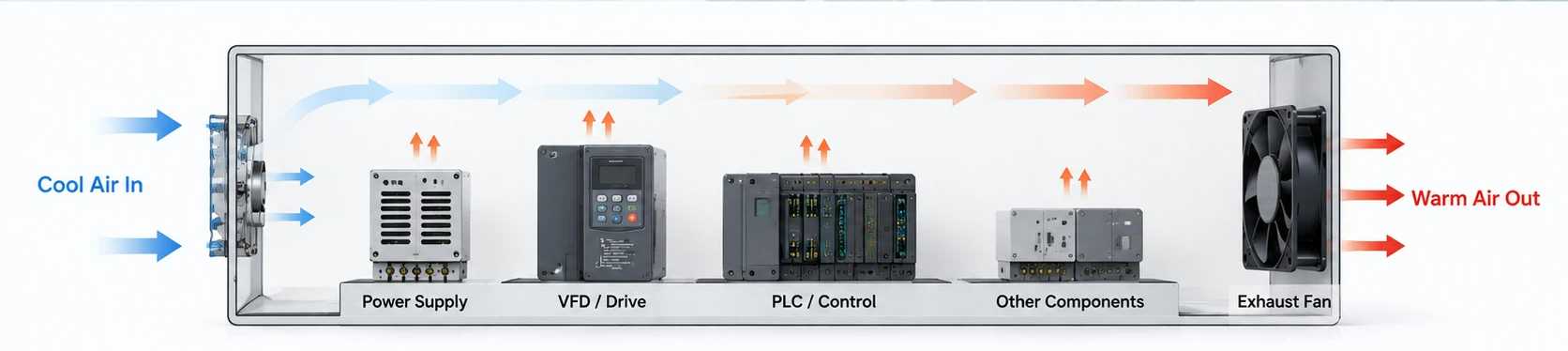
The basic purpose of an enclosure cooling fan is to create controlled forced airflow. Relatively cool ambient air enters the enclosure, passes across heat generating components, absorbs heat, and then exits through an exhaust opening.
However, effective cooling is not simply about moving air. The airflow must be directed through the areas where heat is actually generated.
This is why fan selection and enclosure airflow design should always be considered together.
Start With the Heat Load
Before selecting a cooling fan, engineers should first determine how much heat is generated inside the enclosure.
This is one of the most important steps in thermal design and is sometimes overlooked.
Some equipment manufacturers select a fan based mainly on cabinet dimensions. However, cabinet size alone does not determine cooling requirements.
A large enclosure containing only a few low power electronic components may have a relatively low thermal load. In contrast, a compact cabinet containing multiple variable frequency drives, power supplies, servo drives, and power modules may generate a substantial amount of heat.
The first step should therefore be identifying the major heat sources.
Common heat generating components include variable frequency drives, servo drives, switching power supplies, transformers, inverters, contactors, relays, and power semiconductor modules.
The total heat loss of these components can then be estimated and compared with the maximum allowable internal temperature.
Ambient temperature must also be considered.
For example, equipment installed in a temperature controlled room may have a significantly different cooling requirement from equipment installed in a hot manufacturing workshop.
When ambient temperature increases, the available temperature difference between the inside and outside of the enclosure becomes smaller. As a result, the cooling system may need to move more air or use a different thermal management method.
Why Airflow Is Important
Airflow is one of the most commonly used specifications when selecting a cooling fan.
It indicates how much air the fan can move within a certain period of time. Sufficient airflow helps transport heat away from electronic components and replace warmer internal air with cooler ambient air.
However, higher airflow does not automatically mean better cooling.
If a fan produces a very large amount of air but the airflow does not pass over the main heat sources, the actual cooling effect may still be poor.
For example, if the intake and exhaust openings are located too close to each other, incoming cool air may travel directly toward the exhaust opening. This creates an inefficient airflow path.
The fan may be operating correctly, but only a limited amount of air may actually pass through the area containing the hottest components.
This is why airflow direction and fan placement are just as important as the airflow rating itself.
Static Pressure Is Equally Important
Static pressure is another critical specification that should not be overlooked.
In real industrial enclosures, air rarely moves through a completely open space. Instead, it may need to pass through filters, protective grilles, heat sinks, narrow ventilation openings, cables, electronic components, and other structures.
All these components create resistance to airflow.
When system resistance increases, the actual airflow delivered by the fan decreases.
A fan with a high free air airflow rating may therefore perform poorly after installation if it does not have sufficient static pressure capability.
This is why engineers should review the fan performance curve instead of looking only at maximum airflow.
The relationship between airflow and static pressure provides a much better indication of how the fan will perform in a real enclosure.
For control cabinets containing filters, dense electronic components, or restricted ventilation openings, a fan with stronger static pressure performance may be a better choice.
Why VFD Cabinets Require Special Cooling Attention
Variable frequency drives are among the most common heat sources inside industrial control cabinets.
A VFD regulates motor speed and output power by controlling electrical energy. During this process, power losses generate heat.
When one or more VFDs are installed inside the same enclosure, the internal thermal load can become significant.
If the generated heat cannot be removed effectively, the cabinet temperature can rise and affect the operating environment of the drive.
For this reason, VFD cabinets require careful ventilation planning.
A common design places the air intake near the lower section of the cabinet and the exhaust fan near the upper section.
Cooler ambient air enters from the lower area, passes through the VFD and other heat generating components, becomes warmer, and then rises toward the upper section where the exhaust fan removes it.
This arrangement takes advantage of the natural tendency of warm air to rise while forced ventilation actively removes accumulated heat.
However, the exact airflow arrangement should always be determined according to the actual internal cabinet layout.
How to Select a VFD Exhaust Fan
Selecting a suitable vfd exhaust fan requires more than checking the maximum airflow rating.
Engineers should first determine the total heat generated by the VFD and other components.
The enclosure size, ambient temperature, allowable internal temperature, inlet area, outlet area, filter resistance, and internal airflow path should then be considered.
A common mistake is to install a powerful exhaust fan without providing sufficient intake capacity.
If the exhaust fan attempts to remove more air than the intake system can supply, the enclosure may develop excessive negative pressure. This can reduce the actual airflow and limit cooling performance.
The intake and exhaust sides should therefore be designed as one complete ventilation system.
In dusty environments, an intake filter may be necessary to prevent contaminants from entering the cabinet. However, the filter creates additional resistance, which means the selected fan must have sufficient static pressure.
As the filter becomes dirty, resistance increases further. A maintenance plan should therefore be established for inspection and cleaning or replacement.
Are 5 Volt Cooling Fans Suitable for Industrial Equipment?
Low voltage cooling fans are increasingly common as electronic equipment becomes smaller and more compact.
A 5 volt cooling fan can be suitable for small electronic systems, control boards, communication modules, embedded devices, instrumentation, and other equipment powered by a 5 V DC supply.
Compared with large industrial cabinets, these applications often have very limited installation space.
Therefore, fan dimensions, thickness, voltage, current, airflow, static pressure, noise, and starting performance can all become important selection criteria.
If the electronic system already provides a stable 5 V power supply, using a compatible fan can simplify the overall electrical design.
However, engineers should not select a fan based on voltage alone.
The required airflow must still be sufficient to remove the generated heat. Static pressure should be evaluated if the fan operates behind a grille or filter.
Operating current should also be compatible with the equipment power supply.
For applications requiring continuous operation, operating life and reliability should receive the same attention as electrical compatibility.
AC Cooling Fans Versus DC Cooling Fans
Industrial cooling fans can generally be categorized according to their power supply as AC fans and DC fans.
AC fans are commonly used in industrial control cabinets, electrical equipment, distribution systems, industrial ventilation equipment, and applications where an AC power supply is readily available.
DC fans are widely used in electronic equipment, communication devices, control boards, embedded systems, instruments, and equipment that already contains a low voltage DC power supply.
If a machine already provides a 12 V or 24 V DC power source, selecting a compatible DC fan can simplify the power architecture.
If the equipment is designed around an AC supply, an AC fan may provide a more convenient solution.
There is no single fan type that is ideal for every industrial application.
The correct selection depends on the electrical architecture, thermal requirements, installation environment, available space, and expected operating conditions.
Why Airflow Direction Matters
Airflow direction has a direct influence on thermal performance.
A properly designed enclosure should create a clear and continuous airflow path.
Cooler air should enter the enclosure, pass through the main heat generating areas, and then leave through the exhaust side.
If the airflow path is poorly designed, localized hot spots can occur.
For example, if the hottest components are located in the upper part of a cabinet but the exhaust fan is installed near the bottom, hot air may remain trapped in the upper section.
For vertical control cabinets, lower intake and upper exhaust arrangements are commonly used.
However, the internal layout should always be considered.
If multiple heat sources are distributed across different areas, additional airflow management may be required.
Internal partitions, air ducts, baffles, or multiple fans can sometimes be used to create a more controlled airflow path.
Do Filters Reduce Fan Performance?
Yes.
Filters help prevent dust and contaminants from entering the enclosure, but they also create resistance to airflow.
As dust accumulates on the filter surface, airflow resistance can increase further.
If the fan does not have enough static pressure capability, the actual airflow may decrease significantly as the filter becomes dirty.
For this reason, engineers should consider filter pressure loss during the fan selection process.
The filter material, filter area, expected contamination level, and maintenance interval should also be considered.
In heavily contaminated industrial environments, regular filter cleaning or replacement is essential.
A dirty filter can reduce the performance of the entire ventilation system even when the cooling fan itself continues to operate normally.
Environmental Conditions for Industrial Cooling Fans
Industrial environments are generally more demanding than office or consumer electronics applications.
Equipment may be exposed to dust, oil mist, humidity, high temperatures, low temperatures, vibration, and other contaminants.
These conditions can affect cooling fan performance and operating life.
Dust can accumulate on the blades and change the balance of the impeller, potentially increasing vibration.
Oil mist can adhere to fan components and attract additional dust.
Humidity can affect motors, electrical connections, circuit components, and metal structures.
Therefore, fan selection should take the actual operating environment into account.
Outdoor industrial equipment requires additional consideration.
Rain, humidity, condensation, temperature fluctuations, sunlight, and environmental protection requirements can all affect the cooling system.
A fan designed for an indoor environment should not automatically be used in an outdoor enclosure without evaluating the environmental requirements.
Why Noise Matters
Cooling performance is not the only consideration.
Noise may not be a major concern in a large factory, but it can become important for laboratory equipment, testing instruments, medical equipment, office adjacent machinery, and industrial products operated near workers.
Fan noise is influenced by rotational speed, blade geometry, motor construction, bearing design, airflow resistance, vibration, and installation structure.
In general, higher fan speed can provide greater airflow, but it can also produce more aerodynamic and mechanical noise.
Therefore, engineers should select an appropriate operating speed instead of simply choosing the highest speed available.
Fan mounting also matters.
If the mounting structure is unstable, vibration may be transferred to the cabinet and create additional mechanical noise.
A properly designed mounting structure can help improve both acoustic performance and mechanical stability.
How Bearing Design Affects Fan Reliability
The bearing system is an important factor in the long term reliability of a cooling fan.
Industrial equipment often operates for long periods, sometimes continuously for thousands of hours.
During this time, the bearing must withstand continuous rotation and mechanical loads.
Different bearing technologies have different characteristics in terms of operating life, noise, temperature performance, installation orientation, and application suitability.
For this reason, industrial fan selection should not focus only on airflow and speed.
The bearing structure and expected operating life should also be considered.
For control cabinets designed for continuous operation, a reliable bearing and stable motor design can help reduce the risk of fan failure over time.
How to Determine the Correct Fan Size
Industrial electronic cabinets often have limited internal space.
Therefore, fan dimensions must match the cabinet structure and available mounting area.
If the fan is too large, it may not fit into the designated mounting position.
If it is too small, the airflow may be insufficient.
Engineers should consider more than the external dimensions.
Mounting hole spacing, fan thickness, cable outlet location, inlet clearance, outlet clearance, and surrounding components should all be evaluated.
It is generally better to determine the fan installation position during the early equipment design stage rather than trying to add a cooling fan after the enclosure has already been completed.
Why Maximum Airflow Alone Can Be Misleading
The maximum airflow shown in a product catalog is often measured under relatively open conditions.
Once the fan is installed inside a real enclosure, air encounters resistance from filters, grilles, heat sinks, openings, cables, and internal components.
Therefore, the actual operating airflow is usually lower than the free air rating.
This is why experienced engineers pay attention to airflow and static pressure together.
When system resistance is high, a fan with stronger static pressure performance may deliver better real world cooling than a fan with a higher free air airflow rating but weaker pressure capability.
How to Test Whether a Cooling Fan Is Suitable
After theoretical fan selection, practical testing should be performed.
The fan should be installed in the actual equipment or a representative enclosure and operated under realistic conditions.
Temperature measurements can then be taken at different locations inside the cabinet.
Particular attention should be given to the areas around the VFD, power supply, driver, inverter, heat sink, and other major heat sources.
If certain areas are significantly hotter than others, the airflow path should be reviewed.
The problem may not necessarily be insufficient fan airflow.
It may be caused by poor airflow distribution, an incorrect fan location, an undersized inlet, excessive filter resistance, or an airflow short circuit.
Temperature rise testing is therefore an important part of the industrial thermal design process.
How Proper Cooling Can Reduce Maintenance Costs
A well designed cooling system can do more than reduce temperature.
By keeping electronic components within a suitable operating range, it can help improve system stability and reduce thermal stress.
Reliable cooling can also reduce the risk of unexpected shutdowns caused by excessive temperature.
For industrial production equipment, unexpected downtime can result in significant production losses.
This means thermal management should be treated as part of the overall reliability strategy rather than simply as an accessory.
The cost of a cooling fan is usually small compared with the potential cost of equipment downtime, emergency maintenance, or damaged electronic components.
Why Choose a Professional Cooling Fan Manufacturer?
Industrial cooling fans are not always simple off the shelf components.
OEM equipment manufacturers often require a combination of specific dimensions, airflow, static pressure, voltage, noise, mounting configuration, and operating life.
A professional manufacturer can help customers evaluate these requirements and select a suitable fan through application analysis and sample testing.
For mass production projects, manufacturing consistency is equally important.
If different production batches have significant variations in dimensions, electrical characteristics, airflow, or noise, the final equipment may experience assembly or thermal performance problems.
A stable manufacturing process and comprehensive testing capability can therefore be valuable for industrial customers.
Chungfo Fan provides capabilities covering product design, tooling development, injection molding, SMT production, assembly, and product testing.
These capabilities allow Chungfo Fan to support cooling applications in industrial control cabinets, VFD cabinets, power equipment, refrigeration systems, electronic equipment, automation equipment, and other thermal management applications.
A Complete Cooling Fan Selection Process
A reliable fan selection process should begin with the thermal requirements rather than the fan itself.
First, identify the major heat generating components inside the enclosure and estimate the total heat load.
Second, determine the maximum ambient temperature under actual operating conditions.
Third, determine the maximum allowable internal enclosure temperature.
Fourth, estimate the required airflow based on the heat load and allowable temperature rise.
Fifth, evaluate the resistance created by filters, grilles, heat sinks, ventilation openings, cables, and internal components.
Sixth, select an AC or DC fan according to the electrical architecture of the equipment.
Seventh, verify fan dimensions, mounting holes, airflow, static pressure, voltage, current, noise, operating temperature, bearing structure, and expected operating life.
Finally, perform an actual temperature rise test under realistic operating conditions.
Only after the practical test confirms that the thermal requirements are satisfied should the final fan model be released for mass production.
Common Cooling Fan Selection Mistakes
One common mistake is choosing a fan only according to physical size.
A fan may fit the cabinet but still fail to provide sufficient cooling.
Another common mistake is selecting a fan only according to maximum airflow.
Without considering static pressure and system resistance, the actual installed airflow may be much lower than expected.
A third mistake is ignoring airflow direction.
Even a powerful fan cannot effectively cool a component if the airflow does not reach it.
Another issue is ignoring environmental conditions.
A fan selected for a clean indoor environment may not be suitable for a dusty or humid manufacturing environment.
Maintenance is another factor that should not be overlooked.
Filters, fans, and ventilation openings require periodic inspection and cleaning. A cooling system that performs well when new may gradually lose performance if maintenance is neglected.
How Smart Fan Control Can Improve Thermal Management
Modern industrial equipment can also use intelligent fan control to improve thermal performance.
Instead of operating the fan at full speed continuously, the equipment can adjust fan speed according to internal temperature or load conditions.
This can reduce unnecessary power consumption and noise while still providing adequate cooling when the thermal load increases.
Depending on the fan and control system, speed regulation can be achieved through methods such as PWM control or voltage control.
For equipment with large changes in operating load, variable speed cooling can provide a more efficient thermal management strategy.
However, the control system should be compatible with the selected fan and its electrical characteristics.
Cooling Fan Maintenance for Industrial Enclosures
Even a high quality fan requires proper maintenance.
The fan inlet and outlet should be inspected regularly to ensure that they are not blocked.
Filters should be cleaned or replaced according to the operating environment.
Dust accumulation on the fan blades should also be monitored.
If abnormal noise or vibration appears, the fan should be inspected promptly.
An increase in noise can sometimes indicate bearing wear, blade contamination, mounting problems, or mechanical imbalance.
Early maintenance can prevent a small cooling problem from developing into an equipment shutdown.
Conclusion
Choosing the right cooling fan for an industrial electronic enclosure requires a system level approach.
Heat load determines the basic cooling requirement.
Airflow determines the air exchange capability.
Static pressure determines how effectively the fan can overcome system resistance.
Airflow direction determines whether heat is actually transported away from the critical components.
Voltage and electrical compatibility determine whether the fan can operate correctly with the equipment power system.
Noise, environmental resistance, bearing construction, operating life, and maintenance requirements determine whether the fan can continue to operate reliably over the long term.
For VFD control cabinets, engineers should pay particular attention to heat generation, airflow direction, intake capacity, filter resistance, and exhaust performance.
For compact electronic equipment, low voltage fans can provide practical cooling solutions when the available power supply and airflow requirements are compatible.
For dusty, humid, high temperature, or outdoor environments, environmental protection and filtration should be evaluated as part of the overall thermal design.
A properly selected cooling fan is therefore not simply a small mechanical component inside an industrial cabinet. It is an important part of the equipment's thermal management and reliability system.
Chungfo Fan can provide cooling fan solutions based on airflow, static pressure, voltage, dimensions, noise, installation requirements, and application conditions. With capabilities covering product design, tooling, injection molding, SMT production, assembly, and testing, Chungfo Fan supports industrial equipment manufacturers looking for reliable thermal management solutions.
Frequently Asked Questions
Does every industrial electronic enclosure need a cooling fan?
Not every enclosure requires forced ventilation. If the internal heat load is low and natural heat dissipation can maintain the required temperature, a fan may not be necessary.
However, when electronic components generate significant heat or the enclosure operates in a high ambient temperature environment, forced ventilation can provide a more reliable thermal management solution.
How do I determine the required airflow for an industrial cabinet?
The required airflow depends on the total heat load, ambient temperature, allowable internal temperature rise, enclosure structure, and system resistance.
Engineers should first determine the heat generated by the internal components and then calculate the airflow required to remove that heat.
The resistance of filters, grilles, heat sinks, and ventilation openings should also be considered.
Is a higher airflow fan always better?
No.
A fan should be selected according to the actual thermal load and system resistance.
Excessive airflow may increase noise, power consumption, vibration, and dust intake.
Insufficient airflow, on the other hand, may result in overheating.
The best fan is the one that provides sufficient real world cooling performance under the actual operating conditions.
Why does a VFD cabinet require special exhaust ventilation?
A variable frequency drive generates heat during operation and may represent a significant portion of the cabinet's total heat load.
When one or more VFDs are installed inside a closed cabinet, heat can accumulate quickly.
A properly designed vfd exhaust fan system can help remove hot air and maintain a more stable internal temperature.
Is a 5 volt cooling fan suitable for industrial electronic equipment?
Yes, depending on the application.
A 5 volt cooling fan can be suitable for low voltage electronic systems, control boards, embedded equipment, communication devices, and compact electronic assemblies.
However, engineers should also evaluate airflow, static pressure, current, noise, operating life, starting voltage, and environmental conditions.
Should an industrial cabinet use an AC or DC cooling fan?
The answer depends on the equipment power architecture.
AC fans are suitable for equipment with readily available AC power.
DC fans are often more convenient when the equipment already has a low voltage DC power supply.
The decision should also consider installation space, control requirements, noise, and thermal performance.
Does a filter reduce cooling fan airflow?
Yes.
A filter introduces resistance into the airflow path.
As dust accumulates on the filter, resistance can increase further.
The fan should therefore have sufficient static pressure capability to maintain adequate airflow under the expected filter condition.
Where should an enclosure cooling fan be installed?
The installation location depends on the cabinet structure.
A common arrangement is to introduce cooler air through a lower intake and exhaust warmer air through an upper outlet.
However, the actual location of the heat sources should always be considered.
The goal is to create an airflow path that passes through the main heat generating components before the air exits the enclosure.
What certifications does Chungfo Fan have?
Chungfo Fan has relevant certifications and compliance capabilities including ISO9001, ISO14000, CE, UL, TÜV, CCC, SGS, RoHS, REACH, and IATF16949.
Certain products also have UL related certification information, including UL product listing GPWV2.E311396.
Why choose Chungfo Fan as an industrial cooling fan supplier?
Chungfo Fan provides capabilities covering product design, tooling development, injection molding, SMT production, assembly, and product testing.
The company can support customers with cooling fan solutions based on airflow, static pressure, voltage, dimensions, noise, installation requirements, and application conditions.
For industrial electronic enclosures, VFD cabinets, power equipment, automation systems, refrigeration equipment, and other thermal management applications, Chungfo Fan can support both standard product selection and application specific requirements.
Company Certifications
Chungfo Fan's quality and product management capabilities cover multiple international standards and certification requirements.
The company has relevant certifications and compliance capabilities including ISO9001, ISO14000, CE, UL, TÜV, CCC, SGS, RoHS, REACH, and IATF16949.
Certain products have UL related certification information, with UL product listing GPWV2.E311396.
For industrial equipment manufacturers, certification capability, manufacturing consistency, product testing, and technical support are important factors when selecting a long term cooling fan supplier.
A reliable cooling fan supplier should not only provide a product with the required airflow, but also provide consistent quality, stable production, appropriate testing, and technical support throughout the product development and mass production process.
Chungfo Fan is committed to providing stable, efficient, and reliable cooling fan solutions for industrial equipment manufacturers and helping customers build more dependable thermal management systems.