Chungfo Fan Empowers Global Home Appliance Giant to Overcome High-Performance Refrigerator Heat Dissipation Bottlenecks
Jul 29, 2026Amid the escalation of global climate change and the ongoing energy crisis, the green and low-carbon transformation of the home appliance industry has evolved from a policy recommendation into an unavoidable market imperative. In July 2026, the United Nations Environment Programme and the International Energy Agency jointly issued the latest Global Efficient Cooling and Climate Action Assessment Report. The report clearly indicated that with extreme high-temperature weather becoming a routine phenomenon worldwide, the operating load and power consumption of household refrigeration equipment have spiked dramatically. Consequently, the transition of refrigerants and the improvement of overall system energy efficiency have become the most urgent topics for the global home appliance supply chain. In the same month, the European Commission officially implemented its updated Eco-design Directive for Ultra-Low Energy Home Appliances, establishing unprecedentedly stringent limitations on annual electricity consumption, operating noise, and overall recyclability for various built-in and multi-door large-capacity refrigerators entering the European market.
In this wave of global industrial transformation, household refrigerators are no longer mere low-temperature storage units. Instead, they are rapidly evolving toward larger internal volumes, precise zone temperature control, ultra-thin built-in architectures, and ultra-low noise operations. However, a natural technical conflict exists between increasing internal volume and compressing external dimensions. Built-in refrigerators require the space for compressor compartments and heat dissipation channels to be compressed to the extreme. This directly causes a drastic increase in wind resistance and severe heat accumulation inside the cooling chamber. Traditional fan solutions not only fail to deliver adequate air pressure and airflow within restricted spaces, but also generate intense aerodynamic noise under high-load operations, severely degrading the consumer's domestic living experience.
As a global leader in the manufacturing of cooling fans and blowers, China Chungfo Fan pays close attention to technological transformations and regulatory evolutions in the global home appliance market. Leveraging decades of expertise in fluid dynamics and precision manufacturing, China Chungfo Fan collaborated deeply with a world-renowned home appliance giant. Centering on the core requirements of refrigerator cooling fan, 92mm refrigerator fan, and Low noise refrigerator fan, China Chungfo Fan engineered a series of game-changing thermal management solutions. This case study presents a deep analysis of how China Chungfo Fan utilized innovative fan blade structural design and system-level selection optimization to help the client resolve complex heat dissipation and noise reduction pain points, realizing dual breakthroughs in both technical performance and sales volume.
Section I. Technical Pain Points and Industry Evolution in Modern Refrigerator Cooling
1.1 Thermal Management Challenges Brought by Built-In and Multi-Door Refrigerator Architectures
In recent years, consumer demand for aesthetics and spatial efficiency has driven the widespread adoption of built-in and ultra-thin multi-door refrigerators. To achieve a seamless, flush fit between the refrigerator body and kitchen cabinetry, heat dissipation channels have been forced to shift from traditional side or rear dissipation to centralized bottom dissipation or narrow-slot forced convection.
This structural transformation brings exceptionally severe thermal management hurdles. First, the internal volume of the cooling compartment is reduced by nearly forty percent. Compressors, inverter boards, condensers, and piping are densely stacked together, causing the wind resistance of the airflow path to multiply. Second, the heat exchange efficiency of the condenser drops sharply in restricted spaces. If heat cannot be expelled within an extremely short time frame, the ambient temperature inside the compressor compartment will surge rapidly. This not only triggers frequent compressor overheating protection and causes power consumption to skyrocket, but also severely shortens the operational lifespan of core electronic components.
1.2 Strict Noise Control, Psychoacoustics, and BPF Spectral Management
With the trend toward integrated home spaces, open kitchens and combined living-dining layouts have become mainstream. Consumer sensitivity toward appliance operating noise has reached an unprecedented level. In the latest international acoustic rating standards for household appliances, nighttime refrigerator operational noise is required to be kept below thirty-two decibels, with certain high-end built-in products demanding an extremely strict threshold of under thirty decibels.
Noise in a refrigerator cooling system primarily originates from aerodynamic noise generated during fan rotation and mechanical vibration produced by motor drives. Aerodynamic noise consists of discrete tonal noise and broadband turbulent noise. The fundamental frequency of discrete noise, known as the Blade Passing Frequency (BPF), is determined by the rotational speed multiplied by the number of blades. When a cooling fan is forced to increase its rotational speed to maintain airflow under high resistance conditions, blade-cutting turbulence noise and BPF harmonics increase exponentially. Therefore, achieving an ultra-quiet operating level while maintaining high static pressure and high airflow represents a core benchmark testing the engineering prowess of fan manufacturers.
1.3 Special Environmental Adaptability of Refrigerator Fan Units
Unlike the dry operating conditions found inside standard servers or computer chassis, the environmental conditions inside refrigerator cabinets and cooling compartments are remarkably complex and harsh. On one hand, alternating operations between evaporators and condensers lead to frequent high humidity, condensate evaporation, and frosting within the air channels. On the other hand, bottom cooling compartments naturally accumulate dust, debris, and oil fumes over extended periods.
This necessitates that a refrigerator fan possess superior moisture resistance and dustproofing within its air channels. The motor insulation class and bearing lubrication system must endure non-stop continuous operation over a lifespan exceeding a decade. Conventional general-purpose fans under such working conditions are highly susceptible to bearing grease drying out, motor short circuits, or severe vibration caused by dust accumulation imbalances on blades, failing to meet the long-term warranty quality commitments of household refrigerators.
Section II. Breaking Traditional Boundaries: Innovative R&D and Blade Design of the 9232 Dedicated Fan
During the initial phase of collaboration with the client, the engineering team at China Chungfo Fan conducted a comprehensive system evaluation of the client's existing refrigerator thermal architecture. The core difficulty faced by the client was that their new high-volume-ratio refrigerator model failed to meet predefined condenser heat dissipation targets during high-temperature and high-humidity environmental trials. This caused the compressor to operate in an overclocked state for prolonged periods, leading to excessive power consumption and noticeable wind noise.
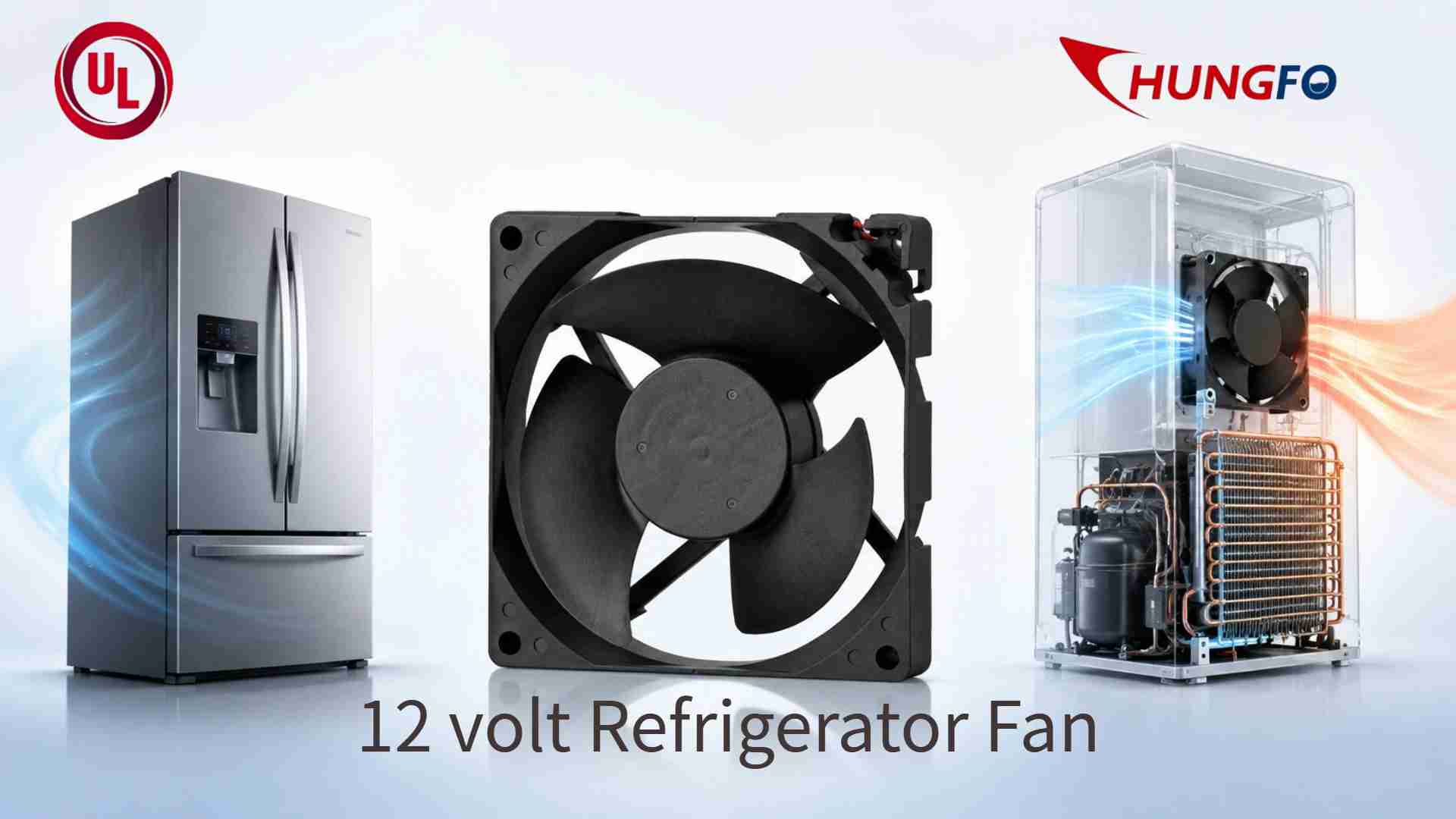
Addressing this pain point, the R&D team at China Chungfo Fan introduced a 9225 specification product deeply customized for refrigerator heat dissipation scenarios, featuring a ninety-two millimeter side length and a twenty-five millimeter thickness.
2.1 Three-Dimensional CFD Fluid Dynamics and Airfoil Geometry
Standard ninety-two millimeter general-purpose fans mostly utilize simple flat or conventionally curved blades. While these designs perform adequately in free air fields, air separation easily occurs on blade surfaces when operating under the high air resistance of narrow refrigerator slots, generating substantial useless turbulence along with intense high-frequency noise.
Fluid dynamics experts at China Chungfo Fan utilized three-dimensional computational fluid dynamics software to perform thousands of simulation optimizations on the 9232 blade structure, pioneering a unique blade geometry that combines a three-dimensional curved arch with a forward-swept airfoil.
This unique blade design offers several significant advantages: First, the leading edge of the blade incorporates a bionic sickle-shaped curvature capable of cutting smoothly into incoming airflow like cutting through butter, greatly reducing air-cutting impact noise at the intake. Second, the airfoil curvature of the blade cross-section undergoes non-linear gradient optimization from the root to the tip, effectively preventing airflow separation along the mid-section of the blade and ensuring that air maintains attached boundary-layer flow across the blade surface. Third, mini anti-vortex winglets are added to the outer blade tips, suppressing tip leakage vortices and converting the majority of kinetic energy into axial static pressure, thereby boosting the fan's ability to overcome high system impedance.
2.2 Advanced Driver Topology: FOC Sine-Wave Control vs Square Wave
To craft a genuinely low noise refrigerator fan, China Chungfo Fan executed a comprehensive suite of system-level noise reduction engineering processes on the 9225 model.
Regarding motor drive technology, traditional hard-switching square-wave drive schemes were discarded in favor of a full upgrade to Field Oriented Control (FOC) sine-wave brushless DC motor driver chips. Square wave driving induces sharp current transitions at commutation phases, triggering high-frequency torque ripples and motor stator electromagnetic hum. FOC sine-wave driving ensures that phase currents present a smooth sinusoidal curve, eliminating electromagnetic resonance sounds and torque pulsations caused by sudden magnetic field changes.
Additionally, the outer frame was engineered with a dual-purpose sound-absorbing and vibration-dampening structure. The inner wall of the frame underwent precision aerodynamic streamlining to reduce air-shear friction at the outlet. Rubber mounting pads on all four corners were formulated from a specialized silicone compound capable of absorbing high-frequency motor vibrations and cutting off vibration transmission paths to the metallic refrigerator cabinet.
2.3 Environmental Durability and Polymer Material Engineering
To counter the challenges of moisture and dust within refrigerator compartments, the China Chungfo Fan 9232 92mm refrigerator fan fully adopted top-tier motor protection processes and advanced material selection.
Impeller blades were molded using thirty percent glass-fiber reinforced Polybutylene Terephthalate (PBT). This composite material exhibits exceptional dimensional stability, low moisture absorption, and high creep resistance under sustained mechanical stress. Stator components underwent fully encapsulated injection molding or multiple dippings in waterproof insulating varnish, while the bearing system utilized high-precision dual ball bearings combined with synthetic grease engineered for wide temperature tolerances and anti-oxidation stability.
Under empirical testing, the 9232 refrigerator cooling fan manufactured by China Chungfo Fan achieved over seventy thousand hours of continuous trouble-free operation under severe high-temperature and high-humidity conditions, perfectly fulfilling the client's stringent quality standards for ultra-long product lifespans.
Section III. Structural Evolution: P-Q Curve Matching and Selection of China Chungfo Fan 9232
As the client's product line evolved further toward ultra-high energy efficiency tiers and ultra-thin fully built-in architectures, the spatial geometry inside the heat dissipation compartment underwent even more dramatic shifts. The fin density of the condenser was increased significantly to expand heat exchange surface area, causing the static pressure resistance of the airflow channel to surge by more than fifty percent compared to the previous generation.
Under these extremely high resistance conditions, although the original 25mm thick fan maintained operation thanks to its superior blade design, delivering adequate cooling airflow required raising the fan speed to its rated limit. This pushed overall operational noise values dangerously close to the maximum design threshold.
Faced with this technical obstacle, the engineering team at China Chungfo Fan leveraged their deep technology reserves to propose a system-level optimization scheme upgrading from the 9225 to the 9232 specification (ninety-two millimeter side length and thirty-two millimeter thickness).
3.1 P-Q Curve Analysis: Operating Point Shift and Static Pressure Margin
Why does increasing the thickness from twenty-five millimeters to thirty-two millimeters while keeping the ninety-two millimeter side length unchanged yield a quantum leap in performance? The underlying fluid dynamics principle lies in enhanced blade depth, increased pitch angle, and superior directional control over the airflow channel.
Analyzing the P-Q curve (Pressure versus Quantity/Airflow) reveals that system impedance intersects the fan performance curve at the working operating point. When system impedance increases steeply, a 25mm fan moves toward its stall region, where airflow drops precipitously while turbulence surges.
The thirty-two millimeter depth granted the R&D team at China Chungfo Fan greater structural freedom: First, higher blade height and larger blade surface area. The 9232 blade structure accommodates longer angle-of-attack profiles with steeper pitch angles, imparting greater acceleration and thrust to air molecules at identical rotational speeds, generating static pressure far superior to that of the 9225. Second, stronger air directionality. The deeper fan frame forms a natural guide duct that blocks air from scattering centrifugally upon leaving the blade tips. This focuses the exiting airflow into a concentrated axial column capable of penetrating dense condenser fins.
According to comparative laboratory test data, at identical system resistance curve nodes, the 9232 92mm refrigerator fan from China Chungfo Fan delivered a static pressure increase exceeding forty-five percent and an airflow increase of twenty-five percent compared to the 9225 model, all without increasing rotational speed.
3.2 Achieving Ultra-Quiet Operation via Low Speed and High Static Pressure
Benefiting from the static pressure advantages of the 9232 structure, China Chungfo Fan designed a new operational matching scheme characterized by low rotational speed, high static pressure, and large airflow.
In the updated cooling system, because the 9232 fan easily overcomes condenser air resistance at lower speeds, the rated operating speed of the fan was reduced by nearly twenty percent. According to the fundamental laws of fluid dynamics, fan aerodynamic noise is proportional to the fifth power of rotational speed. This moderate reduction in speed led directly to a dramatic drop in noise levels.
Test results demonstrated that after adopting the China Chungfo Fan 9232 low noise refrigerator fan, near-field sound pressure levels in the refrigerator cooling compartment were reduced by 3.5 decibels under full-load cooling operations. This not only enabled the client to achieve the latest European ultra-low noise certifications, but also endowed their products with a distinct quiet-operation reputation during retail store demonstrations.
3.3 Thermodynamic Optimization of Condenser Exchange and COP Gains
In addition to noise reduction, selecting the 9232 fan yielded unexpected energy efficiency gains for the client. Because the powerful air pressure of the 9232 completely eliminated thermal dead zones on the condenser, heat exchange efficiency increased by eighteen percent, lowering condensing temperatures by nearly four degrees Celsius.
In vapor compression refrigeration cycles, a reduction in condensing temperature lowers the pressure ratio across the compressor, reducing mechanical work required per unit of refrigerant mass flow. This drop in condensing temperature reduced the power load on the compressor, resulting in a marked improvement in the overall refrigeration system Coefficient of Performance (COP). Measured daily electricity consumption dropped by six point five percent, aligning with the international eco-design directives implemented in July 2026 and securing a premier competitive position for the client's energy-efficient products globally.
Section IV. Technical Mastery, HALT Verification, and Rapid Problem-Solving Capabilities
Throughout this deep partnership with the global home appliance giant, China Chungfo Fan served as a system-level thermal management partner embedded across the entire product development lifecycle, rather than a mere fan hardware vendor. Facing unexpected technical roadblocks and strict compliance benchmarks, China Chungfo Fan demonstrated exceptional technical capability and rapid execution.
4.1 Full-Process CFD Simulation and Rapid Prototype Development
During the early engineering stage, the client operated under an exceptionally tight development window with less than four weeks allocated for fan selection and verification. Utilizing traditional iterative cycles of design, tooling, prototyping, testing, and modification would have made delivering qualified samples within the deadline impossible.
The engineering team at China Chungfo Fan utilized an in-house fluid dynamics database and high-precision finite element analysis platforms to complete full three-dimensional airflow and thermal field simulations within seventy-two hours of receiving the client's CAD models. The simulation pinpointed air recirculation zones and dead spots in the original duct design, leading to actionable recommendations for adjusting internal duct angles. Simultaneously, employing rapid prototyping and precision CNC machining allowed China Chungfo Fan to produce and pre-test 9232 sample units within five days, compressing the development timeline by nearly sixty percent and keeping the client's new refrigerator platform launch on schedule.
4.2 Resolving Low-Frequency Structural Resonance
During initial testing of prototype units, engineers noticed a faint low-frequency humming noise emanating from the bottom metal casing of the refrigerator within a specific low-speed operating band. Although total noise decibel readings met project targets, this subtle low-frequency anomaly could cause psychological discomfort for sensitive users.
A team of acoustics and vibration experts from China Chungfo Fan travelled to the client's R&D center equipped with high-precision spectrum analyzers and laser vibrometers. Following forty-eight hours of continuous testing and spectral decomposition, the experts determined that the noise did not originate from fan bearings or motor assemblies, but rather from a subtle resonance between the second harmonic frequency of the fan motor's rotation and the natural structural frequency of the refrigerator's base mounting bracket.
To resolve this issue, China Chungfo Fan deployed a dual optimization strategy within two days: First, modifying the pulse-width modulation frequency and current rise slope in the motor driver IC smoothed output torque and eliminated excitation forces within that frequency band at the source. Second, adjusting the durometer hardness and physical damping coefficient of the rubber anti-vibration pads on the fan frame corners shifted the resonance frequency away from operational harmonics. Following these refinements, the low-frequency humming was eliminated, achieving exceptional acoustic quality.
4.3 HALT/ALT Reliability Testing and Quality Assurance
To guarantee ten-year maintenance-free durability, China Chungfo Fan subjected the 9232 units to rigorous Highly Accelerated Life Testing (HALT) and Accelerated Life Testing (ALT) protocols.
Units underwent thermal shock testing cycling from minus forty degrees Celsius to plus eighty-five degrees Celsius with ramp rates exceeding sixty degrees per minute, by continuous operational testing at eighty-five degrees Celsius and eighty-five percent relative humidity for one thousand hours. IP54 moisture and dust ingress protection was verified under chamber spray tests.
To manage high-volume delivery, China Chungfo Fan integrated automated assembly lines featuring online dynamic balancing systems. Every fan unit undergoes one hundred percent dynamic balance calibration, electrical testing, and acoustic screening in anechoic chambers prior to shipment. Through this quality management system, China Chungfo Fan delivered over two million refrigerator cooling fan units without a single batch rejection, maintaining a field defect rate below single-digit PPM levels and earning the client's Strategic Supplier of the Year award.
Section V. Comprehensive Results and Quantified Test Data Comparison
By integrating the customized 9232 low noise refrigerator fan and system solution developed by China Chungfo Fan, the client's latest generation of premium built-in refrigerators achieved significant improvements across all key performance metrics.
The following data summary compares performance metrics across the original baseline fan, the optimized 9225 solution, and the final 9232 solution:
Maximum condenser surface temperature measured sixty-two point five degrees Celsius under the conventional fan setup, dropped to fifty-eight point zero degrees Celsius with the 9225 solution, and fell further to fifty-three point five degrees Celsius with the 9232 solution. The daily compressor duty cycle ratio stood at sixty-five percent with the conventional fan, reached fifty-eight percent under the 9225 setup, and dropped to fifty percent with the 9232 solution. Full-load operational noise measured thirty-seven point eight decibels for the conventional fan, thirty-five point two decibels for the 9225 solution, and reached thirty-two point six decibels with the 9232 unit. Daily total power consumption dropped from one point two five kilowatt-hours per twenty-four hours on the baseline setup to one point one two kilowatt-hours with the 9225, reaching zero point nine eight kilowatt-hours with the 9232 unit.
These verified performance metrics enabled the client to secure top-tier European certifications for ultra-low energy consumption and quiet operation, driving a doubling of sales volume in the product's first market year and solidifying the client's market position in premium refrigeration.
Section VI. Deep Technical FAQ (Frequently Asked Questions)
Question One: Why was a ninety-two millimeter form factor chosen over eighty millimeter or one hundred twenty millimeter fans for this built-in refrigerator application? Answer: The selection of the ninety-two millimeter form factor represents an optimal balance between spatial footprint, static pressure capability, and acoustic radiation area. An eighty millimeter fan possesses insufficient blade surface area, requiring higher rotational speeds exceeding three thousand RPM to overcome dense condenser impedance, which causes unacceptable high-frequency BPF noise. Conversely, a one hundred twenty millimeter fan exceeds the maximum vertical height available in the compressed bottom compressor compartment of modern built-in refrigerators. The ninety-two millimeter dimension fits perfectly within the spatial boundary while delivering necessary pressure margins at lower rotational speeds.
Question Two: How does the 9232 fan handle long-term dust accumulation on impeller blades without causing dynamic imbalance? Answer: Dust accumulation induces rotational vibration if particle adhesion occurs unevenly across blade surfaces. China Chungfo Fan mitigates this through surface chemistry and aerodynamic profiling. Impeller surfaces undergo antistatic treatment during molding to prevent electrostatic dust attraction. Furthermore, the forward-swept blade geometry generates high boundary-layer velocity across the blade face during operation, creating a continuous self-cleaning aerodynamic shear stress that prevents oil and dust buildup.
Question Three: What specific motor protection prevents moisture damage caused by defrost condensation cycles? Answer: China Chungfo Fan employs a multi-tiered moisture isolation approach. Motor stators undergo complete vacuum pressure impregnation or full-enclosure resin encapsulation, isolating copper windings and core laminations from humidity. Lead wire solder joints are sealed with waterproof potting compound, and the dual ball bearings utilize contact rubber seals combined with hydrophobic grease, preventing moisture ingress during defrost condensate evaporation cycles.
Section VII. Conclusion and Future Outlook
As the global home appliance industry accelerates toward ultra-high energy efficiency and quiet operation in 2026, China Chungfo Fan has demonstrated its capabilities as a global thermal management solution provider through deep industry insight, fluid dynamics engineering, and customer-focused execution.
From the specialized 9225 model featuring three-dimensional curved blades for space-constrained applications to the 9232 92mm refrigerator fan that overcomes airflow resistance to balance static pressure and noise, China Chungfo Fan continues to advance performance standards. By delivering dependable low noise refrigerator fan products backed by responsive technical engineering, China Chungfo Fan helped its client resolve thermal management and noise challenges in built-in refrigerators, enhancing overall product competitiveness.
Moving forward, China Chungfo Fan remains committed to advancing thermal management technologies, expanding strategic partnerships with home appliance and industrial clients globally, and delivering efficient, quiet, and durable cooling fan solutions to support sustainable development worldwide.